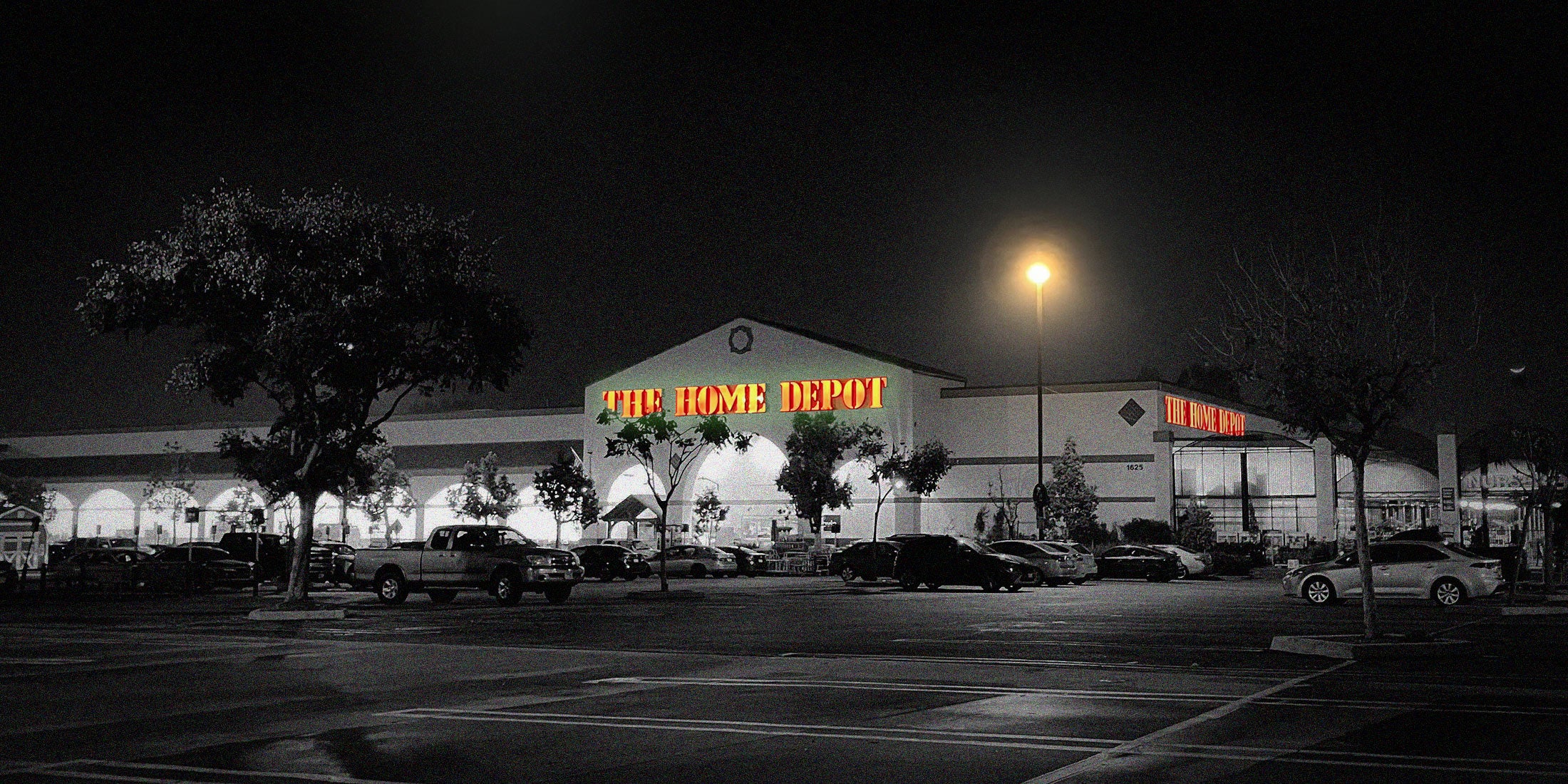
The first movements in the Home Depot parking lot, before the store opened at 6 a.m., before the sun rose, and well before Ernesto woke up, came from the second row. One man climbed out of his car into the dark, shined a flashlight into his backpack, and brushed off the long, white sleeves of his cotton shirt. Then he zipped up the bag, slammed the car door shut, and walked out of the lot, onto the sidewalk, and off down the street.
Next came people who worked for the store. A man in an orange vest trudged slowly through the aisles of the lot, gathering stranded shopping carts, stacking and returning them. Another man in an orange vest walked around the perimeter of the store, inspecting. Then they unlocked its doors, and went inside. A red shipping container sat between the first and second rows of the lot, full of Christmas trees—it was December—and a few men drove into the lot and pried open the door of the container to unload the evergreens. The first sounds of the morning came from the tinny speaker playing hip-hop and reggaeton, and the crash of pine trees falling on the blacktop.
Probably that’s what woke the residential sleepers, who got up next. Out of a Kia sedan emerged a man who carried a bag of trash over to a trash can, rubbed his eyes, and drove off. Out of a Toyota Camry came another, who brushed his teeth in the driver’s side mirror, spit the toothpaste on the asphalt, rubbed the dew off his windshield with paper towels, and drove off.
And in the third row, all the way back, sat a weatherbeaten black SUV. Its tires sagged. It looked as though it had not moved in some time. The door groaned open, and out crawled Ernesto, blinking into the warm Southern California air.
Like the store’s sign, the sky glowed Big Orange, hex code #F96302, or Pantone 165 C, available in the paint department inside. And the store was open.
Now the lot was coming to life. Cars and trucks and vans were arriving. Some parked in the front of the store, a whole world away. Their doors opened and out came customers and contractors, who went into the store and returned with plywood and sheet metal and seasonal plants.
More cars and trucks filled in the back of the lot, and their doors opened, too, though the guys who got out of them did not approach the store. Rarely did they go inside.
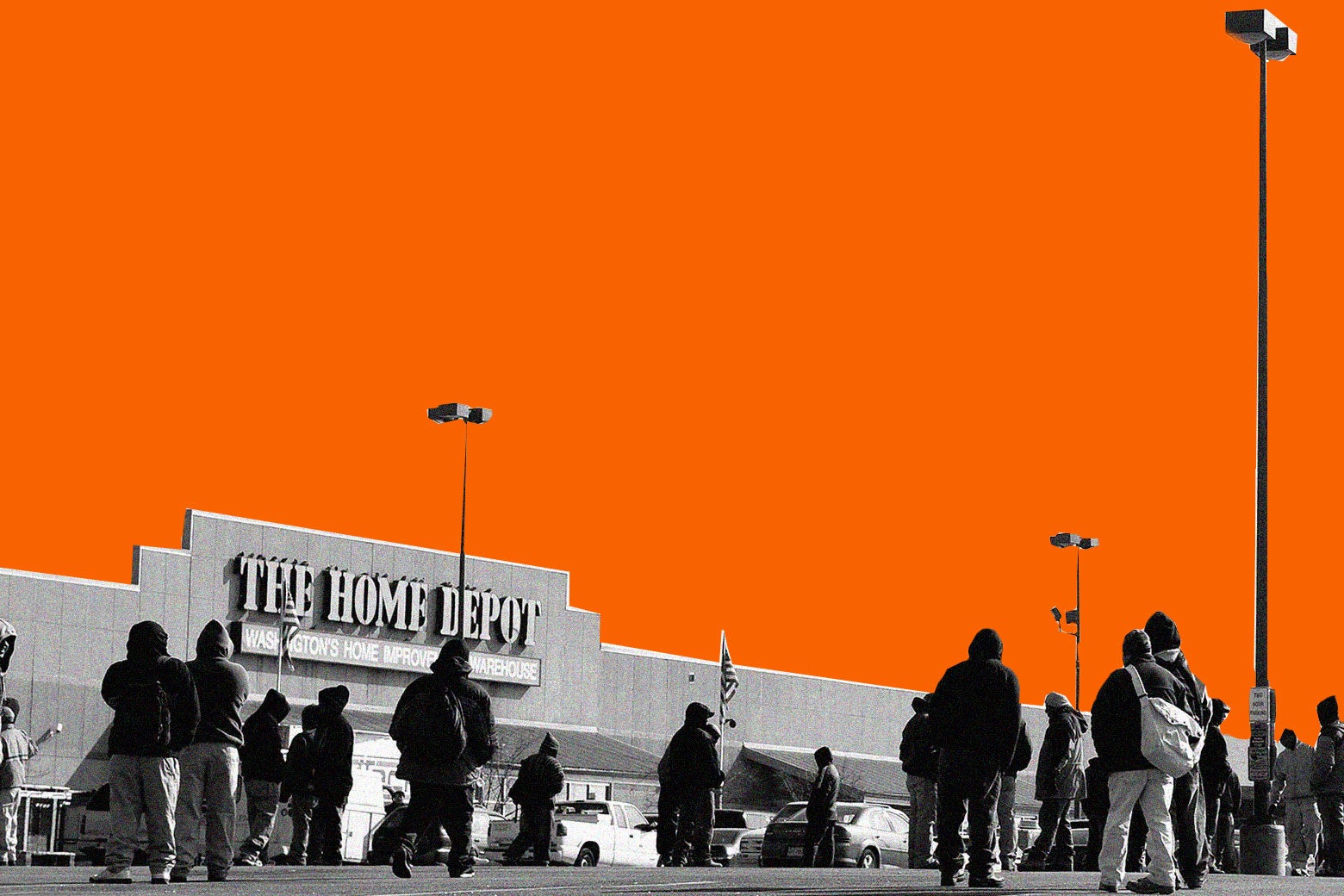
Jornaleros, the day laborers—guys who did construction, demolition, landscaping, whatever—began filling up the back of aisle one, leaning up against parked cars, sitting on the curb, nearest to the street. One arrived on bicycle. Just two or three at first, then six. They scanned the lot for potential hirers, jumped at the sign of a car driving slowly through the aisles. Troques drove in too, pickups with tools piled in the bed, and they parked in the back, in aisle two and aisle three. A red one, then a white one, then another white one. They gave each other space. They had phone numbers painted on them and they advertised those services: hauling, or “houling,” or “haulling.”
Ernesto leaned against the black SUV, among the troques, even though he didn’t have one, and so technically wasn’t one of them, not anymore. And he got to waiting.
He, like everyone else, was looking for work. The window between 6:30 a.m. and 8 a.m. would prove decisive. Anyone looking to hire a crew for the day would come through now. The security guard’s shift began at 7, but the lot was large and shared by multiple businesses, and he patrolled on foot, and was retirement age, which meant that they could probably stretch it until right around 8 before the guard would come through and tell the troques to relocate to the street, and tell the jornaleros to keep it closer to the sidewalk, to keep away from the customers.
Ernesto was hopeful, as were the other guys in the lot, their numbers swelling now to more than 10.
“It’s up and down. It’s been slow, but people will come now because it’s the holidays,” said one worker. There would be yardwork to do and holiday lights to string. It was the first of the month, which was promising, too.
“You do a good job, and they will call you back. As long as you do a good job, you make enough to survive,” Ernesto told me. And he was willing to do anything—drywall repair, landscaping, installing a shelf—anything except electrical.
Things were finally getting back to normal. The Home Depot lot had recently been a dangerous site for the men. But it had been over a month since the last time Immigrations and Customs Enforcement agents had torn through the lot in plainclothes, chasing the laborers and arresting them, even the one with papers. Now, guys were finally making it back.
All of these jornaleros knew each other, maybe not by their real names, but by nicknames, usually wrung from the place they had lived. Everyone had a nickname: El Oaxaqueño from Oaxaca; Chinola from Sinaloa; Los Hondureños, the two guys from Honduras. El Chino wasn’t from China, but some of the guys thought he looked like it. Some of them had been coming there for years; Ernesto had worked out of the lot for 20. But right now, none of them were talking. Some sipped coffees, and looked around, avoided eye contact, and waited. Some watched videos on their phones. (All those names and nicknames have been changed to protect their identities.) Ernesto propped himself against a flatbed among the troques. There were stains on his black long-sleeved shirt.
There was no denying it was harder than ever. The housing market had been stagnant for years, with mortgage rates high, and now supplies were getting pricier due to tariffs. Even Home Depot itself, which makes over $150 billion a year in revenue, was feeling the squeeze, cutting its profit forecast for the year, its stock price falling in response.
Two decades ago, when he first set foot in the lot, Ernesto would find work quickly almost every day. And whenever he was out of work, this was where he would return to find it. That, despite the fact that there were way more laborers back then, too: 50 guys, easy, sometimes 100. Now, there were barely double digits standing in the open, though probably others were hiding in their cars. “It used to be a lot of people. Now, with Immigration, not even the customers are showing up,” he said.
The arrival of ICE agents in the lot was a new and additional challenge. It started on June 6. A signature of President Donald Trump’s immigration policies, these warrantless raids, a new thing to worry about. Sometimes, cars driving slow through the lot were agents scouting, not potential bosses. And ICE had come to this lot at least three times, the first time snatching four people, the second time snatching three, and the last time snatching zero. Which wasn’t that bad compared to some of the other Home Depots in the area.
Plus, there was no getting around the fact that Ernesto was getting older, less desirable for hard labor. If a job came through, he probably would not be the first choice, now that he was 62. He still had strong hands, but he looked it. “When you get old, they push you aside,” he sighed.
So far, the day was starting slowly again for everyone. The first hour went by and no one got hired. At 7:30, and 7:45, and 7:58, guys got back into their troques and drove out of the lot, one after the next. “That’s my dad,” said Chinola, as a truck went by. Were any of them leaving for jobs? “No,” he said.
Yet here they were, all these laborers, few of them with legal documentation. Why would they put themselves in the line of danger like that? “They hungry,” Ernesto said. “I’m here every day. I have to do it. It’s the only way I survive.” He walked over to an empty shopping cart and strained to flip it over onto its side. His gait was unsteady. He sat on top of the cart, in an empty space between two parked cars, now less visible to passing traffic. A black ankle monitor poked out of the left leg of his jeans.
The security guard was approaching.
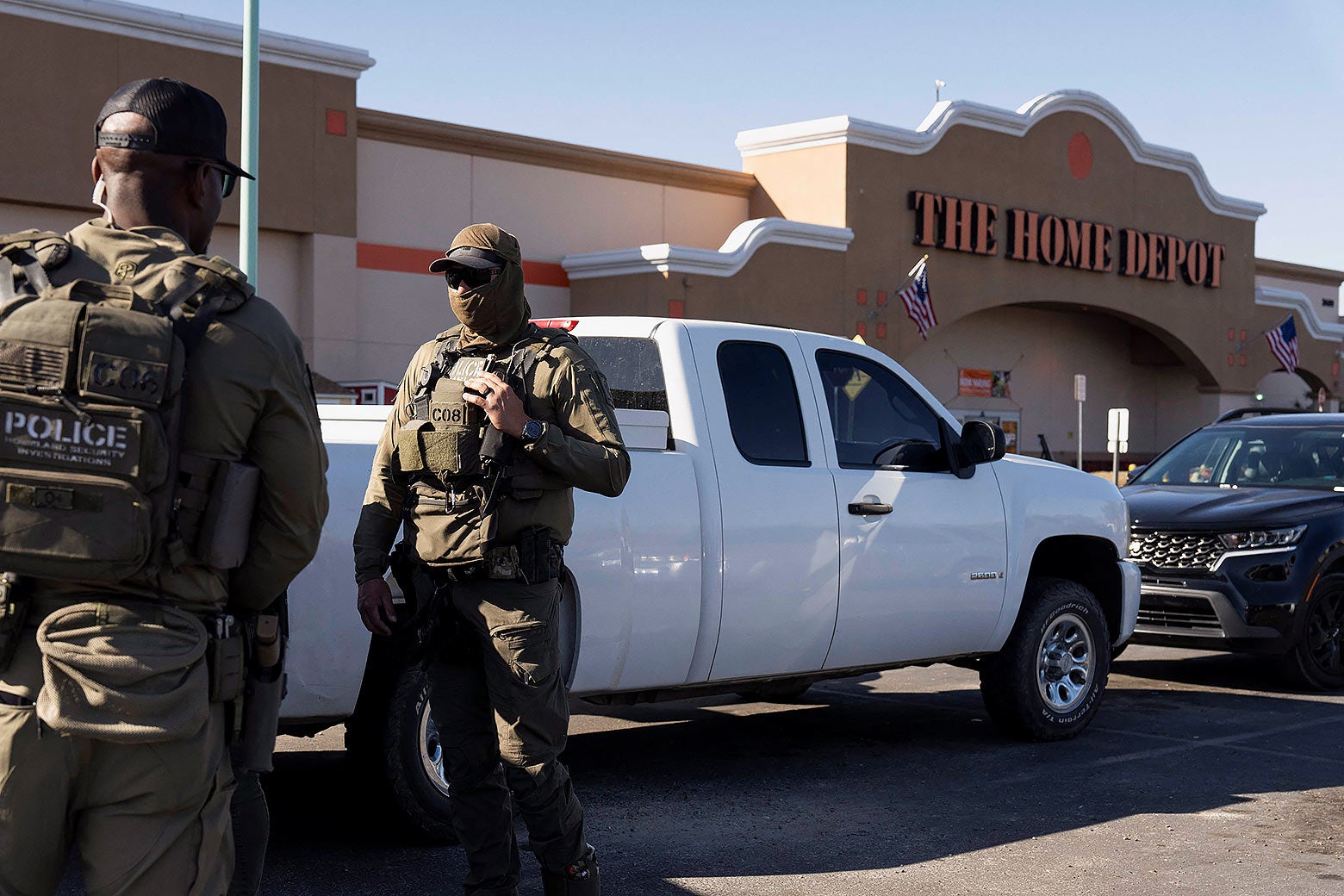
The second time ICE came to the lot, at the very end of September, Ernesto had been sick. He was sitting on a curb beneath a scrawny tree, trying to get some shade, and coughing. He saw people running, heard screams and chaos, and then saw agents close behind.
Well, he couldn’t run anyway. And so the agents came up to him. The exchange, as he remembered it, was brief.
“They asked if I was Mexican. I said yes. They asked if I had papers to be in this country. I was honest. I said no.”
The handcuffs came quickly after that. They loaded Ernesto into an unmarked car. He didn’t fight it. They took him to the ICE staging ground, transferred him to a van with other detainees, and then transported them all to Metropolitan Detention Center downtown.
Ernesto didn’t last long there. In custody, at MDC, he fell to the floor; it turned out he was having a stroke. “I wasn’t scared, but they were scared I was gonna die right there in front of them,” he said.
He was transferred by ambulance to a local hospital. He spent 15 days there; he was handcuffed to the bed. When he was called before an immigration judge, he suffered a coughing fit so relentless that it was nearly impossible to conduct the hearing, which was probably a blessing because he hadn’t been able to find a lawyer anyway.
He was fitted with an ankle monitor and given a date to return, in February. Which was funny, in some sense. Was he a flight risk? He was trying to stay, after all. It was them who wanted him to go.
Soon, the hospital prepared to discharge him, and it was then, finally, that he began to get scared. “I think I was costing them too much money,” he said. They had determined he was getting better, but he was pretty sure he still couldn’t walk, and he had no idea how he was going to get to the bus stop from there. For another thing, he didn’t have any money to pay for it. And it was then, finally, that he first began to feel fear.
There was only one thing he could think to do for certain: He had to get back to the lot.
Back there, the guys had begun to worry. No one knew his real name, and he didn’t seem to have family, or anyone to contact. They knew he was in poor health before he got nabbed, and that immigration detention was freezing cold, and hard on the body. Some began to wonder if he was dead. After two weeks, there weren’t many good options left. Eventually, someone figured out his last name, whatever help that was.
Ernesto deliberated for a while, and then realized that the train that stopped near Home Depot ran right by the hospital. He would have to risk getting arrested by hopping the train without paying the fare. But then how much worse would that be than his current position? Probably, he figured, they would send him back to jail, and then right back to the hospital.
So when they did finally turn him out, he dragged himself to the blue line, and got on without paying, and he didn’t see any cops, and he didn’t get arrested. He found his way back to the lot, got back into the black SUV, and, the next day, set right back up looking for work.
He was sitting on a lumber cart now, smoking a cigarette. He was hunched over.
He was walking a little better, and in better spirits generally. He had barely spoken in the first few weeks back; now he was almost chatty by comparison. But the stroke had taken its toll. The left side of his face remained paralyzed, and as he spoke, spit gathered on the left corner of his mouth. He tried to wipe it away with his sleeve, but he was too slow, and it dripped down onto his black shirt, joining a galaxy of white stains that looked like the night sky. “I’m drooling all the time because my mouth is not straight,” he said, and shook his head, disappointed.
The ankle monitor didn’t look good either, but Ernesto was choosing to see it as an asset. If ICE came through again, they wouldn’t take him. He had protection as long as it was on, he bragged, though even that might have been wishful thinking.
He knew what people might think looking at him—that he wasn’t fit to work, that the stains on his shirt looked terrible, that the monitor had certain connotations, that one more hard task might finish him. “People say ‘I don’t want to be responsible…’ ”
“I say, ‘That’s OK, man, just try me.’ ”
It was 11 a.m. now, and still no one had come, and still no one had been hired. That ICE also hadn’t come was little consolation.
The security guard had been out since 8:30, pacing the lot, and the jornaleros had made themselves scarce. The guard did not speak Spanish and did not even work for Home Depot technically, but for a commercial real estate company that owned the land the Home Depot was perched on. But he had an understanding with the men: He asked the guys to leave, and they would leave, at least as long as he was nearby. He had been the security guard for nine years. He, too, was getting old, and though he believed he had to prioritize the customers, he felt for the men. He’d seen ICE plenty of times. “They are terrified. They are hiding in their cars. Sometimes people will just run,” he said.
At other Home Depots, things were more punitive. According to the Los Angeles Times, the Cypress Park branch had recently installed a high-pitched noise machine in the parking lot, which laborers said was causing headaches and nausea. Advocates alleged that it was meant to drive the jornaleros away, though some of the workers decided to stay and wear earplugs.
Before noon, a truck pulled up and deposited two cardboard boxes in the back of a flatbed, and left.
The boxes were full of fruits, some damaged or nearly expired. There were peaches, pomegranates, even a couple of bright-pink dragon fruits.
One by one, the laborers approached the truck and took what they wanted. Some would put the fruit in their car for later; some ate it on the spot. There was a full cherry pie.
The provenance was not clear, though it was likely a drop-off from one of the mutual aid or religious groups that work in the area. One guy insisted it had come from Albertsons, past expiration.
“Everyone is scared,” said El Michoacan, as he put a mango in his trunk. “Sometimes I’m scared, but I can only control what I can control. I have to live,” he said. “If they come for me, I will end up in Mexico, and everything I have will stay here. Nothing I can do.”
After El Michoacan returned to his car, and when no one else was hovering, Ernesto came over to the truck and picked through the fruit until he found a box of precut watermelon.
The path that led Ernesto to that Home Depot parking lot in Southern California for the very first time began in Chihuahua. He grew up around Ciudad Juárez. It was a time of great upheaval in northern Mexico. By the time he was a teenager, he had lived through the 1982 debt crisis, then the devaluation of the peso, and the explosion of the maquiladora factory system, all of which conspired to sink real wages in northern Mexico dramatically. Poverty was everywhere. The Juárez drug cartel was in its infancy, growing fast. “I was not a good person, but I was not involved with anything like that,” he told me.
And so he decided he would come to the States.
He made a plan: make enough money to find a wife, and buy a taxi. The first step was to cross the border. So he did, in broad daylight, one afternoon in 1983—went right across the Rio Grande, the Rio Bravo del Norte, as they called it in Chihuahua. “It wasn’t even that deep,” he said, holding his hand to his ankle. “I didn’t even get wet.”
At first, he lived in El Paso. For two years, he worked the fields, hard work. Then he heard about better opportunities in Arizona, and California, with better pay. So, in the old American tradition, the young man went west.
And onwards he went, finally ending up in Los Angeles. By then he’d had a lot of jobs, and could do anything. “I was young and strong,” he said. “When you’re young, you get a lot of chances.”
1985, the year he headed west from El Paso, was the same year the Atlanta-based Home Depot turned up in Southern California. It opened its first store in Huntington Beach, Los Angeles, not far from the coffee shop where founders Arthur Blank and Bernie Marcus thought up the idea for the company, which would make them both billionaires. Marcus would soon use those winnings to become a megadonor to Republican political causes, and Donald Trump specifically, and then die on the day of Trump’s reelection in 2024.
According to the company’s official history, the concept for Home Depot came to Blank and Marcus after they had both been fired from another home improvement store called Handy Dan. They chartered a customer “bill of rights,” which stated that “customers should always expect the best assortment, quantity and price, as well as the help of a trained sales associate, when they visit a Home Depot store. These commitments were an extension of the company’s ‘whatever it takes’ philosophy,” reads company’s corporate history page.
Now, California has by far the most Home Depot locations of any state, a core component of a state in which real estate is a pillar of the economy. Home Depots promised cheap material for do-it-yourselfers, and Home Depot parking lots became a repository for cheap labor, for those who had a more relaxed understanding of what it meant to do something “yourself.” Where better to go to find piecemeal work?
Ernesto never did get the taxi, but he did find enough work to make a living. He didn’t exactly find a wife, either, but he did have five children, some of whom he said joined the military, and a steady partner, and he had constant work, which was good, because he needed it. “You ain’t gonna get rich this way,” he said. “You spend all your money on Pampers.”
Rarely did he have to wait long to find jobs at the lot, and sometimes those jobs were long term. He’d been hired digging ditches, he’d been hired loading trucks, he’d been brought on for construction, drywall, yardwork. He made relationships, and got put on crews, which meant he would be away from the Home Depot for long stretches. For years, he worked as the property manager for a residential development with 120 units.
And when those jobs went away, when the ditch was dug or the building built or when the owner of the apartment complex died, Ernesto would return right back to the Home Depot parking lot until he found more. He rented a house nearby and lived there with his girlfriend.
The work was hard, but Ernesto had managed to avoid serious injury. “I was lucky,” he said. “Most of the people I worked with were white, and white people always put safety first. In our culture it’s different. If you lose a leg, we say: ‘You have another one, why are you complaining?’ ”
That’s not to say he didn’t have medical issues: He had diabetes now, and emphysema.
Eventually, he bought a truck, joined the ranks of the troques. “I used to park it right there,” he said, pointing across the lot.
He was not the first to arrive in this lot, not the first to live in it. One guy had been living there a decade, he said. And there were new arrivals all the time, guys who had paid thousands or more to cross the border and come here and work. He knew everyone, even now—not their real names, of course, but their nicknames. He knew that they were behind on bills, that they had families, how hard it was to make the math work with rent, and that guys would keep showing up regardless of what happened at the border, of what happened with ICE, of what happened with Trump.
It could be cliquey sometimes. Guys from similar parts of Mexico tended to hang out with each other; the central Americans self-selected; the troques didn’t do too much mixing with the guys on bikes. Some guys kept to themselves, though it was rare that someone new would show up without having had a member vouch for them. Sometimes it was a family affair—a father would bring his son. Some guys would go to work for contractors, but often they would come back and complain of being overworked. “It’s a good group. I know everyone,” he said. “We try to be friendly. I might need him tomorrow or the next day.” The network worked for spotting ICE as well as locating jobs. There were group chats and contacts everywhere, though Ernesto only had a prepaid phone now, and it often didn’t work.
Ernesto leaned over the flatbed and ate the watermelon with his hands, piece by piece, until the box was empty. Then he returned to his aisle.
At 1 p.m., the security guard returned. His shift was coming to an end soon, and the troques parked outside the lot were watching eagerly from the cabs of their trucks, anticipating his exit.
Once he left, they would file back into the lot, with the hopes of getting hired after lunch. It was less likely, but it was possible.
Ernesto had no problem with the guard, and the guard didn’t bother Ernesto too much. Maybe he didn’t know he was living in the SUV. There was a homeless guy in the lot who wasn’t there to work, and who one time had stolen the guard’s Prius after a standoff, and that was a much bigger issue.
The situation, though precarious, had more or less worked for Ernesto until he met first problem with papers just over a year ago, October last. He had come home one Friday evening to the house he rented not far from the Home Depot, after a long day on the job. He was exhausted, and he had work the next day. He woke up the next morning early, and the truck was gone.
He called the police, told them about the situation. He was sure it had been stolen. “They got upset with me,” he said, because he didn’t have his documents in order. So he got upset with them: “You start talking shit, you know how it goes.”
But then the police found the truck. All he had to do was prove that it was his.
If only it were so simple. In part because Ernesto did not have his papers, he also did not have his registration sorted correctly, did not have his license sorted correctly, did not have proof of sale. He had kept some papers in the glove box of the truck, but of course the thieves had taken those, and they were gone now. He knew the truck was his, but they couldn’t just give it back to him.
Meanwhile, also because he didn’t have his license sorted correctly, he didn’t have his insurance sorted correctly either, and so he fared little better with the insurance company, trying to collect on the stolen truck, which was just sitting there in an impound lot. “Without the liability, you don’t get shit,” he found.
And of course, all the tools in the back were stolen, too, thousands of dollars’ worth.
Things went pretty fast after that. Soon after, Ernesto was mowing the lawn at his house when he fell down. His girlfriend ran outside, perplexed. She tried to prop him up, but his body was too heavy. He was having a stroke. She called an ambulance.
At the hospital, the doctors told him that the stroke was a result of stress. “After they stole my truck, I got anxious and sick and angry,” he said. He wasn’t working, and they were already living so close to the edge financially, it took almost no time for the eviction notice to show up. Once they lost the house, his girlfriend realized she would have to work, that the situation was untenable, and so she decided to go back to Mexico.
There were more details, it was more complicated than that, but that was the simple fact: No truck, no tools, no work, no house, no girlfriend. And Ernesto had a second stroke after that.
Where did he have to go? The place he knew best, after two decades, was the Home Depot parking lot. And so he moved into the black SUV in the third row of the lot. At this point, it was basically where he was from. The mutual aid groups who worked in the region had tried to get him into a shelter, but right now, this was where he was.
By the time ICE got him, he knew all about paperwork problems and a lot about strokes. The one he’d suffered in detention was his third in a year.
The security guard placed a towing warning on the windshield of a silver car that none of the guys knew, and then left for the day. A few minutes later, the troques filed back in.
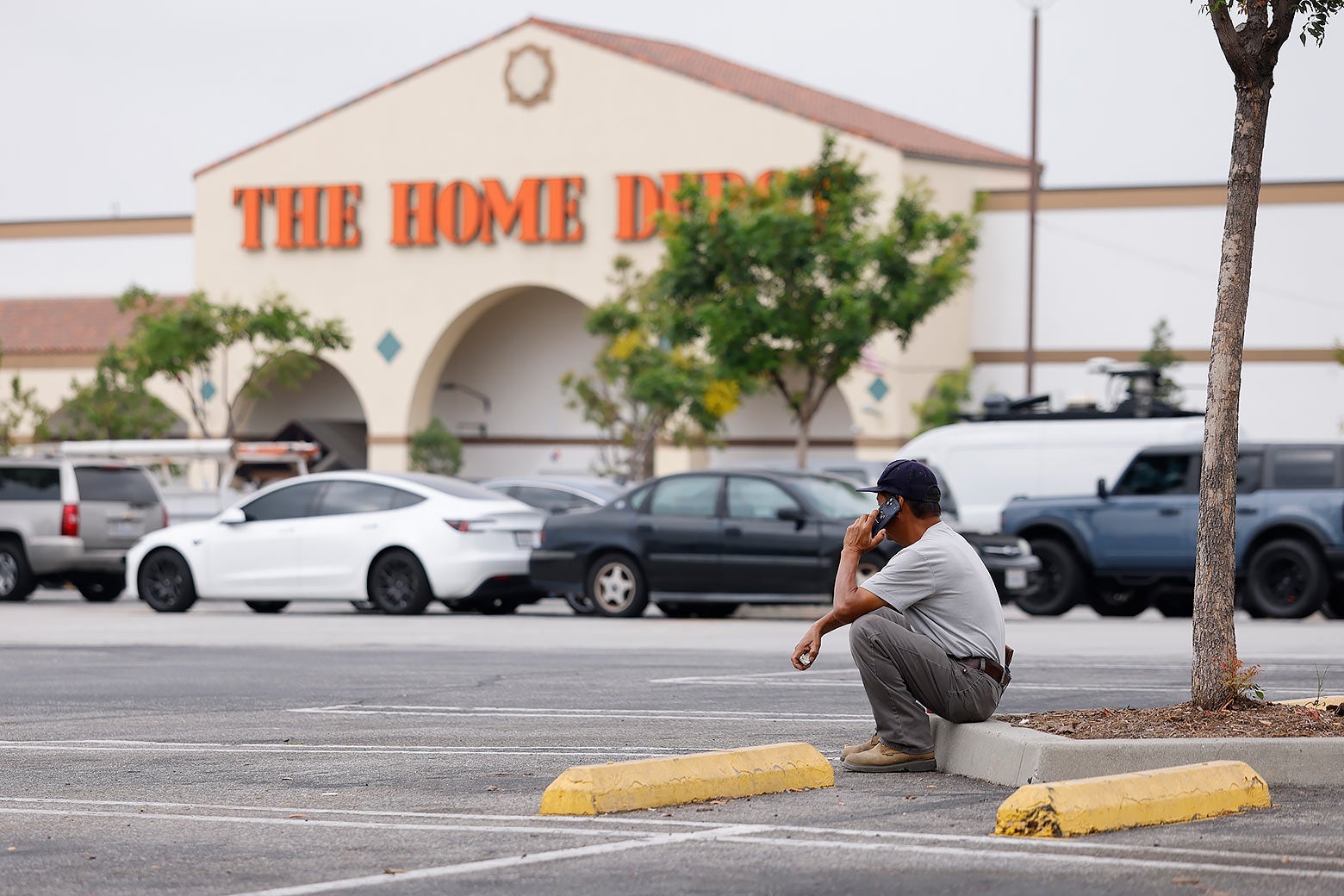
By 2:30 p.m., the second wave of troques were leaving, one by one. It was livelier now, but it seemed certain that no one would get hired today. In earlier days, they might be drinking beers by now. Back then, some guys might even be drinking as early as 9 a.m., but not today, and not anymore.
Ernesto joked with two young workers nicknamed the Hondureños. They were sticking around, waiting. “It hasn’t been good here since 2018,” one said, and he hadn’t gotten here until 2019.
A woman who swept trash came through the lot, wearing gloves and a mask. She wheeled a trash can. She spoke with the Hondureños too. When Ernesto saw her, he said, “This is why we’re not afraid. If someone is coming, she will tell us.”
She laughed and walked away, sweeping, picking up trash. He called out to her, “We need to practice our English!”
In the lot, the numbers were dwindling, and the sun was getting lower already. Ernesto sat on the ground and smoked another cigarette.
He wasn’t ready to give up yet. It was the first of the month, he reminded himself, which meant that people had money, that they needed help with tasks. Like moving, for example: The first was moving day, and assembling furniture was the type of thing that he could do.
“I don’t like to be the charity,” he said. He didn’t want help. “It’s hard to survive,” he said. “The main thing is don’t give up.”
He had had an opportunity recently. The daughter of the man for whom he had worked, managing the 120 units, had offered to bring him back on. All he needed was a reliable form of transportation, she told him, and she would hire him again.
But since the last stroke, stroke No. 3, he admitted, he didn’t think he could do that. “I don’t think clearly like before. I’m scared to drive. I don’t have the quick reaction at the light. I don’t think clearly.”
Troques continued to leave, and laborers continued to leave, and guys negotiated with each other for rides home.
So he would wait here for something else to pop up, and he would keep living in the SUV.
“You have to accept it,” he said. “You have to take it,” he said.
At night, after the store closed, he said, it was quiet. Sometimes young couples would drive in and park for brief and amorous stints. He had to make it to his court date on Feb. 20. He was hoping that one of the activist groups would help him find a lawyer by then. He was not scared, he said. Not to go back to Mexico, or of anything else, for that matter.
“What is your nickname?” I asked him.
“On my truck, it used to say ‘handyman.’ So that’s what everyone calls me,” he said. “Handyman.”