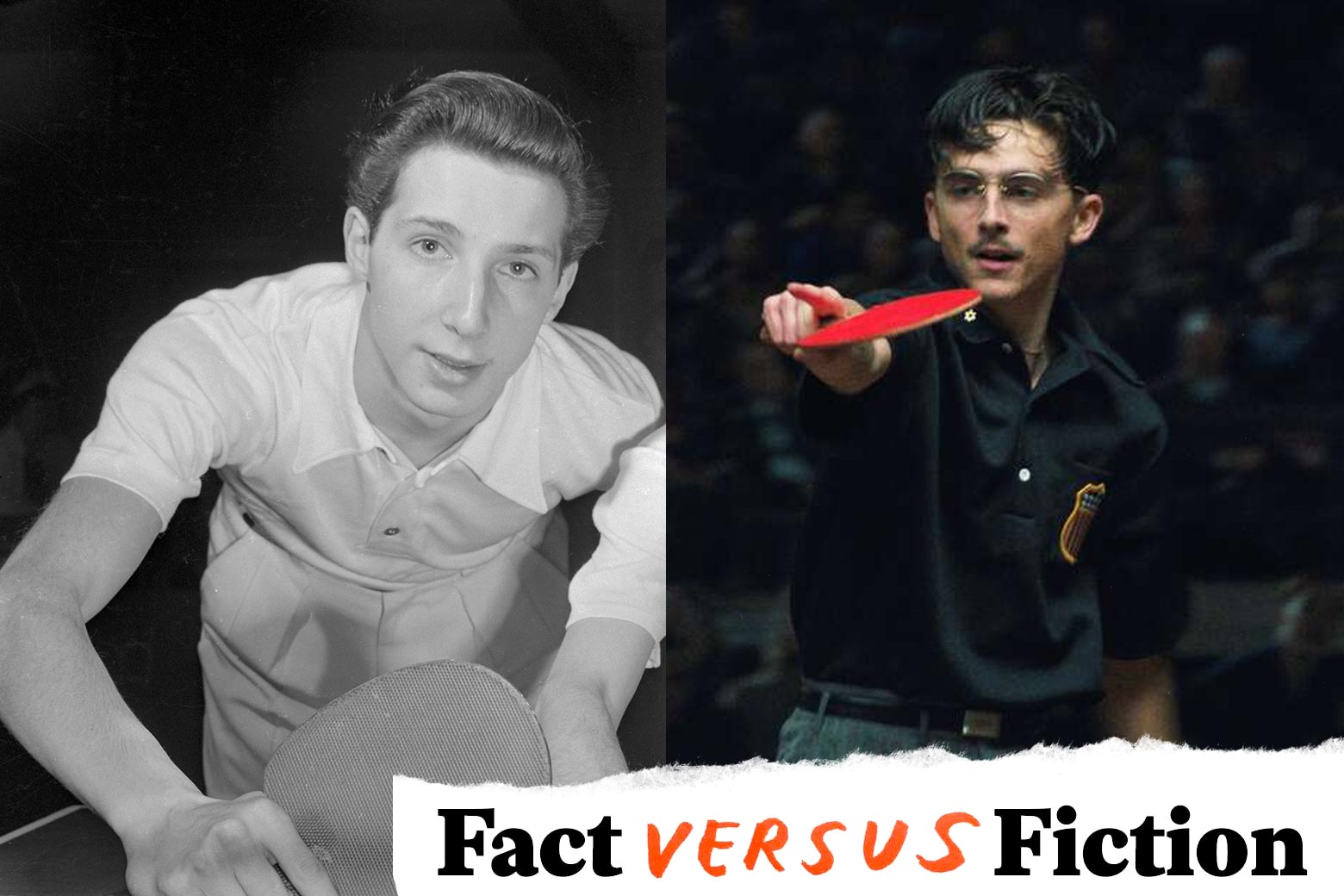
Timothée Chalamet wouldn’t be everyone’s first thought when it comes to playing a character like Midnight Cowboy’s Ratso Rizzo (Dustin Hoffman), a fast-talking New York hustler always on the run from the consequences of one of his scams-gone-wrong. Of course, even with his emo-heartthrob looks disguised by a ratty mustache, lank haircut, and round glasses, Chalamet’s Marty Mauser has several advantages over Ratso: He’s younger, reasonably attractive, not living on the street, and blessed with an exceptional talent—in this case a gift for Ping-Pong mastery. But they both exude the same desperation to pull off that one big score.
The Marty in Josh Safdie’s new film Marty Supreme may be called Marty Mauser, but he is “inspired by” Marty Reisman, the dominant American table-tennis player of the postwar decades, on whose memoir The Money Player the film is (very) loosely based. Although numerous characters and incidents have been invented, the titular character shares the real Marty’s love of the hustle, obsession with the game, determination to be the best at it, and supreme self-belief.
The real and fictional Marty both develop their skills in a funky basement Ping-Pong club on Broadway in New York City, where they pick up extra cash by hustling games with unwary customers, rather like a table-tennis version of The Color of Money’s Vincent Lauria or The Hustler’s Fast Eddie Felson.
Like Safdie’s previous film Uncut Gems, this is another story of a man on a mission (in Mauser’s case, finding money to get himself to Ping-Pong championships abroad while evading people he owes money to and husbands whose wives he has been fooling around with), and is nothing if not kinetic, its main character perpetually in motion. It also shares Safdie’s trademark love of loudness—90 percent of the scenes in Marty Supreme seem to be people yelling at each other, and if anything threatens to get too quiet, Safdie is not afraid to escalate the chaos by throwing in a loudly barking dog or phalanx of screaming babies.
Marty Supreme describes itself as fictional and doesn’t claim, or even aspire, to be an accurate depiction of Reisman’s life. Nevertheless, there are several aspects where the movie overlaps with the almost equally unbelievable truth.
Was Koto Endo a Real Person?
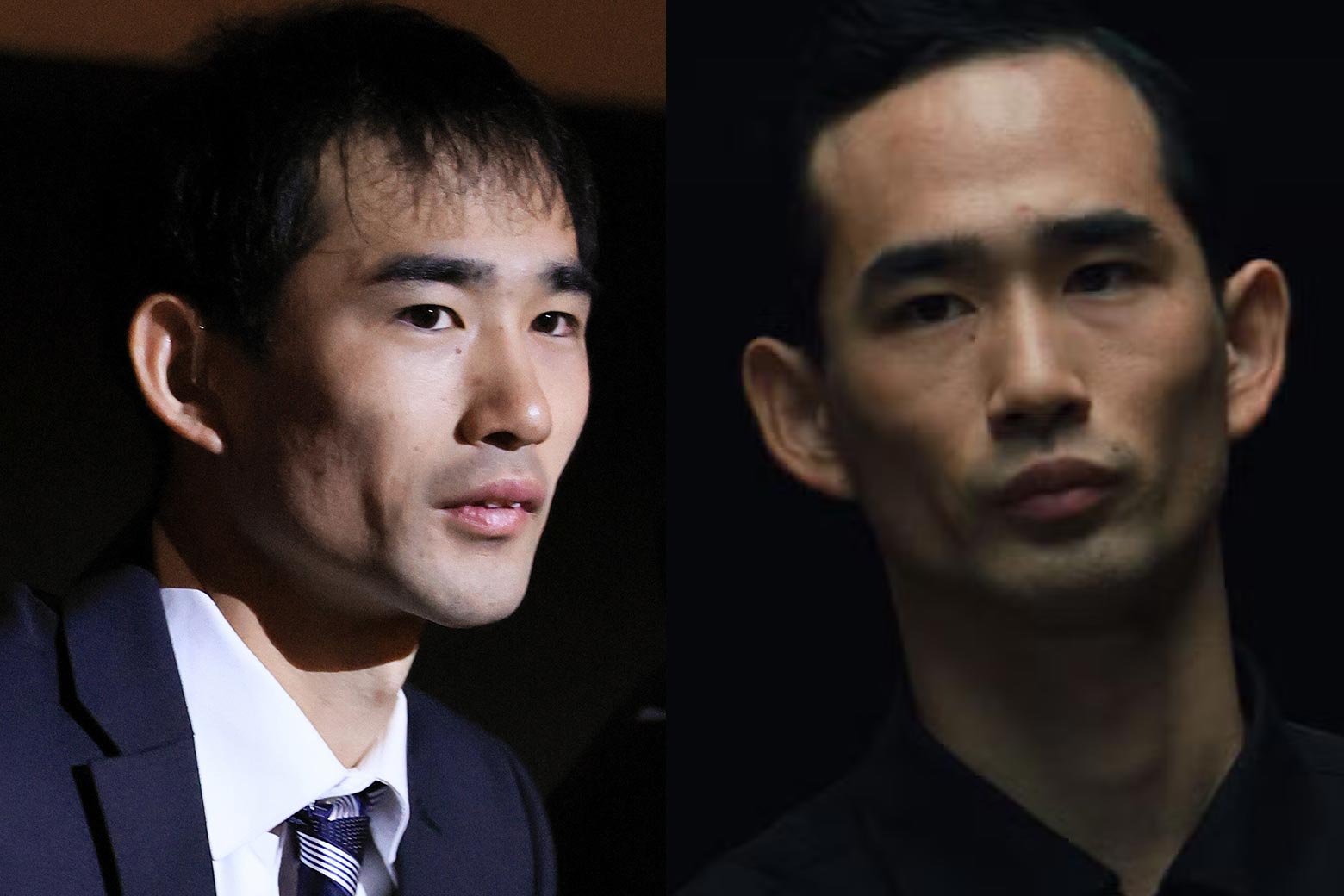
In the film, Marty’s nemesis, the one player even he thinks he might not be able to beat, is a self-contained Japanese champion called Koto Endo. Endo, who was deafened in the huge U.S. bombing raid on Tokyo in 1945, has turned his disability into an advantage, enabling him to focus without distraction, a cool and focused Björn Borg to Mauser’s showboating, ref-challenging John McEnroe.
Endo was not a real person, but the character appears to be based partially on the actor who plays him—Koto Kawaguchi, himself a real-life Japanese table-tennis champion who happens to be deaf—and partially on a real-life Japanese champion Reisman lost to in the 1952 World Championships, Hiroji Satoh. Satoh had announced his presence at the championships in Bombay when, as an unknown, he decisively defeated four-time world champion Richard Bergmann, a British player, in the opening match and Reisman in subsequent matches.
Months later, Reisman faced Satoh in a thrilling (for Ping-Pong aficionados) match, a U.S.–Japan showdown held in a movie theater in Osaka, evoked in the film’s climatic match between Mauser and Endo. As in the movie’s depiction, the theater was packed with thousands of fans and the match was broadcast on Japanese radio.
There’s another way in which the film echoes the reality. Satoh was an excellent player, but he owed his dominance at the 1952 championships to a technical innovation in the Japanese team’s rackets. One side of the racket was wood, but on the other side was a 1-inch foam layer under the usual thin rubber covering, while most rackets had a pimpled rubber layer directly over the wood. This resulted in a soundless return that disconcerted the opposing players. In the film, there’s little question that Endo is a formidable rival, but at the British Open, his sponge racket similarly baffles his competitors, including Marty. In real life, Reisman was an advocate for traditional “hardbat” rackets to the end, insisting, “The sponge offends my dignity.”
Did Marty Really Have an Affair With a Golden-Age Movie Star?
In the film, Marty has a recurring affair with Kay Stone (Gwyneth Paltrow), a sophisticated Grace Kelly–esque woman and former Hollywood leading lady, despite the fact that she has settled down with a pen magnate named Milton Rockwell (Shark Tank’s Kevin O’Leary). Both Milton and Kay seem to have been invented for the film. Reisman’s book refers to only one romance on tour, with a beautiful 18-year-old in Rio.
Did Marty Really Talk His Way Into a Suite at the Ritz?
In the film, Marty scrapes together (with an assist from a farcical stickup) enough money to fly to London for the championships. The downmarket hotel the International Table Tennis Association has booked for the players does not meet with his approval, and he complains to the ITTA’s championship organizer, who dismisses this upstart. Not one to take no for an answer, Marty uses the organizer’s name to book himself into the Royal Suite at the Ritz, the hotel where the tournament bigwigs are staying. He spots Kay in the lobby and somehow manages to persuade her to come up to his suite, where he orders everything on the room service menu. Needless to say, when he checks out, he omits to settle the bill and it becomes another of those things keeping him on the run in New York.
The real Reisman did manage to talk himself into a hotel upgrade, if not quite to the Ritz. According to his memoir, after finding themselves in an unsatisfactory hotel, Reisman and one of his teammates “moved into the more expensive Cumberland Hotel at Marble Arch and charged our expenses to the ETTA [English Table Tennis Association] … we charged our dry cleaning; we ran up a telephone bill. The reaction of the ETTA could have been anticipated: They refused to pay.”
However, while it’s true Reisman was not booked into the organizers’ hotel, he was not nearly as much of a scrappy outsider as the film’s Mauser. At 13 he became New York City’s junior champion, then at 16 won the junior title. As a member of the three-man U.S. team at the 1948 world championships in London, his travel (on the Queen Elizabeth luxury ocean liner, no less) was paid for. As well, in true Marty fashion, his bags were filled with nylon stockings, much prized but difficult to obtain in postwar Britain, so he was able to charge five times what he paid for them when he sold them to eager British women. And though the film depicts Mauser as sort of a marginal figure at the British championship, in real life Reisman made it to the finals, where he played the British No. 1 Bergmann in front of a crowd of 10,000 (he lost but it was hard-fought) at only 17.
Did Marty Really Open for the Harlem Globetrotters?
In the film, Marty goes on tour with the Harlem Globetrotters as the halftime act, performing tricks like breaking a cigarette in half with a serve or playing Ping-Pong using his feet. Marty is at first deeply offended by this, thinking it’s beneath him, and refuses, but after a situation escalates to violence and he has to get out of town fast, he accepts the offer.
Reisman did work as the halftime entertainment for the Globetrotters. He was offered the opportunity by his teammate Doug Cartland, who had already been touring with the Globetrotters with a different partner. Reisman and Cartland spent the next three years, between 1949 and 1951, touring the world with the basketball team, performing a table-tennis comedy routine as an opening act. Far from feeling that the work was beneath him, Reisman recalled in his memoir that he “had the time of my life touring with the Harlem Globe Trotters” but ultimately felt that “the stability of a regular income and a mild case of affluence” was sapping his edge and that he had to get back to playing competitively at a high level.
Similarly, Reisman didn’t travel to Osaka for the U.S.–Japan showdown in a tycoon’s PJ. Instead, he and Cartland financed the trip by playing exhibition matches across Asia, from Bombay to Burma (as it was called then), Malaysia, the Philippines, Vietnam, Cambodia, Taiwan, and more, supplementing their Ping-Pong income with a little light black-market currency trading.
Did Marty Try to Merchandize a Line of Orange Ping-Pong Balls?
In the film, Marty comes up with a scheme to create and sell a line of Mauser-endorsed orange Ping-Pong balls, and his devoted cousin Dion actually manages to get a manufacturer to produce several boxes as samples.
This may have been inspired by the fact that the Osaka tournament was sponsored not by an American manufacturer of ballpoint pens but by a Japanese manufacturer of Ping-Pong balls, which paid Reisman and Cartland to endorse a line bearing their name.
Was Marty a Rough Diamond?
Chalamet’s Marty has a charming side, but he is more than a little rough around the edges, abrupt and often rude, with a dress sense best described as “disheveled” (possibly because of all the rushing around).
However, Tim Boggan, editor of the bimonthly Table Tennis Topics, told Sports Illustrated in 1977 that the actual Reisman “adds dignity and class to a game that has no dignity and class. Yes, there is the cat burglar side, but he is a Cary Grant cat burglar, the kind of person who operates on both sides of some laws and makes it all seem right because he does it on his own terms. There is no comparable bravado figure in the game today. He is the James Bond of table tennis.”
Correction, Jan. 9, 2026: This article originally mischaracterized a few subtle aspects of the film, including the design of Endo’s racket, Marty’s reasons for touring with the Harlem Globetrotters, and Milton Rockwell’s reasons for hating Marty: Endo does use a foam racket, Marty’s tour with the Globetrotters isn’t demanded by Milton, and it’s not clear that Milton ever discovers Marty’s affair with his wife. Those sentences have been corrected.