
Jonathan Haidt and Catherine Price, having literally changed the world with their 2024 bestseller The Anxious Generation, are back with a new book for tweens: The Amazing Generation: Your Guide to Fun and Freedom in a Screen-Filled World. The book uses charts and sidebars, pull quotes from Gen Z about their negative experiences with phones, graphic novel–style fictional comic pages, and colorful design, repackaging for a middle-grade audience arguments and ideas that will be quite familiar to people who’ve read Haidt’s and Price’s work for adults. Among these: Apps are dopamine-hijacking machines; tech companies are knowingly hacking our brains for profit; everyone’s screen time is hours more per day than you’d like; twentysomethings wish that TikTok had never been invented (or at least they will tell inquiring pollsters so); kids should be outside, moving around, and hanging out with one another more—all the basic stuff.
I was curious as to whether kids like mine—children of phone-queasy, anti-algorithm parents who have been subject to ad hoc lectures about Phone Bad at random times in their childhoods but have not yet seen the arguments presented in a way that’s aimed at their age group—would be interested in or remotely convinced by The Amazing Generation. To find out, I convened a book club of four kids—two 11-year-olds in fifth grade and two 9-year-olds in third grade (plus their moms, who tried hard not to say too much).
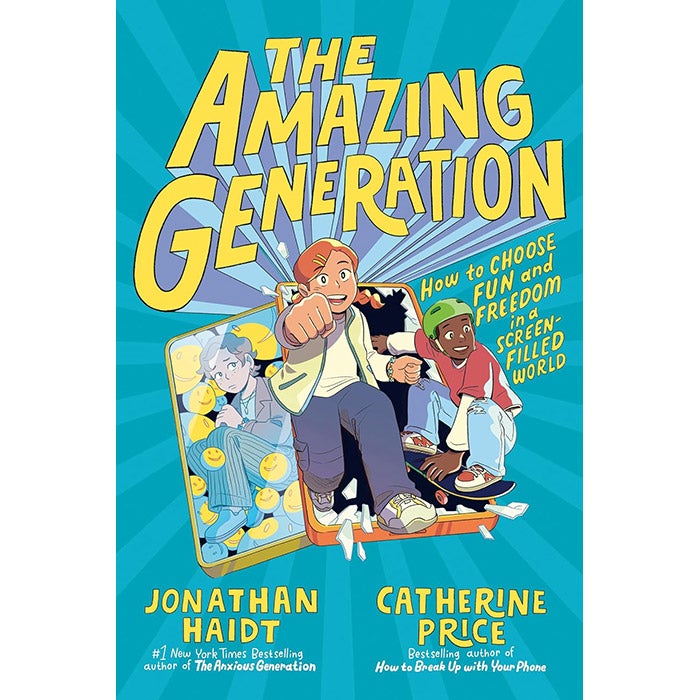
The Amazing Generation: Your Guide to Fun and Freedom in a Screen-Filled World
By Catherine Price and Jonathan Haidt. Penguin Random House.
Slate receives a commission when you purchase items using the links on this page. Thank you for your support.
My group was made up of kids without smartphones, whose parents hope to delay their acquisition until eighth or ninth grade, and the opening of social media accounts until an unknown time. (Asked when he would probably get a social media account, 9-year-old W. said: “About age 20.”) They watch television and movies (in the case of my own daughter, a whole LOT of television and movies), and some are allowed a small amount of time for video gaming on weekends. The 11-year-olds have plenty of classmates with phones; the 9-year-olds have a few. They all read the book to some degree—some halfway, some skipping around to the funnest-looking pages, some from beginning to end.
I was curious what in the book they’d find persuasive. The winning argument, they reported, was the idea that the apps that their classmates enjoy are created by people who make money from grabbing their attention. I found Haidt and Price’s framing of this for kids—they describe workers at tech companies as “wizards,” apparently trying for a Harry Potter vibe—to be a little bit hokey, but these readers liked it. One was quite impressed by a page collecting quotes from the CEOs of various tech companies about keeping their kids off their own products. “The CEO of TikTok knows that TikTok could get you addicted to it. And he doesn’t want that to happen to his kids. But why does he want it to happen to us?” 11-year-old C. asked. I realized I had underestimated this age group’s sense of justice and injustice and desire not to be manipulated by any “wizards.” Tweens are natural populists—and the authors know it.
After I asked the group again what arguments worked best on them, J., almost 9, brought up the idea that phone users’ brains were (as she said) “melting and rotting” and “turning into old rotten cheese.” The Amazing Generation, surprisingly, hits the “depression and anxiety” connection fairly lightly, mentioning this outcome that (Haidt would argue) flows from phone use—a dominant issue in adult discourse around The Anxious Generation—less than I expected. Instead, the book reiterates that phones take up time that could be better spent in other ways: on hobbies and studying, as well as connecting with friends. I suspect that this (valid) point got scrambled up with the current tweenage popularity of the term brainrot (not used in this book) to produce a general impression on the part of this group of readers that phones make you, well, dumb.
This was one of many points in this conversation when I felt, paradoxically, mildly defensive of kids who have phones. I wondered whether this kind of anti-phone argument might unproductively set children against one another, with the non-phone kids feeling like a superior species. (Another thing about tweens: They do love to feel like a superior species.) Haidt and Price are clearly trying to leave the door open for phone-using readers of The Amazing Generation to feel included in the conversation, but for this group of pre-phone tweens, it seemed to feel kind of good to be on the “right” side of things. The book’s use of the term rebels to describe non-phone kids, a move I found somewhat tryhard—since when is it rebellious to do something your parents desperately want you to do?—also helped solidify the idea that non-phone kids could actually be cooler than phone kids.
To this point, the graphic novel sections of The Amazing Generation, which follow three fictional kids who have phones and three kids who don’t over the course of a school year, as the non-phone kids learn to skateboard and play music while the phone kids stay up late at night gaming and texting, were the “best parts,” said the participants. The older kids said the social dynamics depicted here—friction between phone kids who want to take pictures while getting ready for trick or treat, and non-phone kids who just want to get going, for example—felt real. They’re navigating this all the time. C., whose classroom is split about 50–50, said: “Usually, if someone doesn’t have a phone, they sit with kids that don’t have phones.” A., also 11, described sitting with a classmate on the bus, while he looked at his phone the whole time. Then, she said, “we saw each other later, and he said, ‘A., I didn’t know you rode this bus!’ ” (We all laughed.)
The book, says its marketing copy, should work equally well with kids who have phones as those who don’t, but some of the descriptions of what it’s like to be on social media were hard to scan for these dear souls who’ve never spent hours vanishing into doomscroll. W., 9, reported being confused by a page describing the “defend” mode of approaching life that social media can put a user in (versus the more desirable “discover” mode). This is an idea that made a lot of sense to me, since I’d taken Instagram off my phone for this very reason last year (too much compare-and-despair), but I could see how someone without any experience might be confused by it. The book’s discussion of dopamine rang true to most of them, however, because, they said, they recognized the feeling of watching TV or video gaming and being desperate to keep on going.
The Amazing Generation, for these kids, was a good starting point and conversation piece. We all thought it was a bit overlong for its purpose, and I’d add that it might be better for older kids than younger. We asked the group whether they’d recommend the book to their friends and classmates who might be curious about the effects of phones, and A. replied: “Yeah, but they would probably not read it, because people in my class don’t really read books.” So there’s that.