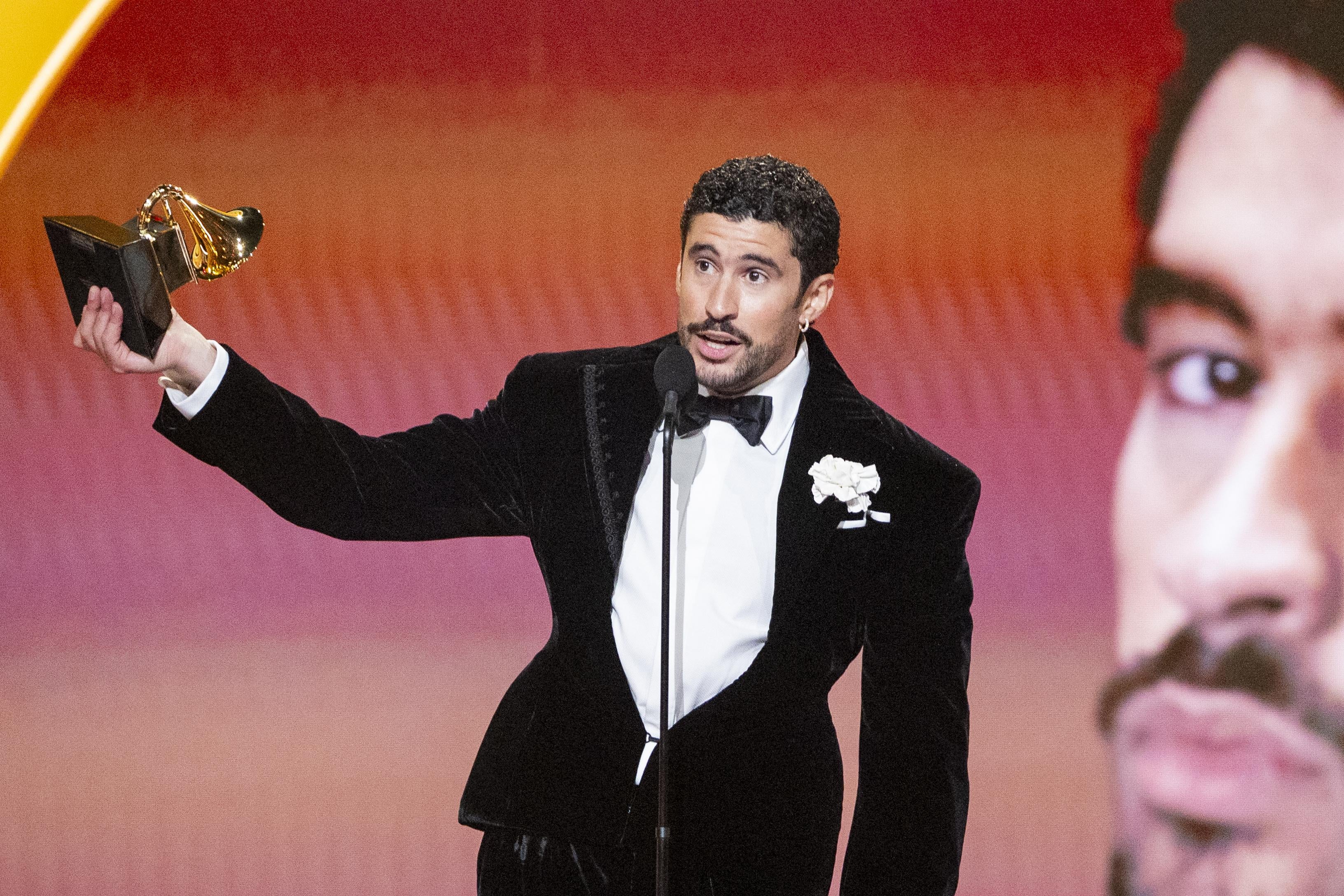
Aside from Bad Bunny’s important Album of the Year win, the Grammys were so generally lackluster this year that this morning people will mostly be talking about the part where a woman of a certain age got confused. After receiving a lifetime achievement award, 79-year-old Cher wandered offstage before presenting the nominees for Record of the Year, the main task she was there to do, and had to be gently called back by host Trevor Noah. Then she forgot that she had to open the “Grammy goes to …” envelope. And when she did, seeing that the text on the card said “Luther” by Kendrick Lamar and SZA, she announced happily that the winner was Luther Vandross (er, “Luther Grandross”), who of course died back in 2005.
To be fair, Lamar and SZA’s hit track is partly a tribute to Vandross, built on a sample of his music, a fact Lamar graciously used in his acceptance speech to soften the embarrassment. But for viewers, it served as a rare outbreak of reality, a sense that something was actually happening—reminiscent of the 2017 Moonlight–La La Land Oscar mixup or John Travolta’s surreal 2014 blunder calling Idina Menzel “Adele Dazeem.” (Cher’s fellow legend Joni Mitchell had her own “senior moment” during the afternoon awards presentations, which thankfully far fewer people witnessed.)
The other points when spontaneity bloomed in last night’s show were likewise mostly non-musical, in outspoken acceptance speeches—very welcome after the neutered overtones of the Grammys a year ago. With events in Minnesota looming in the background, many participants were wearing “Ice Out” pins on their lapels or gowns. After about 90 minutes, Bad Bunny became the first to say it out loud, while accepting the Best Música Urbana award, in remarks worth repeating: “We’re not savage. We’re not animals. We’re not aliens. We are humans, and we are Americans. … I know it’s tough not to hate on these days, and I was thinking, sometimes we get contaminados—I don’t know how to say that in English. The hate gets more powerful with more hate. The only thing that is more powerful than hate is love. So, please, we need to be different. If we fight, we have to do it with love, yeah. We don’t hate ‘them’—we love our people, we love our family, and that’s the way to do it, with love.”
There was more in that vein from Best New Artist winner Olivia Dean, referring to herself as “a granddaughter of an immigrant” (she’s British of Jamaican and Guyanese descent) and thus “a product of bravery,” as well as from Billie Eilish, who declared “no one is illegal on stolen land” then was muted by CBS when she went on to say, “Fuck ICE.” Even country-music winner Jelly Roll, in his frequent preacher mode with a miniature Bible in his hand, went out of his way to assert that “Jesus is not owned by one political party.” That probably caused ripples in Nashville, which has gone much more MAGA in the past year than it did during Donald Trump’s first term. It was almost enough to make up for the fact that Jelly Roll definitely should not have won that award instead of actual progressive country artist Tyler Childers, or indeed any of the other nominees.
Donald Trump’s name itself was spoken onstage only by Noah, hosting for his sixth and final round. First it was a joke about Trump and his supporter Nicki Minaj comparing butt sizes, then one about Trump desiring Greenland because he misses Epstein island—a barb that drew the president to social media to threaten to sue Noah and complain about the “virtually unwatchable” show.
It wasn’t unwatchable, but it was much snoozier than the past few. In the spirit of the night, what absolutely should have happened was Bruce Springsteen parachuting in to perform his new ICE protest anthem, “Streets of Minneapolis” (as he did searingly in a surprise performance in that city on Friday). I’m not surprised the producers didn’t make that happen, though I’d love to know if they tried. Absent that, there was a sense that Grammy-style spectacle rings hollow right now.
Perhaps too the whole event sagged as it fell back into Grammys business as usual after 2025 resolved the yearslong tension over whether Beyoncé would ever win best album, and by extension the Grammys would begin to repair their relationship with the younger Black-music world. Or perhaps there are backstage stories relating to why this was the final Grammys on CBS after 54 years of partnership. (It’s moving to ABC, Disney+, and Hulu next year.) In any case, inspiration was scant in most of the planned proceedings, as well as many of the award choices.
Though Bad Bunny’s Debí Tirar Más Fotos did score that crucial album win, the first ever for a Spanish-language album, it came as much as a relief as a milestone—evidence that the academy’s efforts to expand their voting pool in recent years indeed seem to be helping them avoid whiffing the zeitgeist in the ways that made the Grammys wincingly notorious for decades. When Bad Bunny appeared to accept the Música Urbana trophy, I worried we wouldn’t see him again. But his night wasn’t the sweep it probably should have been, and since Puerto Rico’s favorite son was unable to perform due to his Super Bowl halftime show contract (Noah made a running bit of trying to get him to sing, almost to the point of harassment), the excitement felt half-squelched. Much of the broadcast came off like an extended teaser for next week’s NFL event.
For whatever reason, there were likewise no performances from Song of the Year winner (for the third time) Eilish, nor Record of the Year recipient Lamar, now the most-Grammy-winning rapper of all time, surpassing Jay-Z. (While picking Bad Bunny over him for the big prize was the right choice, it’s worth remembering that no mainline rap album has won since Outkast in 2004—though of course Bad Bunny is in part also a rapper.) This year also saw the KPop Demon Hunters smash “Golden” become, shockingly, the first K-pop Grammy winner ever—the music should really have its own category, as was instituted for African music last year—but there was no performance of that song, maybe because it’s already booked for the Oscars next month.
I do enjoy the recently introduced format of all the Best New Artist nominees facing off in short bursts, in a kind of Hunger Games for the fresh meat. But this year the effect was mostly to confirm the impression that 2025 was a lean year for emerging talent in mainstream music. Given the field, retro-soul artist Dean earned her win, but she could just as easily have been onstage at the 1976 Grammys as in 2026.
The producers compensated for the shortfall in premium acts with a super-extended tribute section in the middle of the show. First Reba McEntire, in her first-ever Grammy performance, sang “Trailblazer” over the usual montage of names of musicians who passed in the past year. This was followed by Post Malone, of all people, backed by a motley group of ex–Guns N’ Roses members and a couple of other random rockers, in a costume-party-like Ozzy Osbourne tribute.
Then finally came a D’Angelo and Roberta Flack homage led by Lauryn Hill (in her first Grammy appearance since 1999, and surprisingly neither late to stage nor leaving early) that became a virtual Black Music Summit. Its ranks included Bilal (great on “Untitled”), Lucky Daye, Raphael Saadiq, Chaka Khan, Jon Batiste, John Legend (inevitably), Leon Thomas, Wyclef Jean, Lalah Hathaway, and October London, plus D’Angelo’s band the Vanguard. With Hill shouting out names as each musician entered, there was kind of a clown-car effect, as it seemed like the stage might just keep filling up forever, but it at least provided a real sense of occasion. If you’d told me last week the Grammys were going to devote much more time to mourning Roberta Flack than to Sly Stone or Brian Wilson (who each got brief video tributes), I wouldn’t have believed you, though my colleague Chris Molanphy points out that Flack actually was “Grammys royalty” in her day.
Otherwise, there weren’t a lot of performances I find that memorable a few hours later. Probably mostly Justin Bieber in his new-dad uniform of boxers and socks, singing “Yukon” over his own electric-guitar loop in front of a full-length mirror, an authenticity gambit that still did seem genuinely vulnerable. (But was it just me or did he have his own Cher moment when he had to return to the stage to hit stop on his looping pedal because he forgot?)
I liked Lady Gaga rocking up “Abracadabra” with herself on synths and wearing an elaborate wicker-birdcage headpiece as well as vintage Alexander McQueen. I did not like Bruno Mars showing up for two separate songs, a needless redundancy I will remember mostly for inspiring writer Eric Harvey to refer to Mars on Bluesky as Chat-RNB. Sabrina Carpenter gave us a straightforward but worthy “Manchild” with a whole airport set complete with partial airplane, multi-costumed dancers, live doves, and her own winking charms—it’s been suggested she should succeed Noah as Grammys host, and I would endorse that. Tyler, the Creator similarly presented his own miniature Tyler, the Musical, though the staging was much more distinctive than the medley of Chromakopia songs. And to cap things off, Clipse fell back on the standard Grammy tactic of softening hip-hop up with a gospel choir—although it was hilarious that the “coke rap” group closed with “snow” falling from the rafters.
So better luck next year on ABC, if the Grammys are still legal then. Meanwhile, yes, Billie, fuck ICE, and warmest congratulations, Luther Grandross.