Few movie versions of Wuthering Heights have borne more than a passing resemblance to Emily Brontë’s stubbornly adaptation-proof novel. For one thing, nearly every screen version leaves out the book’s second half, the part where the seeds of intergenerational trauma sown in the first start to bring forth their bitter fruit. The novel’s plot is an intricate tangle of broken familial bonds and unholy alliances, told from several confusingly nested points of view. Combine this narrative density with the fact that every major character seems to share either a first or last name, making it necessary to maintain a mental org chart of all the Catherines, Heathcliffs, Earnshaws, and Lintons, and Wuthering Heights may be too much book to fit into a single movie.
It’s understandable why filmmakers taking on this thorny, defiantly strange book have chosen to concentrate on the first half, with its focus on the thwarted and destructive love between Catherine Earnshaw and the Cher-style one-namer Heathcliff, a foundling orphan brought home by Catherine’s father and raised alongside the young Cathy as a sort of ill-treated brother. Heathcliff and Cathy’s fierce attachment to one another goes beyond romantic love: at different points in the novel, it could be described as incestuous, adulterous, necrophiliac, and an act of defiance against the very notion of a cosmic order that separates the earthly from the divine. “I am Heathcliff,” Catherine avers in one of the book’s most famous passages, before making clear that, when she dies, she would prefer to spend eternity in neither heaven nor hell, but on the windswept moors that give the hilltop house of the title its name.
It’s too bad that, in lopping off the story’s second half, the English writer-director Emerald Fennell has deprived herself of the chance to film the scene in which a grief-crazed Heathcliff opens up Cathy’s coffin so he can embrace the body that has lain underneath those moors for 17 years. It’s hard to imagine a more Fennell-friendly image, perhaps because in her second movie, Saltburn, she has already filmed a bereaved man literally copulating with the still-loose dirt over the resting place of his beloved. Fennell is an unapologetic fan of the lurid, the Gothic, and the extreme—a quality that would make her well suited to tackle the weirdness of the second-to-youngest Brontë sister’s only novel, if only she shared more of that author’s other defining trait, a ferocious and wide-ranging moral intelligence.
Alison Willmore of Vulture is probably right that Wuthering Heights is the best yet of Fennell’s three feature films—although coming from me, that constitutes faint praise, given that I consider her debut, Promising Young Woman, to be so muddled in its exploration of revenge, consent, and rape culture as to be actively pernicious, and her sophomore outing, Saltburn, to be a stylish if hollow rehashing of overfamiliar tropes about class warfare lifted more or less directly from works like Brideshead Revisited and The Talented Mr. Ripley. Fennell’s commitment to maximalism and provocation, often at the expense of thematic coherence or basic narrative logic, is certainly fearless. She has said that the “Wuthering Heights” she is choosing to adapt is the one she read and loved at the age of 14—hence her choice to render the title of her adaptation in quote marks. This postmodern punctuation makes it clear that the movie is less a screen version of the novel than a fanfic-style riff on its best-remembered if most-misunderstood storyline: the forbidden love between a brooding outcast and his impetuous, iron-willed darling.
One element of Wuthering Heights the book that the teenage Fennell seems to have missed out on is the racial ambiguity of Heathcliff—a matter of considerable interest to the other characters, who refer to him as “a dark-skinned gipsy,” a “little Lascar” (an English term for sailors of South Asian or Middle Eastern origin), and, jestingly, as the possible offspring of “the Emperor of China” and “an Indian queen.” Heathcliff’s uncertain racial status and the stigma associated with it are arguably the primary reasons for his increasingly rage-driven relationship, not just with Catherine, but with the whole of the stratified social world that surrounds him. By deciding to cast the decidedly white Jacob Elordi, Fennell is certainly in keeping with a long cinematic tradition—the one that has, in the past, given this iconic (and Byronic) role to Laurence Olivier, Richard Burton, Timothy Dalton, Ralph Fiennes, and Tom Hardy. (A loose adaptation by Andrea Arnold in 2011 featured Black British actors as the teen and adult Heathcliff.) But in depriving the character of this key motivation for the revenge that powers the book’s story, Fennell leaves so many interesting ideas on the table—ideas that would do far more to make this adaptation feel “modern” than any number of Charli XCX needle drops and blood-red latex dresses.
But once you’ve accepted that Fennell’s interest lies less in exploring class and race relations in colonial-era England than in watching Jacob Elordi bale hay without a shirt on, there’s fun to be found in this pulpy, carnal, proudly idiotic “Wuthering Heights,” with its Valentine’s Day weekend release date, its unabashedly horny tagline (“Come undone”), and its title font that appears to be made of lace. For better or worse, it’s a Brontë adaptation for the era of Instagram and TikTok, second screens and viral memes. When Catherine (Margot Robbie) races off to the moors to pleasure herself behind what turns out to be a not-so-private rock, or when she and Heathcliff spy on some servants in the barn engaged in erotic play with the bridles and whips, the intent is both to turn the audience on and to make us giggle at the characters’ (and the filmmaker’s) transgressions. The effectiveness of this maneuver wears off as it begins to become evident that it’s one of the only tricks in the director’s bag. But more crucially, turning nearly all the novel’s shocking acts of cruelty into consensual kink scenarios sands down the story’s edges and makes this little more than a tale of two hotties who, in their brief time together on Earth, really knew how to get down.
Fennell does grasp some key emotional truths about the characters: Though Elordi’s version of Heathcliff is, in my opinion, too open and vulnerable (perhaps an unavoidable consequence of casting the Frankenstein actor, whose whole 6-foot-5 body plan screams “gentle giant”), Robbie’s Cathy does get a chance to act out some of that hard-to-like character’s monstrous selfishness. After weeping over the dead body of her father (Martin Clunes), a self-pitying alcoholic who took out his misery on the rest of the family, she stands up and gives the corpse a pair of swift kicks, a moment that made me laugh aloud in surprise and delight.
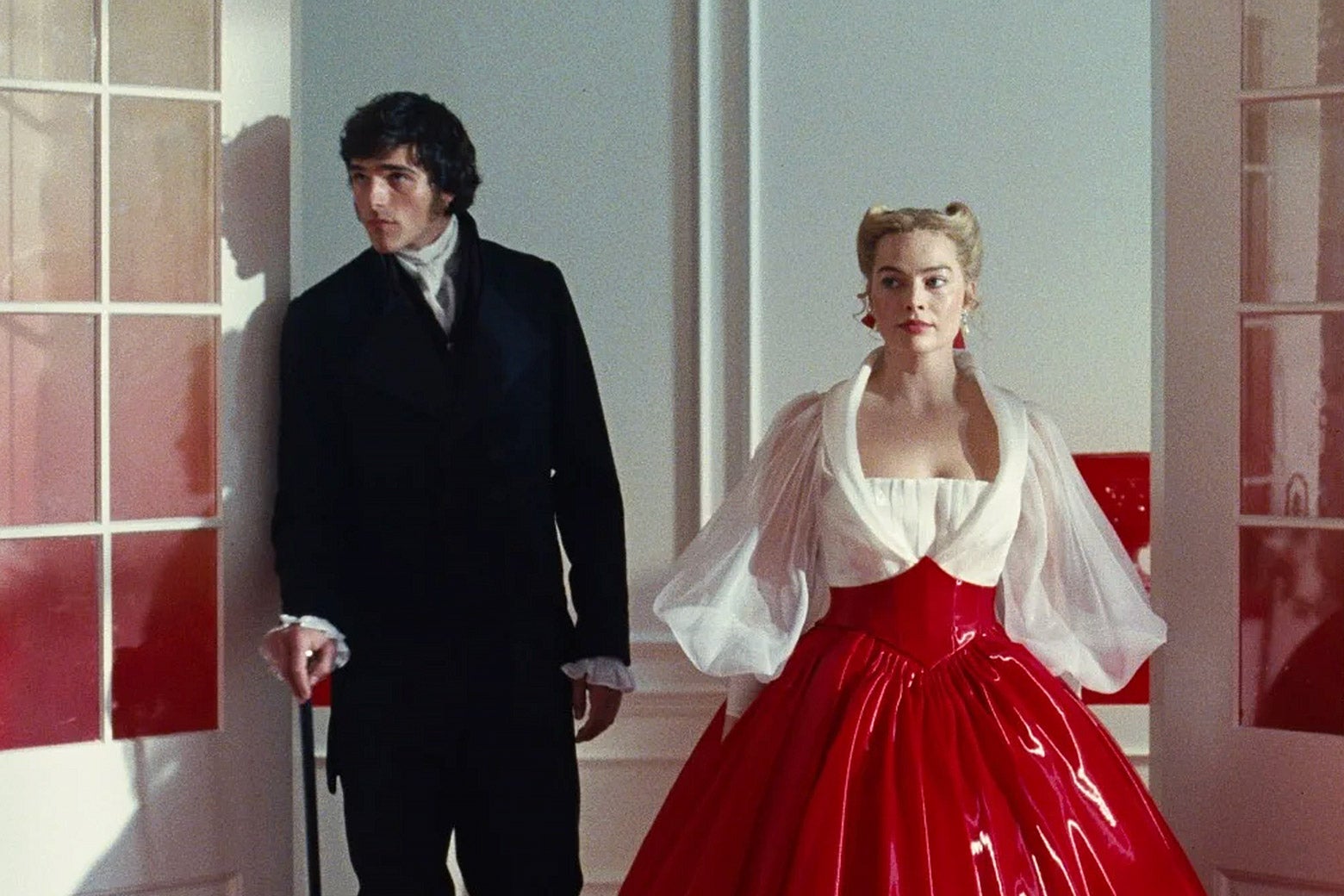
Like all of Fennell’s films to date, Wuthering Heights boasts an impressive level of craft and a novel design sensibility; its aesthetic evokes a vintage romance book cover as reimagined by Lisa Frank. There are images so elaborately composed they seem like deliberate camp, as when a heartbroken Heathcliff, seen in stark silhouette against a flame-red sky, leaps astride a horse to literally ride into the sunset. The costumes by the great Jacqueline Durran (Little Women, Peterloo, Barbie) are eye-poppingly original and shamelessly non-period, especially after Catherine marries Heathcliff’s rival Edgar Linton (Shazad Latif) and moves from the run-down farmhouse at the Heights to the Linton estate of Thrushcross Grange. In Fennell’s reading, this well-appointed Yorkshire home becomes a place of lavish, decadent wealth, an extravagant yet joyless mansion with décor as anachronistic as it is perplexing. Why is the mantelpiece over the fireplace encrusted with what appear to be hundreds of plaster casts of human hands? Why is the wallpaper in the room that Edgar creates for Catherine designed to resemble her skin, right down to the veining and freckles? This last Cronenbergian detail unfortunately never plays a role in the story—though Heathcliff does at one point lick the wall—but it’s one of the many triumphs of Suzie Davies’ production design.
In focusing so narrowly on Catherine and Heathcliff’s doomed romance, Fennell does a disservice to one of the book’s most important and most opaque characters, the housekeeper Nelly Dean (played as a teenager by Vy Nguyen and as an adult by Hong Chau). Nelly is, in terms of sheer page count, the book’s primary narrator; her shifting alliances between the two feuding families make it hard to trust her version of the events she describes, yet she seems to be one of the few characters in the book capable of expressing real compassion. This Nelly functions mainly as an obstacle to Catherine and Heathcliff’s adulterous assignations, and by the second half, she is essentially the villain, though one whose motives the script only hand-waves at: Is she jealous? A prude? Morally outraged on behalf of her kind, if gormless, boss?
The essence of this silly but crowd-pleasing Wuthering Heights—a movie that will be enjoyed by fans of Baz Luhrmann, and probably by those who swoon for Sofia Coppola’s Marie Antoinette—can be summed up in the moment when, warming up for a snogging session, Elordi’s Heathcliff uses Catherine’s corset—a corset that, as we’ve been shown, is already laced so tight it leaves bloody marks on her flesh—as a tool to lift her all the way up to his perfectly symmetrical face for a nice wet close-up kiss. There is the affectionate if slightly derogatory genre category of bodice-ripper, and then there is … a bodice that does its own painful ripping, assisted by the hero and with the sadomasochistic heroine’s full and enthusiastic consent. What could have been a symbol of female oppression becomes a kinky sex accessory. That’s the Emerald Fennell difference.