Sign up for the Slatest to get the most insightful analysis, criticism, and advice out there, delivered to your inbox daily.
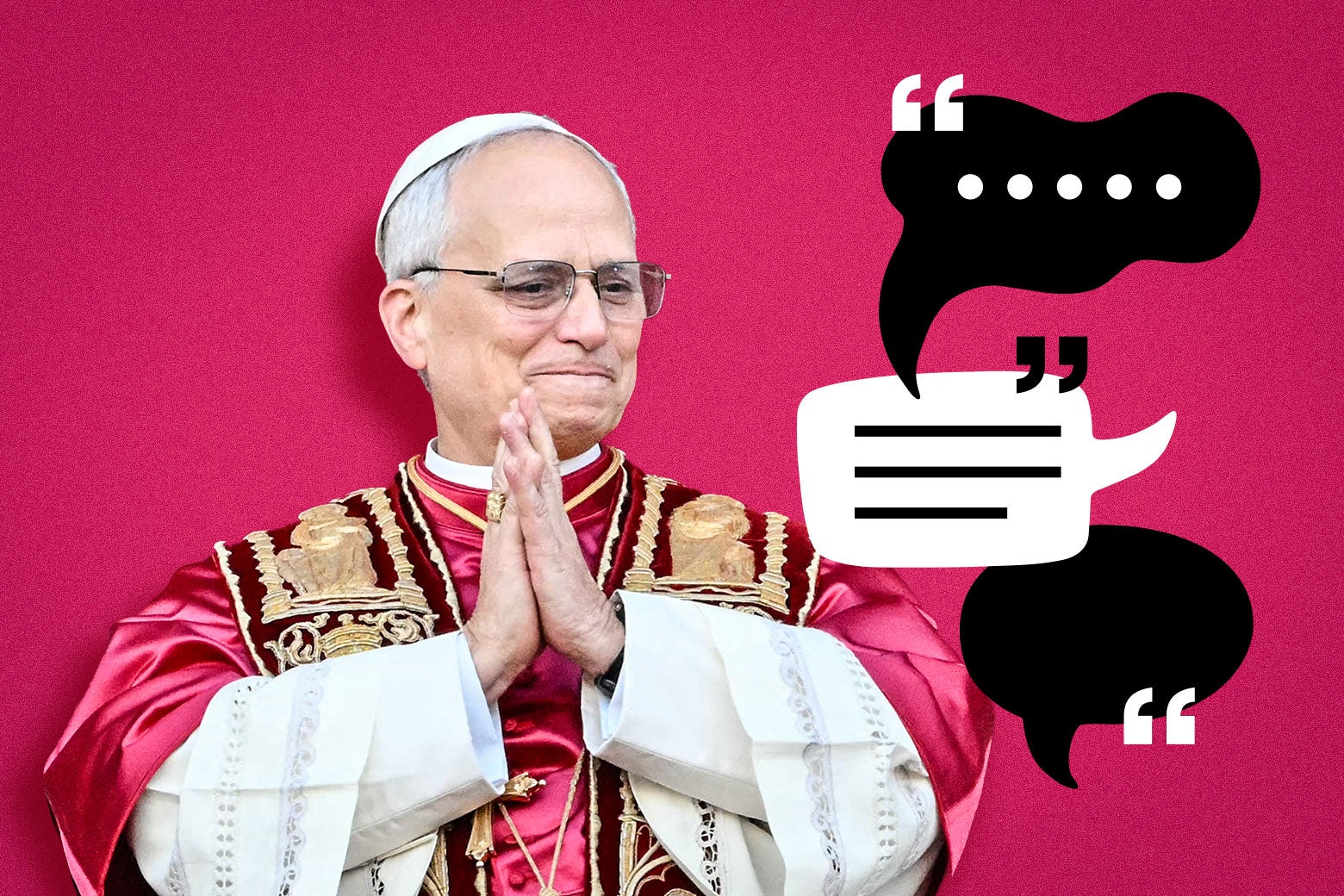
American Catholics have spent the first few days of Leo XIV’s papacy desperately searching for clues about who the first American pope will become. Online, they combed through his social media accounts, shared fabricated quotes attributed to him, and looked for messages in his sartorial choices. From the left and the right, these Catholics picked through tidbits from his past and his first few days in office and found material for both panic and gloating. To an outside observer, it seems that at this point, the image of Leo that most of these internet users have cobbled together has ended up more a projection of their own politics than anything else.
But we do know one clear political identity marker for Pope Leo: He voted in the Republican primaries in 2012, 2014, and 2016. That’s notable. For the first time in history, we can feel confident that the pope understands U.S. partisan politics, that his views can be mapped onto American political values, and that one of our two parties could, at least for some portion of recent history, claim him.
And yet, the political response from the right has been, overwhelmingly, one of dismay.
“Of course he’s anti-MAGA and WOKE,” the far-right activist Laura Loomer, who has President Trump’s ear, wrote on X. “Another Open Borders Pope. Gross.” In another post, Loomer, who is Jewish, called Leo “just another Marxist puppet in the Vatican” and concluded that “Catholics don’t have anything good to look forward to.”
Loomer’s response, and those of people like her, largely arose in response to activity from an X account that appears to have belonged to then-Cardinal Robert Prevost. That account had, for example, reposted a quote about the Trump administration’s deportation of Kilmar Abrego Garcia in April: “Do you not see the suffering? Is your conscience not disturbed? How can you stay quiet?” In February, the account posted an editorial from a Catholic newspaper with the headline: “JD Vance is wrong: Jesus doesn’t ask us to rank our love for others.”
“Is it too much to hope that some 20-year-old ran the new pope’s X account and he never looked at it?” Megyn Kelly asked on X on Thursday.
Because of these comments, the right-wing troll account known as Catturd, who has 3.7 million followers on X, described Prevost’s election as a “nightmare” and reposted the CEO of the Federalist, who listed off complaints: “the newly selected pope trashed Trump, trashed Vance, trashed border enforcement, endorsed DREAMer-style illegal immigration, repeatedly praised and honored George Floyd, and endorsed a Democrat senator’s call for more gun control.”
Leo’s past political statements do indeed indicate he would have progressive stances when compared to Trump’s supporters on the matter of climate change, immigration, and social safety nets to care for the poor. But he also, in line with Catholic tradition, is firmly anti-abortion and has more conservative views on marriage and reproduction, calling “gender ideology” “confusing” in 2016 and complaining in 2012 that popular culture encouraged “practices that are at odds with the Gospel,” such as gay parents adopting children. (We don’t have any indications to know if his views have changed over time.) Because Prevost was perceived by the cardinals who elected him as a moderate candidate, meant to ease anxieties about growing factionalism within the church, he stands out neither as a fearless reformer nor as an old-fashioned moralist. But because the posts from the X account touched on issues that are not particularly controversial within the global leadership of the Catholic Church but very controversial in American politics, right-wing commentators saw only the Democrat-coded sentiments.
“I was considering becoming Catholic,” wrote the influencer Matt Wallace. “Not anymore.” The editor in chief of the conservative satire site the Babylon Bee highlighted one of Prevost’s reposts about George Floyd and added “We may be cooked.” Mike Cernovich, the conspiracy theorist commentator, took particular issue with the X account’s previous posts about COVID. Like Pope Francis and most of the rest of the Catholic hierarchy, Cardinal Prevost had urged wealthier countries to help make vaccines available to everyone. Cernovich described Leo as a “shitlib” and a “far left wing agitator who wants Americans to surrender their guns.”
To be clear, the activity from Prevost’s account on X didn’t deviate from official positions from the Vatican. Pope Francis spoke out openly against the Trump administration’s treatment of refugees, for example, and chastised Vance for his notion of ordered love. But as the first American—and first native-English-speaking—pope, and a former Republican voter, Pope Leo XIV is in a different position than Francis. If he speaks out against Trumpism, it will be seen as more informed, more targeted, and significantly more charged.
Not everyone on the right was displeased by the news of the conclave’s choice, though. The YouTuber Benny Johnson joked that this election showed the efficacy of Trump’s tariffs: “Another Trump win.” And the Daily Wire commentator Michael Knowles, in a post reposted by Ben Shapiro, asserted that “the most liberal Catholic prelate is substantially to the right of most conservative Republicans on most issues.” (This talking point only really applies to issues of reproduction, sexuality, and gender.)
Others celebrated the existence of Leo’s MAGA brother, who said he learned of Leo’s election while watching Newsmax. “Just went on War Room and said I’d be happy to sponsor the Pope’s brother flying to Rome to spend some quality time with Leo and talk about immigration!” the activist Jack Posobiec wrote. In response to a New York Post article highlighting the brother’s Facebook post calling Nancy Pelosi a “drunk c—,” the manosphere influencer Nick Adams wrote, “It’s great to see the Pope will be receiving a pro-MAGA influence from his alpha male older brother. It’s important to have a Pope that understands where MAGA is coming from and does not look down on the America First movement.”
On social media, much of the debate over Leo’s actual politics came down to the choice of his papal name. The pope has said he chose his name because the 19th-century Pope Leo XIII “addressed the social question in the context of the first great industrial revolution.” To the new Leo, a new industrial revolution with new technologies and artificial intelligence “pose new challenges for the defence of human dignity, justice and labour,” as he explained it. The 19th-century pope had addressed these issues through a document called Rerum Novarum.
Today’s Catholics have revisited the document. Depending on their politics, they found critiques of capitalism or of socialism.
“This is a great sign,” wrote Roger Severino, a top Heritage Foundation figure. “Now Pope Leo XIV seeks to apply [Catholic faith and teaching] to the AI revolution which is already being used to attack human dignity. Remember when Google Gemini refused to make an image of a white Pope?”
But the fight was more complex than just left vs. right. Within conservative Catholicism, there is the traditionalist faction, which tends to portray itself as protecting the ancient character of the church. The traditionalists vary from the mild to the extreme, with some at the far end making only-partly-joking memes itching for a new holy war against secularists, Protestants, and non-Christian faiths. Pope Francis had clashed with this cohort, which he generally found to be uncomfortably fundamentalist, shallow in their priorities, and worryingly Eurocentric. In an effort to disperse their movement, which in certain corners fosters antisemitic extremism, he limited the use of the traditional Latin Mass. This ended up one of the most unpopular moves of his papacy, as many more mainstream Catholics are fond of this old-fashioned form of worship, as well.
In the context of this intra-Catholic conflict, signs of alignment or deviation from Francis’ behavior early in Leo’s papacy took on significant meaning. The traditionalists were delighted that in Leo’s official portrait he wore a red cape and richly embroidered stole, unlike Francis’ simple white garb, but they were dismayed that he was later spotted wearing scuffed black shoes, rather than traditional scarlet slippers. They were anxious upon learning he had said a Catholic bishop was “not supposed to be a little prince sitting in his kingdom,” but were pleased to learn he will probably live at the papal apartments in the Apostolic Palace, which Francis had opted not to do.
Similarly, they found themselves reassured by reports that their own heroes in the church leadership were content with Leo, but fretted when they learned that James Martin, a Jesuit priest famous for his pro-LGBT activism, expressed his delight about the new pope. They were heartened when they saw a 2023 clip circulating in which Leo said “not all meetings with [the future Pope Francis] Cardinal Bergoglio were mutually agreeable”; but they were concerned when they recalled that while working under Francis at the Vatican, Leo had been involved in elevating bishops they disliked and participated in some of the disciplinary actions against dissident traditionalist clerics.
It was, in other words, something of a wash. But excited by the unknowns, many traditionalists began feverishly theorizing that Leo was secretly one of them. Some speculated, based on rumors and false reports, that their own cardinals had organized to block the more Francis-aligned Cardinal Pietro Parolin and were responsible for Prevost’s election—that their representatives in the conclave saw something in Prevost that other cardinal-electors missed. They became particularly excited by a video that seemed to show Leo artfully dodging a peace flag that looked like a rainbow flag. “The great restoration has begun,” one traditionalist account wrote. “We’re BACK,” wrote another.
It does seem, based on Leo’s early actions, that he plans a more conciliatory approach to traditionalism, and that he hopes to serve as a kind of bridge between this faction and the larger Catholic community. But such outreach should not be mistaken for right-wing politics: In his earliest speeches and homilies, Leo has made it clear that he plans to continue the priorities of Francis, carrying on his predecessor’s project of giving laypeople a voice at Vatican councils—a deeply unpopular notion among traditionalists. He indicated that he would maintain Francis’ focus on the poor and marginalized, that he would emphasize the need to confront climate change, and that he would focus on creating a church that felt welcoming to the larger world.
Some of the more astute traditionalists observed the signs of Leo’s real priorities without getting distracted by his more surface-level deviations from Francis.
“Prevost is a continuation,” Steve Bannon, who has for years worked to insert himself into Vatican politics, said in an interview with the Financial Times. “He was the perfect acolyte for Bergoglio to continue his thing.”
Bannon, who believes that Prevost was chosen in part to access “American cash” to help with the Vatican’s financial crunch (its vast wealth is tied up in non-liquid and often priceless assets), told the Financial Times that “the conclave for the pope was more rigged than the 2020 election. This was totally rigged by the curia to be both anti-Trump and to drive … a schism in the church because the traditional Catholics are not going to go along with the continuation of Bergoglio.”
Pope Leo last voted in the general election in 2024. We don’t know how he voted then, or how he voted in the general election in 2018. The last time he participated in a Republican primary, it was the first of the Trump era. The reality is that while no one can yet know what Leo’s election will mean for the internal politics of the Catholic church, Bannon is likely right: This doesn’t seem like good news for the MAGA movement. We may not have a “woke pope,” as Laura Loomer described him, but we certainly don’t have an America First one, either.