Sign up for the Slatest to get the most insightful analysis, criticism, and advice out there, delivered to your inbox daily.
On Cinco de Mayo in 2018, I found myself dancing at a gay bar with Dolores Huerta.
I hadn’t wanted to go out that day. Just the day before, writer Zinzi Clemmons had stated that the Latine writer Junot Díaz had forcibly kissed her when she was a graduate student. I was attending a conference for Latinx educators in Los Angeles when I read the news. During break times, I read the stories of several other women who had since come forward against Díaz with similar stories of their own. By Saturday, I thought I needed time alone to process it all, but conference friends persuaded me to instead dance it out at Micky’s, a gay bar in West Hollywood.
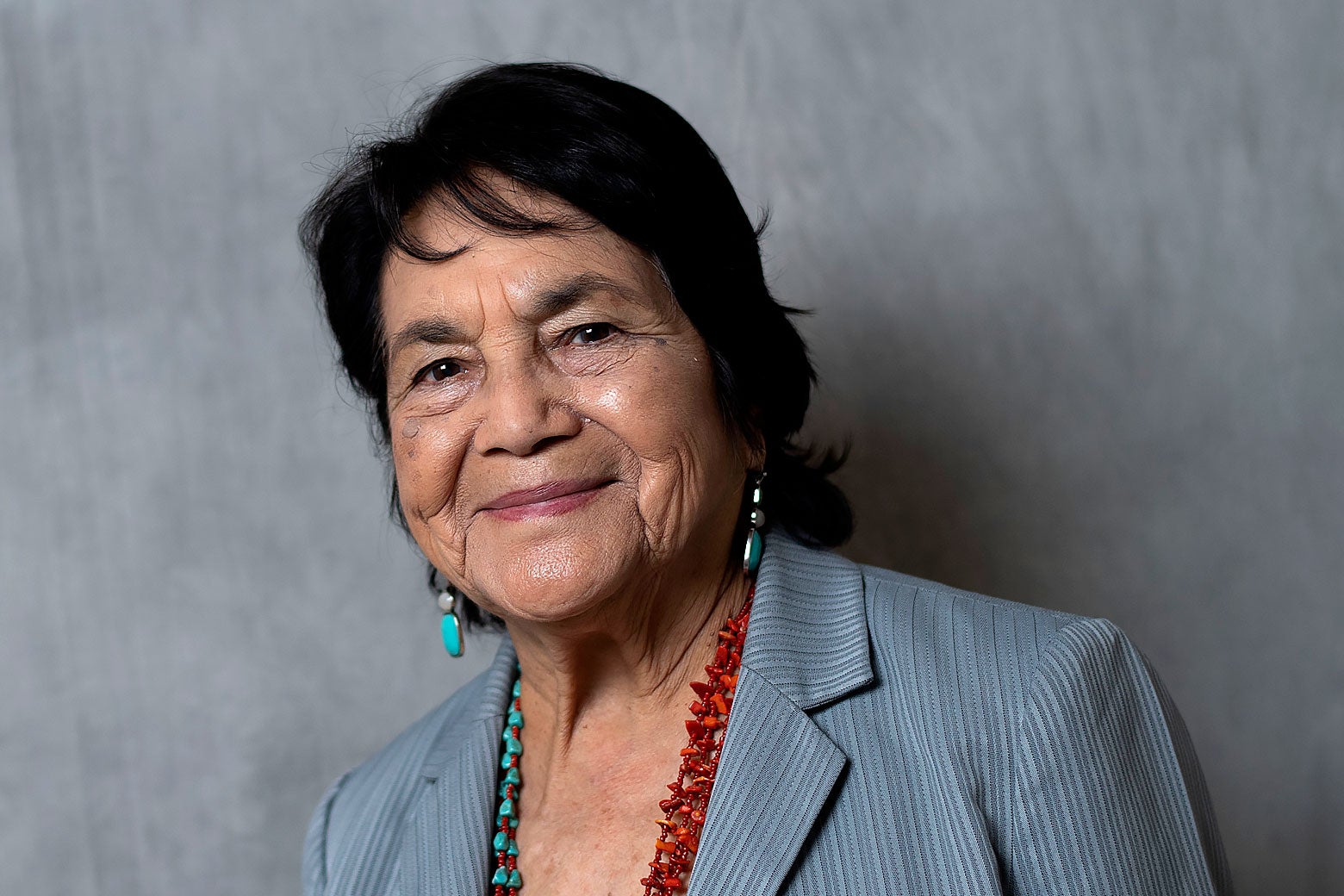
I spotted her on the dance floor. She wore a bright carnation-pink shirt, a gray blazer, and a beautiful orange-and-turquoise beaded necklace. She held a tequila drink with lime in her right hand. She came with a small group of women and assistants who had accompanied her to the United State of Women Summit, where she had spoken earlier that day.
“Afterwards, she just told us she really wanted to dance,” one of her assistants said to me.
Song after song, Dolores danced with us. When the DJ played Robin S.’ “Show Me Love,” a man vogued for her, and she bobbed her head and swayed to the beat, cheering him on. Later, we all applauded as a drag queen, wearing a red sequin dress and a golden halo headpiece, performed “Cucurrucucú Paloma” flawlessly.
I was mesmerized the whole night by how free she seemed. I don’t know if Dolores Huerta will ever identify as queer, but watching her, at age 88, unapologetically dancing with us gays until late into the night in and of itself felt queer to me, like a giant statement of what an elder woman’s single life could be like, how liberating it could feel, how fun.
Last Wednesday, Huerta released a statement describing how Cesar Chavez, with whom she co-founded United Farm Workers, had sexually assaulted her twice. Both times resulted in pregnancies she kept hidden from nearly everyone. After witnessing the liberation she modeled for me that night at that gay bar, I was devastated to know what it had cost, what she has always had to hold in her body, even on the nights she seemingly looked so free.
In Latine activist spaces, this was not new. Critiques of Chavez’s racism, xenophobia, and womanizing had existed for years. The “militant machismo” of the Brown Berets—a Chicano revolutionary organization that fought against police brutality, government abuse, and social inequality—was so deeply entrenched that Gloria Arellanes and other women within the East Los Angeles chapter together wrote, “We have found that the Brown Beret men have oppressed us more than the pig system has, which is a serious charge in the eyes of revolutionaries.”
This has been true of so many Latino men and organizations who call themselves “revolutionary,” yet who never include the autonomy of a woman’s body in their cause. During the Mexican Revolution, leader Pancho Villa ordered the rape of every woman in the town of Namiquipa to retaliate against a man who had betrayed him. In 1970 the Puerto Rican Young Lords’ “13-Point Program” embraced the idea of “revolutionary machismo,” until Denise Oliver-Velez persuaded the organization to explicitly take a stance against it.
In an essay for Salon about the aftermath of the Junot Díaz allegations, Latine writer Ricardo Frasso Jaramillo lamented that our historic examples of Latine masculine leadership so often become only examples of what to avoid. “I am struck by the realization that perhaps we all deserve more than a model of what it means to be broken,” he wrote.
As a light-skinned queer nonbinary Latine person with U.S. citizenship, and a survivor of multiple experiences of sexual assault, I have written extensively about how I grapple with the nuanced power dynamics at play in each incident. When I was assaulted while traveling abroad, my U.S. citizenship gave my story a specific kind of narrative power that other women didn’t necessarily have. But living in the States as a woman of color, the power flips. I have internalized—as so many other women of color have—that it is my responsibility to hide the abuse men of color commit, rather than contribute to stereotypes of these men as violent. Living in a country where the current president called Mexican men “rapists”—a country that lynched thousands of Black men based on false accusations of rape—I believed I could not provide yet another piece of evidence toward what our country already assumed about these men. I could not put their literal lives at risk in a legal system that has always wanted to kill them. Cis men of color have certainly protected me from sexual and physical violence, but they have also enacted the worst of it.
I can’t imagine holding the immensity of what Huerta held for decades, but I do know what it’s like to hold secrets for the sake of abusive men. I have refused to physically describe the person who raped me at a party, because they were one of few men of color attending, and I didn’t trust the mostly white organizers to handle the situation correctly. As a teacher, I wrote a recommendation letter on behalf of the high school student of color who assaulted me to ensure that he could still attend a good school. And now, as a writer, I have strategically rearranged the details in my work so that I can tell the stories of my assaults while not risking these men being identified. I don’t know if I regret any of these actions, and I don’t know if I stand by them. Perhaps, like Dolores, those are questions I will grapple with all my life.
But possibly what most disturbs me about her story is that it illustrates just how well versed and practiced women of color are at swallowing our own pain, and enduring rape and assault as if it isn’t just as traumatic as the other violations we fight against in our movements. For the years I have written about sexual trauma, I have dreamed of what our movements would be like if they prioritized the trauma experienced by women and trans and nonbinary people as much as that of cis men. It would mean that the decision Dolores felt she had to make—between hurting a movement and hurting herself—would no longer be necessary. It would mean that men would no longer, as Victor Interiano wrote, “center their own trauma, act out abusively from that trauma, then expect women to set aside their own healing so they can coddle masculine fragility.”
My great-grandmother was also named Dolores, and was also a survivor of sexual abuse from a prominent man in the very small town where she was raised. Like Dolores Huerta, she held this secret for decades, though a family member told me that she also began sharing more about her experience “later in her years.” Dolores Huerta was 95 years old on the day she finally decided to share her story. For both women, I keep thinking about the incredible amount of energy they exhausted on enduring and hiding the violations inflicted on their bodies. I keep thinking about what different lives they could have lived had this not happened to them. What would their desires have looked like? Who would they have become? I grieve so much that we will never know those answers. And, at the very least, I am grateful that both Dolores Huerta and Dolores my great-grandmother did not spend the final years of their lives ashamed or in fear. They did not die holding this entirely on their own.
Just a few weeks ago, I marched in Guadalajara, Mexico, for the 8M protest against gender violence, with a poster that read “Marchando Por Mi Bisabuela” (Marching for My Great-Grandmother). I felt such solidarity seeing dozens of others with posters honoring their survivor grandmothers and exposing abuse in their families and communities too.
In one portion of the route, someone had left a giant blank sheet of butcher paper with the title Expon a Tu Agresor. Expose Your Abuser.
By the time I reached it, the sheet was blanketed with names and had no more empty space. Later, I saw another sheet of butcher paper, tacked to a wall, titled: Deja tu huella si alguna vez te han acosado (Leave your handprint if you have ever been assaulted).
The entire poster was covered in painted hands. There was no empty space on that poster either. All along the route, protesters had spray-painted the names of their abusers on city walls. Some had written the names of abusive priests and church officials on the walls of churches. Others on the walls of a university. Folks marching past would chant:
“No estás sola. No estás sola. No estás sola.” You are not alone.
Dolores Huerta admitted that she had decided to share her story only after hearing that Ana Murguia, Debra Rojas, and Esmeralda Lopez were ready to share their own. I can’t stop thinking about this, how a survivor’s story has exponential power, how one story emboldens another and another, which emboldens a hundred more, and then a thousand more, until our stories become marches, become movements, become historical events.
One of my favorite posters at the march read, “Espero que sepas que hay mucha vida después del dolor” (I hope you know that there is a lot of life after pain).
When I think back to that night dancing with Dolores at the gay bar in Hollywood—knowing now what she held during that time, what she had survived, what she carried—it is still so clear to me that Dolores was determined to have a life after pain. The only memory I have of my great-grandmother is her singing and laughing in Guanajuato, the one and only time I got to see her before she died. I’d like to believe that this means she too gifted herself a life after what had happened to her. And by choosing to tell our stories, we gave ourselves even more life still: a life after secrets, a life after holding them alone.