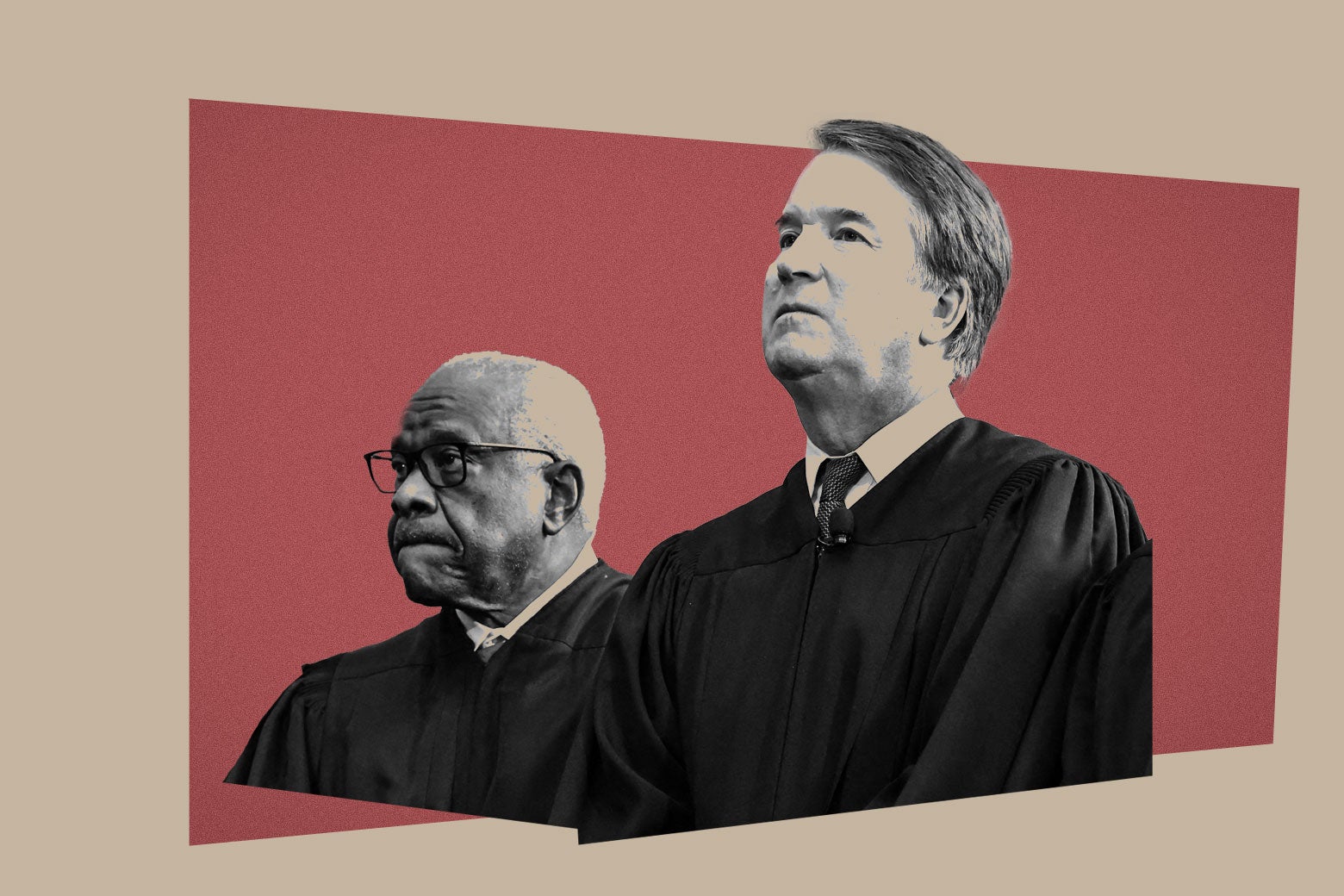
The Supreme Court delivered an important victory to disabled children on Thursday, unanimously affirming their right to reasonable accommodations in public education. Chief Justice John Roberts’ opinion for the court reiterated that schools engage in unlawful discrimination when they deny these accommodations to kids, even if officials are not acting in bad faith. His ruling provides a lifeline to schoolchildren throughout the country who are wrongly denied equal access to learning opportunities because of a disability.
Yet this victory comes with an asterisk: In a concurrence, Justice Clarence Thomas—joined, alarmingly, by Justice Brett Kavanaugh—launched an assault on civil rights law that would devastate disabled Americans’ ability to receive an education and participate in all aspects of public life. Thomas and Kavanaugh suggested that the long-standing interpretation of disability law is, in fact, unconstitutional, arguing that states should have far more leeway to discriminate against those with disabilities. We should expect such callous radicalism from Thomas. But Kavanaugh’s endorsement of this position is yet another ominous sign that the justice is drifting toward the hard-right flank of the court.
It is difficult to know exactly what to make of Kavanaugh’s drift to the right because he remains an intellectual lightweight who struggles to articulate and defend his views with any coherence. Is he just another MAGA-pilled jurist eager to promote Trump’s agenda? Did his bruising confirmation battle leave him with a lifelong grudge against Democrats that he acts upon by trashing progressive priorities from the bench? Has he fallen under the influence of Thomas and Justice Samuel Alito, who spurn centrism as craven capitulation to their perceived enemies on the left? Whatever the cause of his transformation, it is by now an undeniable fact that he has abandoned the middle of the court, sliding to the right of Roberts, Justice Amy Coney Barrett, and sometimes even Justice Neil Gorsuch.
Thursday’s case, A. J. T. v. Osseo Area Schools, shows exactly why robust federal protections for disabled Americans remain so vital. The plaintiff, Ava Tharpe, “suffers from a rare form of epilepsy that severely limits her physical and cognitive functioning,” as Roberts put it. Her seizures are worst in the morning, leaving her able to learn only after about 12 p.m. each day. When Tharpe transferred to a new school district in 2015, officials refused to provide her with special evening instruction, leaving her with far fewer hours of instruction than her peers.
Eventually, Tharpe’s parents sued under several laws, including the Americans with Disabilities Act and the Rehabilitation Act, which broadly bar discrimination on the basis of disability. But the federal courts tossed out their suit. These courts acknowledged that Tharpe was denied equal access to education because of her disability. But they held that Tharpe was not entitled to an injunction or damages under the relevant statutes because she had not proven that school officials “acted with bad faith or gross misjudgment.” Mere “non-compliance” with the law, the courts concluded, was not enough to justify judicial intervention.
This holding was, Roberts wrote, flatly wrong. The widespread adoption of this approach, however, has allowed rampant discrimination against disabled children to fester for decades, despite Congress’ clear effort to stamp it out. “In other disability discrimination contexts,” Roberts wrote, courts do not force plaintiffs to prove that state officials acted with malign intent. And there is no reason why this rule should apply to “the educational services context” alone. “In imposing a higher bar for discrimination claims based on educational services as compared to other sorts of disability discrimination claims,” the chief justice declared, the lower courts bungled “the unambiguous directive” of the law. So Tharpe’s suit can move forward. And now all disabled children denied accommodations by school officials will have an easier time establishing illegal discrimination and securing judicial relief.
But Thomas and Kavanaugh were not content to let Roberts deliver a clean victory for civil rights law. Instead, Thomas chose to write a concurrence, joined by only Kavanaugh, that aimed an arrow at the heart of disability law. He argued that courts have been misinterpreting these statutes for decades, granting overly generous protections to disabled people. And he warned that this prevailing understanding of civil rights law may actually violate the Constitution in several different (and dubious) ways.
Thomas’ central gripe is that, as Roberts wrote on Thursday, federal courts do not typically need proof of intentional discrimination to rule in favor of disabled plaintiffs. Under the Americans with Disabilities Act and the Rehabilitation Act of 1973—two closely related statutes that cover much the same ground—disability discrimination can occur even when government officials are not actively seeking to inflict harm. For instance, a school district might not intend to injure wheelchair users when it installs a stairway with no ramp. This refusal to consider the needs of mobility-impaired students has long been seen as discrimination nonetheless. Both the school district and a coalition of red states, however, argued that federal law does not clearly prohibit “unintentional” discrimination against disabled people. In his concurrence, Thomas embraced that argument. And he wrote that Congress must use clearer language under the Constitution’s spending clause if it wishes to outlaw such unintentional discrimination.
This solution, though, turns out to be a mirage—because Thomas then declared that even if Congress clarified the statute, his view is that it would violate the Constitution in at least three different ways. First, he wrote that Congress has no general power to “protect the learning environment in schools” under the commerce clause. Second, he wrote that Congress has no authority to mandate “special accommodations for the disabled” under the 14th Amendment. Third, he wrote that Congress cannot compel states to provide such accommodations without violating the anti-commandeering doctrine rooted in the 10th Amendment. If the Supreme Court adopted these views, it would effectively eviscerate all disability rights law—not just public education requirements, but the entire framework prohibiting discrimination against disabled children and adults alike.
Thomas did hedge by noting that he expressed “no definitive views” on these theories. But he urged the lower courts to “carefully consider whether the existing standards comport with the Constitution.” And caveats aside, the justice left no room for doubt that he believes all three of these constitutional objections to disability law have serious merit.
It is hard to know where to start with this hodgepodge of grievances, because none of them are plausible under a fair reading of the law as it stands today. Justice Sonia Sotomayor, joined by Justice Ketanji Brown Jackson, dissected Thomas’ gripe about “unintentional discrimination” in her own deft concurrence. Sotomayor explained that existing statutes apply whether or not officials show “any invidious animus or purpose.” At bottom, these laws do not simply outlaw state bigotry toward disabled people; they also “impose an affirmative obligation” to accommodate disabilities. Their expansive language clearly applies “even where no ill will or animus toward people with disabilities is present.” So the Constitution’s spending clause does not require Congress to speak any more clearly than it already has.
Thomas’ deeper constitutional objections are equally specious. The Supreme Court has consistently held that the commerce clause empowers Congress to address noneconomic conduct as part of a broader regulatory scheme. Disability laws are a key part of Congress’ efforts to grant all children equal access to education, a universal public service on which the federal government spends billions each year. If these statutes exceed the commerce clause, then much (perhaps all) federal rules and regulations in this area must fall, too.
But disability laws like the ADA do not even need a foundation in the commerce clause to survive constitutional assault, because they are—contrary to Thomas’ claim—deeply rooted in the 14th Amendment, a standalone basis for their enactment. It is true that the Supreme Court has never held that the 14th Amendment, on its own, always requires states to accommodate disabled people. But SCOTUS has held that this amendment empowers Congress to go beyond what the Constitution requires in order to “prevent and deter unconstitutional conduct.” The court has, in fact, expressly upheld some of the ADA’s mandates under congressional authority to enforce the 14th Amendment. The court has also wielded the 14th Amendment to invalidate discriminatory policies in public education. It seems obvious that, under this precedent, Congress may rely upon the amendment to impose expansive nondiscrimination policies on state education systems. And when Congress acts pursuant to its enumerated powers, it cannot run afoul of the anti-commandeering doctrine.
Of course, Thomas has long taken a hostile view of Congress’ right to protect individual freedoms, particularly when it does so by limiting state authority. It is no surprise that the justice sounds eager to tear down the whole edifice of disability law. What is jarring, and portentous, is that Kavanaugh signed onto Thomas’ opinion in full, further solidifying the justice’s spot on the court’s ultraconservative bloc. Earlier in his tenure, Kavanaugh often posed as a moderate, siding with the chief justice nearly 100 percent of the time. Over the past few years, though, he has shifted to the right, making bedfellows with Thomas and Justice Samuel Alito more and more often. Just in recent weeks, Kavanaugh has argued that the Second Amendment protects AR-15s, and—alone among the justices—argued for a ruinous assault on class actions. (The class-action case involved blind people denied an accommodation, a hint of the animosity toward disabled people he displayed in Thursday’s case.)
The list goes on. In March, when the Supreme Court ordered the Trump administration to pay out $2 billion in foreign aid, Kavanaugh joined Alito’s bilious dissent, which smeared the lower court judge as a power-drunk hack. Last year, Kavanaugh sided with the hardcore conservatives in voting to let Texas nullify the Biden administration’s authority over immigration enforcement. In other cases, the justice has staked out a far-right position, as when he suggested that a landmark federal law protecting Native children is, in fact, unconstitutional discrimination. And he pressed the court to consider striking down laws restricting “conversion therapy” for LGBTQ+ minors before some of his conservative colleagues were ready to do so.
“You sowed the wind,” Kavanaugh warned Democratic senators during his confirmation battle, and now “the country will reap the whirlwind.” That threat now reads less like a warning than a mission statement.