Sign up for the Slatest to get the most insightful analysis, criticism, and advice out there, delivered to your inbox daily.
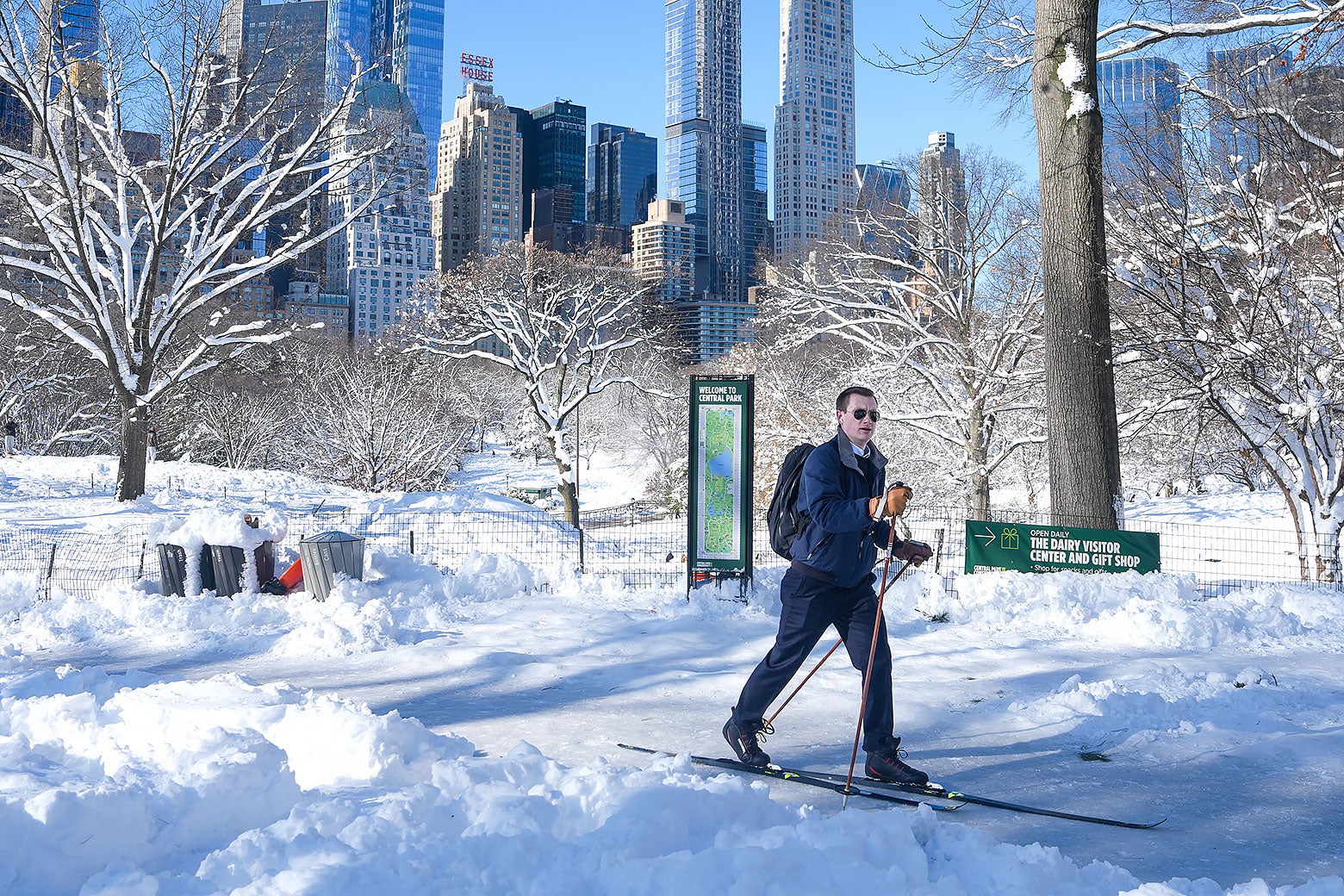
It’s not your imagination—this winter has been abnormal. For many places in the Northeast and mid-Atlantic, it’s the coldest winter in more than 20 years. This past week’s snowstorm has been described as “historic” for its hurricane-force winds and massive amount of snowfall, and it’s just one of several snowstorms this area of the country has had this season. And thanks to the low temps, this winter hasn’t just felt like a real winter; it’s also really looked like one. I haven’t seen grass since December. To be honest, after so many years of mild winters, I missed that feeling of living in a snowy—and often slushy—wonderland. In other parts of the country, winter has been weird in the opposite direction: For Americans who live out west, winter all but hasn’t showed up. Denver has seen temps in the 60s this week.
But if you live in a part of the U.S. that has been hyper-wintery this year, you’re probably wondering: When will this end?!
To answer that, we need to take a look at the polar vortex, a ring of frigid air that typically sits high up in the atmosphere above the North Pole. It tends to be circular, keeping the cold air in the Arctic, explains Judah Cohen, a climate scientist at Massachusetts Institute of Technology who writes a seasonal forecasting blog. But sometimes a disturbance can cause the polar vortex to stretch like a rubber band. As it stretches, its very cold air moves along with it, leading to periods of extreme cold in the regions below it.
This stretching of the polar vortex isn’t uncommon (though some experts hypothesize that the disturbances are increasing due to rapid warming in the Arctic caused by climate change). What was unusual this year, though, is that the stretching happened so early. It was in November that a disturbance first knocked cold air southward and “sent weather patterns into a tailspin this season,” meteorologist Ben Noll wrote to me in an email. (Noll is part of the Capital Weather Gang at the Washington Post and has been tracking this winter’s quirks closely.) In the months since, the polar vortex has been stuck in a cycle of stretching, snapping back, and stretching again, contributing to the bone-chilling temperatures. And probably all the snow: Recent research by Cohen found that polar vortex stretches align with the heaviest and deepest snowfalls. For much of the winter, the bulk of the vortex has been sitting over Canada and occasionally blowing frigid Arctic air into the eastern states. But its bend-and-snap routine has been restricted to about half of the country. In the West, a mix of other factors—marine heat waves and weakened jet streams—has kept things dry and warm (which sounds nice but is actually a big problem).
The storm this past week happened during one such stretch. The vortex will relax this weekend, with likely one more stretch next week, says Cohen. Indeed, there’s more snow forecast in the days ahead.
But fear not! The cycle is nearing its end, with a dramatic finish. By Cohen’s estimates, the polar vortex will actually split within the next two weeks. Our polar vortex is being pummeled by a “wrestling tag team,” says Cohen. The two fighters: repeated stretches, which weaken the polar vortex and cause it to snap more easily (think a rubber band), and also the calendar. As the days get longer, the sun gets stronger, and the temperatures rise—also weakening the polar vortex. “It’s back on its heels,” Cohen explains, “you know, can’t get a really good footing.”
A split sounds intense, and it can be, but timing might be on our side. Weather impacts from a polar vortex split tend to be delayed for about two weeks, so that puts us at roughly three weeks from now. By then, though, we’ll be in mid-March—in fact, it will be the spring equinox—and the days will be longer and warmer. There could be snow if it’s cold enough, but Cohen thinks it’s likely that we get a rainy start to the spring instead as a result of that snapped vortex. That’s a bummer, but at least there’s no shoveling involved.
During that delay, though, we’ll have a bit of lull where we experience some rather mild weather. Forecasts show that all lower 48 states can expect above-normal temperatures in early to mid-March, says Scott Handel, the lead meteorologist at the National Oceanic and Atmospheric Administration’s Climate Prediction Center.* He notes that late March may also continue to lean warm for the Northeast and much of the country.
All to say: We’re almost to the end. In the meantime, we might as well try to appreciate it. It’s hard to remember summer in the depths of a snowy winter, but it’s morphing into something far less of a fun reprieve than it used to be, with more untenable heat and overwhelming humidity that is not just uncomfortable but extremely dangerous. Not to be a bummer, but come summer, you might just find yourself missing the snowflakes.
Correction, Feb. 25, 2026: This article originally mistaken referred to the “lower 58 states” of the U.S.