Sign up for the Slatest to get the most insightful analysis, criticism, and advice out there, delivered to your inbox daily.
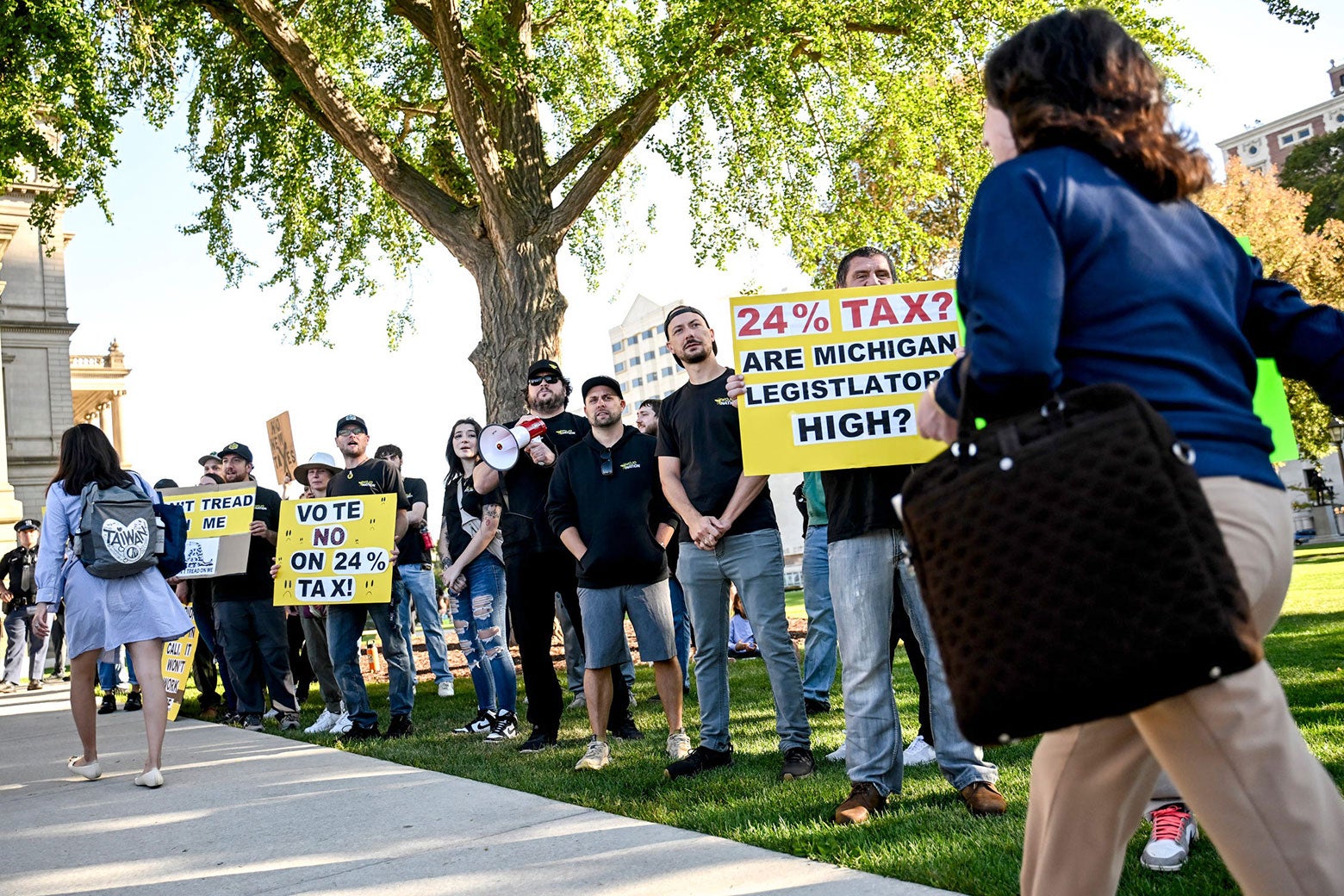
About a week after the federal government officially closed for business, Michigan’s state lawmakers managed to avoid a shutdown of their own by approving a hard-fought local budget, the product of some tough compromises between a Republican-controlled House and a Democratic-majority Senate that had delayed the process for months. Whatever relief Michiganders may have felt has quickly ceded to outrage over one of the bill’s key provisions: an added 24 percent wholesale tax on marijuana sales, to take effect in the new year. The tax will inevitably hike costs on its famously dirt-cheap products and possibly crush the flowering industry—just seven years after Michigan became the 10th state to legalize recreational weed with an overwhelming popular mandate.
What’s even more troubling for pot advocates is that the new sales tax—which will cumulatively raise the state’s haul from each cannabis transaction to 40 percent, making for the second-highest wholesale weed tax in the country—may only be the beginning of a wider crackdown. (The initial rates consist of a 10 percent excise tax added to the statewide 6 percent sales tax.) The Michigan Senate is also considering bills to place new restrictions on license eligibility and allow municipalities more input on decisions for proposed dispensary sites; although the local weed lobby approves of both measures as possible solutions to a well-noted market-saturation problem, many smaller store owners do not, fearing monopolization from bigger chains.
These recent developments have demonstrated that Michigan’s marijuana will only become more central to the state’s politics, especially as next year’s already-competitive races for the governor’s mansion and the state Legislature come into view. The new 24 percent tax was the key engine and funding salve for a state budget that was smaller than prior years’ funding plans, thanks to aggressive cuts by statehouse Republicans.
To plug in the gaps for infrastructure money—a particularly important plank for Gov. Gretchen “Fix the Damn Roads” Whitmer—many Senate Dems came to embrace the weed-sale levy, which is projected to raise, yes, $420 million annually for the repair and maintenance of Wolverine State roads and bridges. (Whitmer, for her part, had initially proposed a 32 percent tax increase, which would have given the state nearly half of all funds exchanged in everyday cannabis deals; House Republicans took credit for reducing that burden.) As Michigan Advance noted, had the state Senate refused the tax, budget negotiations would have had to start all over again, and a dual federal-and-state shutdown would have hit Michiganders especially hard, obstructing all public operations writ large, from state parks to unemployment offices to Secretary of State branches.
Still, pot-industry reps view this as a counterintuitive fix—not least because the state appears to be penalizing stoners and their suppliers through a product tax that far exceeds the levies applied to beer sales. Both advocates and dispensary owners have warned that if the excess prices drive away customers and put stores out of business, there will be far fewer legitimate sales that can be taxed to fund the roads, ensuring that revenue falls far below the $420 million yearly goal. Instead of patronizing fewer and pricier stores, consumers may just return to black-market networks, as Jeff Irwin, state senator for the ganja-loving hippie town Ann Arbor, told MLive. (Another bill pending in the state Senate mandates closer regulation of the intoxicating-hemp market, including products like delta-9, while placing industrial hemp in a separate governance category.) Already, a hike in retail prices this September fueled a subsequent, record sales plunge.
Another urgent concern regards what could generously be referred to as interstate commerce. Stoners from legal Midwestern markets like Ohio and Minnesota often travel to Michigan to stock up on kush, which is far, far cheaper there than anywhere in their home states. (Enthusiasts from Indiana and Wisconsin, stuck in two of the only states where THC is still illegal, also make for frequent visitors.) Low-population border towns have especially benefited from these cross-state influxes, with the Michigan Cannabis Industry Association estimating that such state-line transactions account for a third of the Mitten’s weed revenue. If the low-price advantage dissipates, so could a hefty chunk of profit; combined with the state Senate’s aforementioned plans to limit dispensary licenses in smaller areas, the effect could be to close down a lot of border business altogether. (At least Illinois’ somewhat-lagging industry might be advantaged in turn.)
It’s essential to acknowledge that Michigan’s weed sector is in a shaky spot and in dire need of major overhaul. There’s a sweeping market correction underway, the result of myriad factors: an oversupply of local crop, an abundance of licensed dispensaries whose collective presence has reduced prices and cut into profit margins year after year, high federal interest rates that have slowed investments and hires. The tax collection and redistribution from the state have been of great benefit to many Michigan cities thanks to a voluminous market; what’s less convenient is that the price of an ounce of bud has cratered by nearly 90 percent since the state’s legalized market took off. The amount of product moved is as high as ever, but the income from sales has dropped as weed prices there reach some of the lowest levels ever recorded nationally. This is why trade reps have lobbied Lansing to limit store licenses, even as market effects shutter dozens of dispensaries all on their own. As Crain’s Grand Rapids reported in August, 37 weed businesses failed to earn the state’s reapproval this year due to delays in tax receipts and renewal payments.
Yet it’s because of the industry’s precarious state that so many of its workers and executives are opposed to the new taxes and pending reforms. Since collective protests at the Capitol couldn’t change the Legislature’s mind, the Michigan Cannabis Industry Association decided to file a legal complaint on the same day the budget passed. The trade group’s argument is that the tax is unconstitutional at the state level because it was passed with a narrow legislative margin, whereas most policies approved by ballot initiative—as legalization was in 2018—require supermajority approval among lawmakers. (Some legal experts think this challenge is unlikely to prevail, and one local Republican is already warning that if the 24 percent tax were to be canceled, more state-budget cuts would be necessary.) Other business leaders are attempting to exploit federal tax loopholes to save cash however they can.
It’s yet to be seen what will really happen to Michigan marijuana come 2026. But one thing’s for sure: The Mitten won’t hold the country’s cheapest weed for too much longer. Get those nickel bags while you still can.