Sign up for the Slatest to get the most insightful analysis, criticism, and advice out there, delivered to your inbox daily.
On the night of April 28, 2024, rain thrashed along FM 2989, a six-mile, two-lane road in Walker County, Texas. Save for lightning that revealed the roadside trees, the road was pitch black. Jaquila Goodman, her fiancé Sylvester Degrate, and their 4-year-old daughter were driving northwest from Huntsville to Madisonville. Their daughter would stay with Goodman’s father while the couple went to work. The trip, usually a half-hour, was made “very slow” by the storm.
Throughout the area, swollen creeks overflowed, spilling onto roadways and flooding basements of homes and businesses. Winds splintered trees and downed power lines. Earlier in the day tornadoes spun through surrounding counties, tossing cars, lifting roofs, and destroying a mobile home, whose resident died a few days later from injuries.
Degrate had turned down FM 2989 as an alternate route. Earlier that night, they were driving along Route 247 but had to stop in the middle of the increasingly flooded road. “We ran right into it,” Goodman told me via email. “No signs, no cones, nothing.” She told her fiancé to turn around. Degrate crept the car in reverse, while saying, “I’m trying to be real safe because I know this road is real thin.” Shortly afterward, Goodman noticed a car on the side of the road, and “what looked like a dirt ditch.” Or so she thought.
Then they dropped. “Nose-dived,” Goodman told a local reporter. “It felt like a bottomless pit.” The family’s car fell into a sinkhole.
Hours of rain had collapsed FM 2989 into a rapidly expanding hole. Their car crashed into the bottom, deploying the airbags and smashing the windshield. Water quickly gushed into their car. Goodman pulled her daughter out of her seat; she and Degrate popped their seat belts. The front doors were sucked closed from the pressure. They only had seconds to escape. Degrate punched the windshield, bloodying his hand, but the cracked glass wouldn’t budge. He rushed into the back seat and somehow managed to get a door open, and the family barely escaped.
The other stranded motorists helped them out of the sinkhole. Firefighters and EMTs soon arrived, but “the road was quickly collapsing,” expanding the sinkhole to over 30 feet deep and 20 feet wide. Goodman told me they “could see and hear the road getting eaten away by the rapids” while climbing across a ladder to the roadside. She suffered a broken kneecap and multiple injuries to her neck and back. Degrate broke orbital bones in both of his eyes.
Goodman’s ordeal wasn’t the first mess on FM 2989. The route was made impassable in previous years due to flooding of Bedias Creek, which curled under the roadway. The local volunteer fire department would make water rescues in the area year-round, at all hours of the night. Their advice for motorists was simple: Turn around and don’t drown.
“There is no national plan for sinkholes,” says George Veni, a hydrogeologist who spent 16 years as the executive director of the National Cave and Karst Research Institute. The United States Geological Survey has “determined sinkholes cost a minimum of $300 million [a] year just in road damage in the USA.” Veni cautions that the USGS figure is rather conservative; certain states combine sinkhole damage with other repairs. His best guess: “The total is over $1 billion of losses” each year.
That’s nearly the cost of annual tornado damage in America. Sinkholes, Veni explains, “are dispersed over time and throughout the country.” Scattered losses accumulate, but sinkholes don’t capture national attention: “Fires and floods happen at one time and place where their magnitude is seen. The magnitude of sinkholes remains generally hidden.”
New Jersey started imploding the day after Christmas in 2024. A sinkhole spanning 40 feet wide and just as deep opened on Interstate 80 in Morris County. Traffic was routed onto smaller roads, which remained congested for months while affected lanes were shut down. Local businesses lost revenue. Nearby residents feared that the sinkhole was causing structural damage in their homes.
More sinkholes opened in the coming months. The New Jersey Department of Transportation officially called one of the sinkholes a “significant void”—the most existentially accurate description of my beloved home state. The cause of these sinkholes? Collapsed mineshafts, long since abandoned.
Interstate 80, completed in 1966, was built over a spate of mines in the area. North Jersey is covered with abandoned mines near major roadways and buildings. There are 588 abandoned mines in the state, many dating back to the early 1800s. The older the mine, the greater the chance of collapse, according to Veni.
Veni spent years running NCKRI’s annual sinkhole conference, a multidisciplinary examination of the engineering and environmental impacts of karst, a type of terrain formed over thousands of years from the chemical process of rain collecting carbon dioxide from the atmosphere as it falls. That weak carbonic acid ultimately soaks into the soil, full of carbon dioxide.
He’s made it his life’s work to educate the public. “About 20 percent of the world’s land surface and 25 percent of the USA is karst,” he says. “Karst areas are typically characterized by caves, underground streams, and sinkholes. The sinkholes fall into two general categories: solution and collapse.” The former are “good” sinkholes: “About 700 million people worldwide depend on karst aquifers as their sole or primary source of water, including many millions in the USA,” Veni says. The problem is collapse sinkholes, which cause damage, injury, and death.
I asked Veni about the incident with Goodman’s family. Although he didn’t investigate that case in person, I shared photos of the site with him. He concluded that most likely the sinkhole was the result of an “induced collapse.” At the site of the collapse, a culvert—a drain-like tunnel—had been installed “so surface water could flow below the road from one side to the other.” A hole might have formed in the culvert from rust, age, damage, or other causes, leading water to seep from the soil fill into the culvert, weakening the structure.
Often sinkholes that appear in roads arise from how those roads are constructed. Water typically runs off roads into drainage ditches. Over time, that water “soaks down, finds a hole in the bedrock, drains away the soil too, and the road collapses.”
After several months of disruption and frustration, the I-80 sinkhole was fixed, and the lanes reopened in June. Yet the problems continue elsewhere in my state. In August, heavy rains caused a drainage pipe to collapse on Route 38 in Burlington County, resulting in a sinkhole. Our road troubles aren’t merely a punchline; they’re a sign of a greater American infrastructure problem.
Across America, sinkholes are exposing how our infrastructure is crumbling in distinct ways, particular to how each state has built over former economic foundations. There are nearly half a million abandoned mines across America. An abandoned mine doesn’t automatically lead to a sinkhole, of course; Veni notes that the risk “depends on the mine and the geologic conditions of the area.”
Yet other causes of sinkholes are even more widespread. In Texas, a sinkhole around a former oil well in McCamey has grown 200 feet wide and 40 feet deep. The Daisetta sinkhole opened in 2008, “swallowing oil tanks, trees, telephone poles and several cars,” according to a report in the Dallas Morning News. The sinkhole grew to 900 feet wide and 260 feet deep before stabilizing but began expanding again in 2023.
Sinkholes abound in Florida. The Villages, which had a population and development boom, have been prone to sinkholes in recent years. In 2013, a sinkhole in Seffner opened beneath a family home, killing one resident.
Veni blames “the fluctuating water table of the Floridan aquifer” for the high rate of sinkholes in the state. Drought periods bring the water table into the bedrock, which is later raised through significant rain. As the cycle continues, the “washing down of the soil eventually creates a cave,” and a hole opens. Veni’s research work in Florida revealed that “induced sinkholes” were “11 times more likely to occur in urban areas,” suggesting that developed locations are far more likely to have sinkholes than untouched spaces.
Sinkholes on roadways pose obvious risks, but sinkholes in urban and suburban areas threaten telecommunications and electrical infrastructures, as well as water mains and gas pipelines. States like Florida that are most affected by sinkholes have attempted to be proactive in addressing their infrastructure problems, but Veni tells me that such assessments can only predict the risk to a particular area.
The most effective approach takes time, collaboration, effort, and, of course, a lot of money. Veni says it starts with a hydrogeologic assessment of a property. Most private and public clients want to save money and only pay for one geophysical tool, but experts say that multiple tests are needed. Only drilling—which is costly and disruptive—reveals the truth about a site’s susceptibility to collapse. Veni warns: “Remember that most sinkholes are cover-collapse sinkholes, and next week’s rain may start to produce a cavity in a year or two where today there is no evidence that a sinkhole will occur there.”
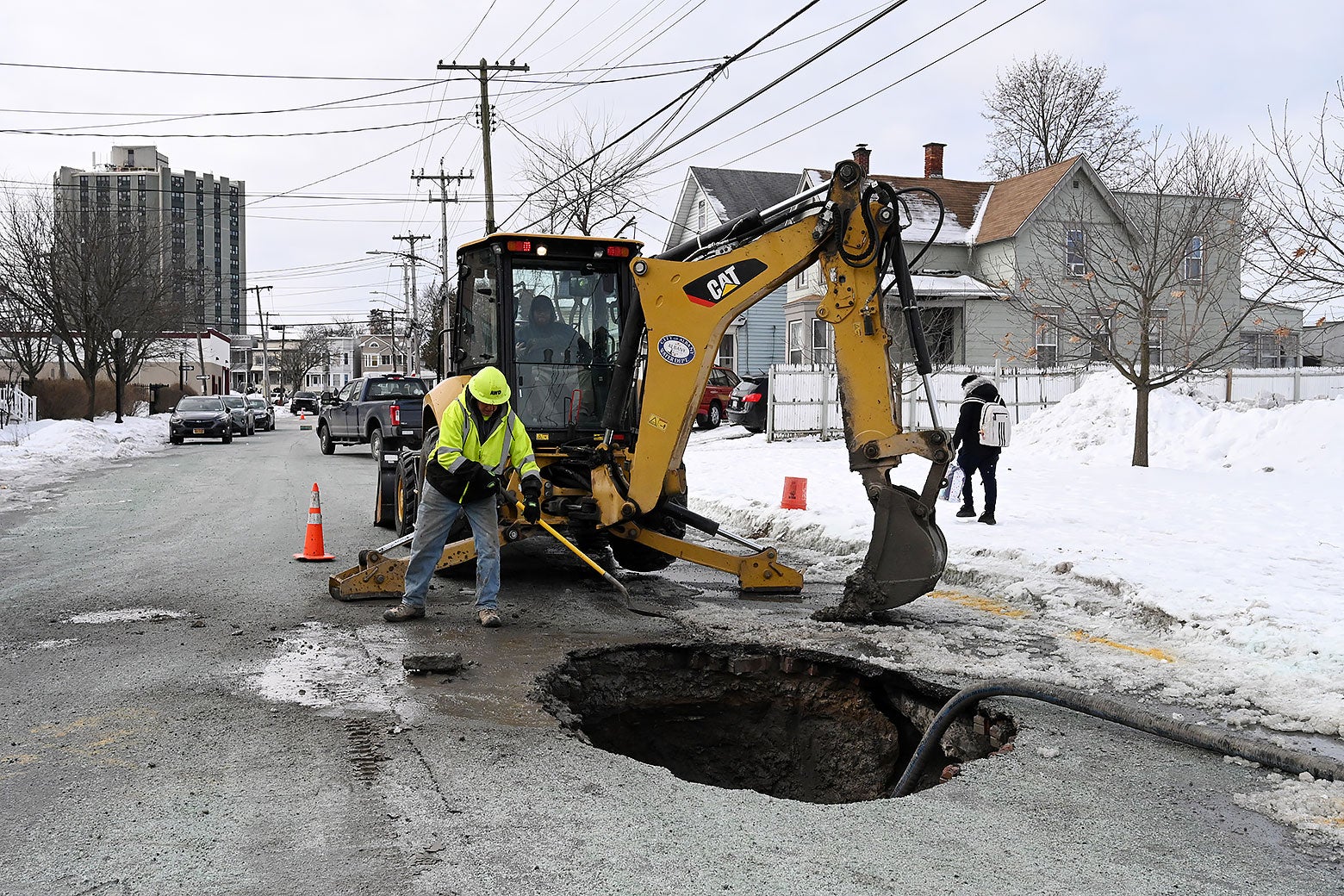
When a sinkhole opens on a roadway, the repair process takes several months. Crews need to test the road’s base, which includes drilling and grouting of smaller holes and voids in the surrounding area. Then they excavate the sinkhole down to the rock base and layer the open area with stone, gravel, and other fill, followed by a concrete slab. Fill and soil are compacted onto the slab and topped with several layers of asphalt.
There’s some hope for mitigating sinkholes, especially in areas of new construction or road reconstruction. For highways, one method Veni notes is “building a net of cables into sections of roads where the risk of collapse is higher to prevent vehicles from falling into a hole during an abrupt collapse.” Dynamic compaction is another approach. A crane lifts and then repeatedly drops a heavy weight onto the ground, a method Venis says will “collapse any soil caves that may be forming and compact the soil to make it resistant to water seeping through it.” And there is hope for earlier detection: Researchers at the University of Cambridge and Penn State are testing how embedded fiber-optic cables can help monitor roadways as a warning system.
A year and a half later, Goodman and her family are still recovering. The hospital bills continue. They are still seeking a lawyer to take on their case. “Mentally we’re still struggling. My fiancé needs glasses. My neck, back, knee constantly hurt.” Goodman is thankful for the help that she’s received, but the sinkhole has completely disrupted her life. And the lives of those she loves.
“My daughter still has a mark across her eyebrow,” Goodman says, “and still tells everyone to be careful of the ditch.”