When he was hauled in for questioning by the British military in the early 1970s, Gerry Adams, then the head of the Irish Republican Army’s Belfast Brigade, had a simple tactic: claim he was not Gerry Adams. As absurd as that denial might have been, it prevented his interrogators from asking anything else, because as long as Adams maintained that he was someone he was not, he could claim not to know any of the things that Gerry Adams knew.
The purest act of resistance was to deny that he existed at all.
Say Nothing, the nine-part FX miniseries adapted from Patrick Radden Keefe’s bestselling book, is built around a similar absence: the disappearance of Jean McConville, a single mother of 10 who was abducted at gunpoint from her Belfast flat in December 1972 and never seen again. The taunts of neighbors who McConville’s children had once considered friends led them to understand that Jean had been identified as a “tout,” a snitch for the British occupying forces. But rather than make a public example of her supposed treachery, the IRA chose to simply have her disappear, leaving her family in an excruciating limbo for what ended up being almost 30 years—until her skeleton was found, in 2003, with a bullet in her skull.
Jean McConville’s story occupies a relatively small slice of Say Nothing, which focuses primarily on the story of sisters Dolours and Marian Price, who spent seven years in prison for their part in a 1973 car-bomb attack that wounded more than 200 Londoners. But as in Keefe’s book, McConville’s disappearance serves as a thematic throughline, an illustration of the harm that sustained conflict can do even to those who escape physical injury.
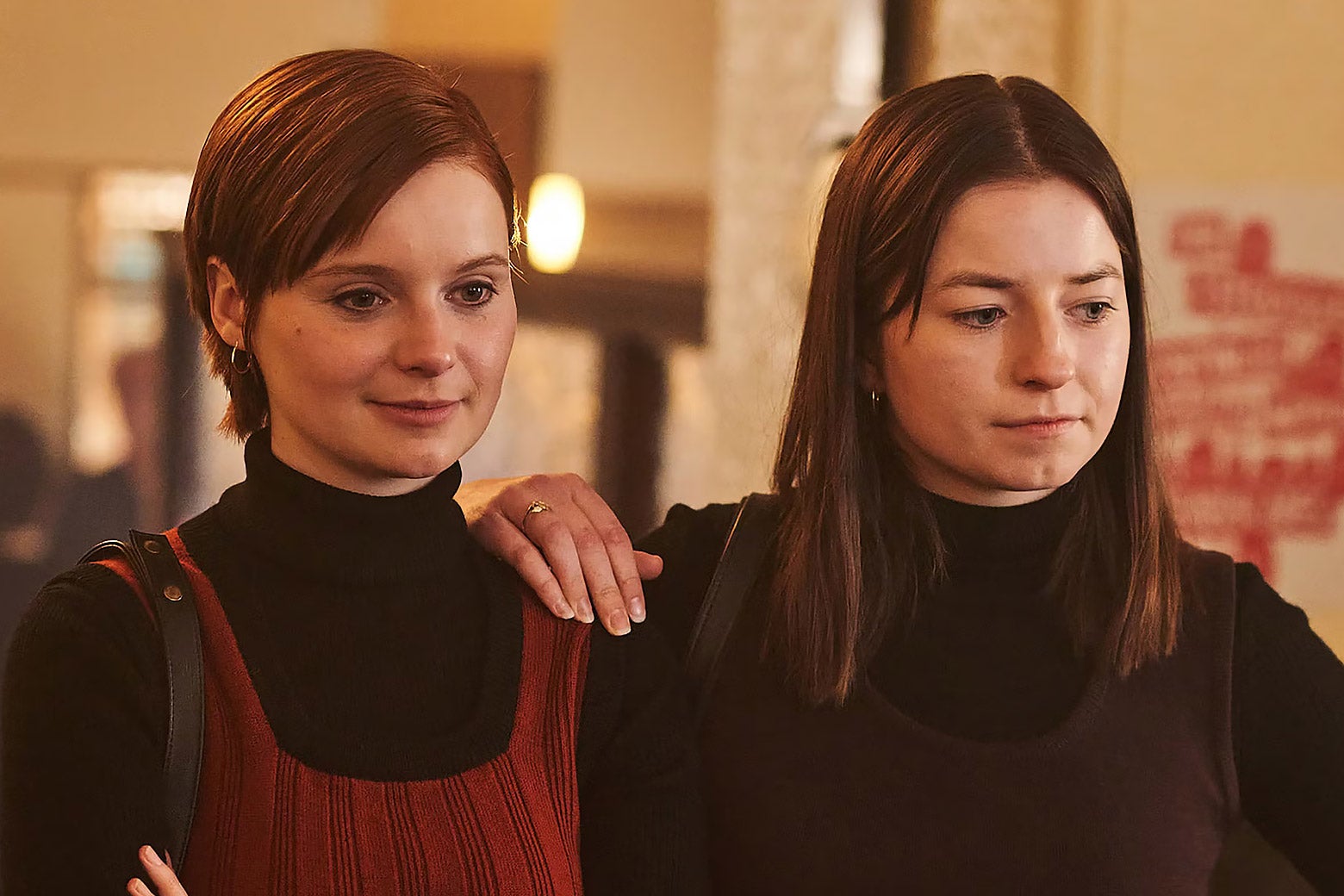
Framed by a series of taped interviews given by an older Dolours (Maxine Peake) and her former comrade in arms Brendan Hughes (Tom Vaughan-Lawlor) in the early 2000s, the series spans more than four decades, roughly overlapping with the period of especially bloody armed conflict known as the Troubles. In 1972, the young Dolours, played by Lola Petticrew, is a champion of nonviolent resistance modeled on the American Civil Rights Movement, despite growing up in a household with a long history of dedication to political violence. She and Marian (Hazel Doupe) take turns caring for their aunt Bridie (Eileen Walsh), whose hands were blown off and eyes blinded while she was handling explosives. But when Dolours takes part in a protest march that is savagely attacked by Protestant loyalists, who come at them with bats and pipes while the police either stand by or join in, she loses her taste for the way of peace and joins Marian in the IRA, now under the local command of a “gawky fucker” named Gerry Adams.
Say Nothing captures the youthful exhilaration of the sisters’ entry into a world where, prior to their arrival, women had traditionally been allowed to hide guns but not to fire them. An IRA bank robbery is scored to Tones on Tail’s infectious dance track “Go!,” and in the following episode, the Price women take down another bank while dressed as nuns, hiding shotguns under their habits. (Reading this scene in Keefe’s book, it seems a miracle it took six years to come to the screen.) Dolours frets about potential blasphemy, but she has no second thoughts about armed robbery, in part because it plays out like a kind of ritual in which everyone knows their part: They draw their guns, the tellers hand over the money, and the IRA replenishes its coffers. But the situation escalates when the British bring in Frank Kitson (Rory Kinnear), a veteran of putting down revolts in the British colonies. He shows one underling a photograph from his time in Kenya, where hooded informants would identify suspected revolutionaries as they passed in the street. If innocent people suspected of being those informants ended up getting executed, as far Kitson is concerned, so much the better. “We’re either getting vital information or we’re driving them to murder their own men,” he explains proudly. “Either way we win.”
Keefe’s book is elegantly structured, interweaving decades of Irish history with personal stories, but in the series, much of that history is gleaned or omitted altogether. An entire episode is devoted to the Price sisters’ 206-day hunger strike—prolonged by force-feeding—demanding that they be treated as political prisoners and not ordinary criminals, but we don’t see anything of the 10 men who starved themselves to death in 1981 after the British government withdrew that status, nor of the schisms within the IRA itself. Showrunner Josh Zetumer wisely avoids placing the Prices, Forrest Gump–style, at the scene of every important political development, but the series wobbles in how much assistance it wants to provide to viewers unfamiliar with the history of the conflict, or of Ireland itself. It’s definitely designed to be more ruminated over than binged, although FX is releasing all nine episodes as a single drop. (It’s hard to imagine someone getting to the end of the hunger strike episode and asking, “One more?”)
Gerry Adams floats in and out over the course of Say Nothing, to the extent that it’s surprising when, in its final few episodes, he emerges as the story’s designated villain. While Dolours, over the years, suffers increasing doubts about the violence she committed and abetted, Adams washes his hands of the IRA, denying his past involvement the way he once denied his own name. Every episode of Say Nothing ends with a disclaimer noting Adams has always denied any affiliation, even though reams of reporting attest to it, as well as any connection to the murder of Jean McConville. As an older Adams, now a respectable public figure as the leader of the political party Sinn Féin, prepares to sit for one TV interview, he looks down at the notecard where he has jotted down an important talking point: “regrettable violence.” On an island where some date the beginning of present injustices back 800 years, perhaps the past is best, or at least most easily, forgotten. But that erasure is its own kind of violence, leaving wounds that can never heal because no one knows where to find them.