This article contains spoilers for Season 2, Episode 6 of The Last of Us.
Is it possible to mount a strong argument against the now-Joel-free version of HBO’s The Last of Us without being mean to Bella Ramsey? The online backlash against the casting of Ramsey to play Ellie, the young teenager who’s immune to the Cordyceps infection that has devastated the world, and who becomes like a daughter to Pedro Pascal’s grizzled survivor Joel, has been mounting for years. You can, if you first perform certain spells to defend against the accumulation of bad karma, tour corners of Reddit that are dedicated entirely to mocking Ramsey’s performance. These people hate the actor’s face, body, and entire existence; for them, the show’s second season has been a bonanza of fodder for cruel memes.
Because of all this, those of us who have found Season 2 to be a real letdown, post-Joel, but are neither disappointed gamers nor mean bullies regarding an actor’s looks, are struggling. Joel dies in Episode 2, as anyone who had played the game (or who, like me, marched right past spoiler warnings to consume TLoU content) knew he would. In this season’s premiere, which aired in April, we see that Joel and Ellie, who were close when we last saw them, have become at odds at some point over the five-year time jump, and are barely speaking. The script drops clues about Ellie’s uncertainty over what happened at the end of Season 1, in Salt Lake City, where Joel murdered a whole bunch of Firefly resistance fighters and a doctor to ensure an unconscious Ellie’s safety, and then lied to her about it. Then, of course, Joel’s death. Then, in Episodes 3, 4, and 5, Ellie has been on the road, bent on revenge, with traveling buddy and lover Dina (Isabela Merced), and the show has—forgive me—fallen apart.
In Episode 6, which aired Sunday night, we learn, through a series of flashbacks set on Ellie’s successive birthdays, how Ellie and Joel spent the past five years of safety in Jackson, Wyoming, where Joel’s brother Tommy (Gabriel Luna) and his partner Maria (Rutina Wesley) have set up a fairly functional little walled community, complete with therapists, bars, and baseball games. There are growing pains in these years: Joel doesn’t get that Ellie is a lesbian, and then, once he understands it, isn’t quite comfortable with it. Joel wants to protect the impulsive Ellie and keep her from hijinks, like climbing an old dinosaur statue, and from more serious danger, like going on patrol. Ellie rehearses questions to Joel about what happened during the extraction from Utah, but doesn’t pose them until the very end of the episode, that final night on the porch. We see that, shortly before the events that resulted in Joel’s murder at the hands of Abby (Kaitlyn Dever), the pseudo-father-daughter pair had finally cleared the air and started to reconcile.
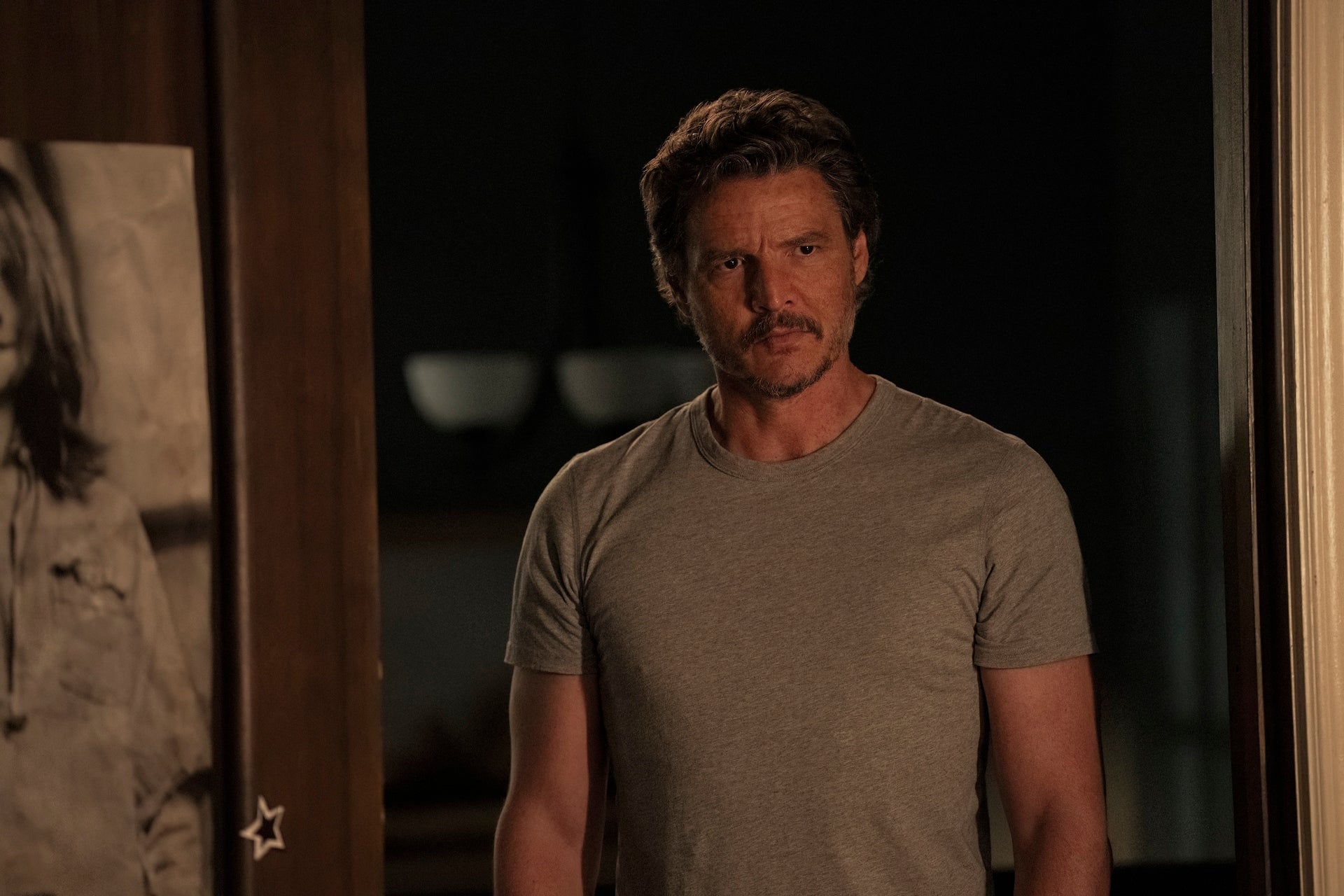
Watching this episode is an awful reminder, for Joel fans, of what we had. This is pure Pascal—the almost lovelorn way he plays his interactions with the teenage Ellie; the light, funny chemistry Pascal and Ramsey shared, that the show has not quite replaced with the Ellie–Dina relationship; the heartbreaking moment at the end of the episode where Joel weeps, after admitting what he did to the Fireflies, “I’ll pay the price, because you’re gonna turn away from me.” (We know, having already seen Episode 2, that he’ll also pay with his pound of flesh.)
But this is not just about loving Pascal, and missing him as an actor. It’s about the loss of something that makes the best postapocalyptic entertainment click: the theme of generational conflict, extrapolated and amplified by circumstance in the way only good science fiction can do. Think about the band of children led by the charismatic Tyler Leander in Station Eleven, and how Tyler copes with the trauma of living through an apocalypse by cultivating a whole new culture in a group of children who don’t remember anything else. Or how the people who adapted Station Eleven from book to television greatly improved the story by putting twentysomething Jeevan and tween Kirsten together in a caregiving situation, delving deep into what the break with “civilization” would mean to people who experienced it at those different ages.
In The Last of Us, as it was before Joel died, it was the relationship between Joel and Ellie that best conveyed that sense of transition between pre- and post-. In Episode 6, the writers show us that they know this. Joel introduces Ellie to music, makes her a guitar. There’s the scene where Joel takes the enraptured Ellie to a science museum for one of her birthdays, puts her into a vine-crusted Apollo lander, and plays her a tape that captured the transmissions between Houston and the ship while it went into space. In a fight between the two of them, Joel tells Ellie she won’t smoke weed and get a tattoo and kiss a girl “in MY house,” and she, who’s lived under the military rule of FEDRA, on the road with him, and now in the communal world of Jackson, fires back: “You don’t own it, they gave it to you. Sorry, to us. You don’t own anything!”
Then there’s the moment when, worried about Ellie, Joel goes to a café in Jackson and sits down with Gail, the therapist played by Catherine O’Hara, who is reading a beautiful vintage copy of the 1949 book Earth Abides, by George R. Stewart. In that novel, Stewart writes about a pandemic that kills most people on Earth. The main character, Ish (modeled on Ishi, the famous last member of the Yahi tribe), watches the survivors and their descendants, including his own children and grandchildren, slowly lose science, history, writing, reading—all those things not immediately relevant to their survival—and build back up superstition and magic. The Earth abides, but human civilization changes, beyond recognition.
By having Gail, an older lady who lived half-before and half-after, read Earth Abides, and having Joel happen upon the scene, the people who make The Last of Us may or may not be purposefully invoking Ish, comparing him to Gail or Joel. (Or maybe they’re being faithful to the game, which apparently contains references to Earth Abides, and another Ish; or maybe that paperback’s cover was just too cool-looking to pass up.) But seeing it helped me understand why the loss of Joel—and, to a lesser extent, the loss of the rest of the older adults in Jackson when Ellie departs on her journey, from Tommy to Gail, to even the unlikely ally Seth (John Burke)—is such a problem for me, a non-game-playing, non-Ramsey-hating viewer of The Last of Us.
Since Joel died, and Ellie left Jackson with Dina, the map of the show’s world has opened up. But because both of our adventurers are now kids, they just do reckless things constantly, with nobody there to tell them not to. The problem is, so far, their choices have resulted in little consequence to themselves. (One correct thing people have pointed out on that cursed subreddit is that Ellie and Dina both look way too clean to have been on the road without showers. They also constantly escape from dangerous situations at the last minute, improbably unscathed.) And their destination of Seattle, embroiled in a war between two factions—the Washington Liberation Front and the Seraphites—is, so far, simply red in tooth and claw; the lack of characterization of these two cultures is enough to make me jones for a meeting of Jackson’s city council. Joel was always a violence guy; ironically enough, the show has become more meaninglessly violent without him.
The problem is not intractable—the show will get a third season, and there’s still time for it to recover its ballast, to develop a few other characters, to give Ellie’s choices new stakes, to explain what the Seraphites believe, to show some building-up and evolution, instead of constant combat and destruction. But for now, The Last of Us is languishing. Joel, we miss you.