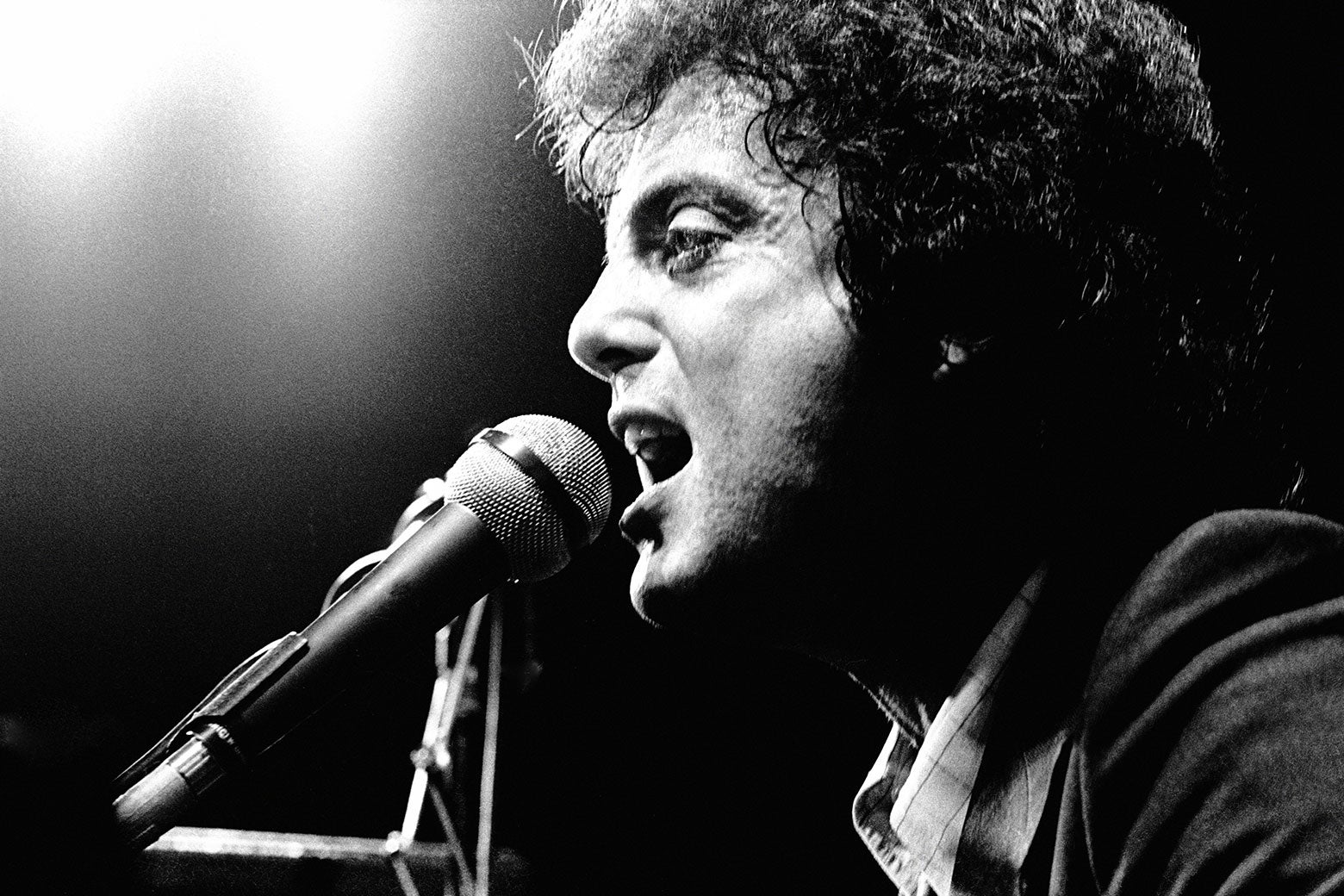
I’ve long believed that the first hugely popular music you realize you hate is in many ways as important a discovery as the first music you realize you love. There’s something crucial and formative about the recognition that an artist whose music is beloved by millions makes your skin crawl, not simply in the realization that said music “isn’t for you,” but in the fierce and irrational conviction that those millions of people are wrong, that sometimes art that’s enormously successful is not, in fact, correspondingly good. As misanthropic as that sounds, it’s a significant milestone in coming to learn that everyone’s taste is (or at least should be) individuated and distinct, and that those distinct tastes are a large part of what makes people attractive, maddening, and above all else interesting to one another.
I don’t remember exactly when I discovered I hated Billy Joel’s music, but it was sometime in middle school, when as a relatively proficient young piano player, I was asked, for the 10th or 100th time, to play “Piano Man.” At that age I only vaguely knew the song and hadn’t learned how to play it, and for reasons I probably couldn’t have articulated, I promptly resolved that I never would. To be clear, I certainly wasn’t some classical-music snob: I would have happily played “November Rain,” or the theme song from Cheers, or even Mötley Crüe’s god-awful “Home Sweet Home,” all of which I knew inside and out. But for some reason, people seemed to only ever ask for “Piano Man.” This was the early 1990s, just a few years removed from Joel’s chart-topping “We Didn’t Start the Fire” (a song I had loved when I was in elementary school but had since come to regard as embarrassing), and roughly around the same time that Joel would have been enjoying yet another massive hit with “The River of Dreams,” a song I immediately recognized as one of the most annoying things I’d ever heard in my life. In this context, I resolved the following about myself: I hated Billy Joel. Thirty-some years later, I can’t say I’ve really budged.
I might therefore seem a strange choice to review Billy Joel: And So It Goes, the new two-part documentary about the singer-songwriter, which premieres Friday at 8 p.m. Eastern on HBO. (Part 2 premieres July 25.) But I sometimes love watching documentaries about artists whose music I don’t otherwise like, particularly when the films are good; they can be edifying and expanding in the best, most unexpected sort of way. I adored the recent Sly Lives!, but I’ve also never needed convincing that Sly Stone was a musical genius. Every time I’ve watched Alison Ellwood’s magisterial History of the Eagles, on the other hand, I find myself impossibly compelled by the musical odyssey of a band that I’ve barely spent a second listening to of my own volition. My friend and Slate colleague Chris Molanphy’s Hit Parade episode about Billy Joel himself is one of my favorite entries in that podcast, deftly exploring the musical-chameleon qualities that have made Joel a shameless opportunist in the eyes of his detractors and a one-stop earworm factory for his fans. Learning more about music I don’t like doesn’t always help me like that music, but it helps me learn more about the world and the tastes of people I share it with.
It thus gives me no pleasure to report that And So It Goes is a disappointingly underwhelming music documentary. Clocking in at nearly five hours, it’s both indefensibly long and exasperatingly short on formal inventiveness. The film’s first part methodically takes us from Joel’s musical upbringing on Long Island to his lean and hungry 1970s years struggling to find commercial success in L.A., before finally breaking through with 1977’s mega-blockbuster LP The Stranger. The film’s second part is more intimate, dealing with Joel’s family, his struggles with drug and alcohol addiction, and his various comebacks, before finally (and predictably) ending with Joel’s monumentally successful decadelong “residency” at Madison Square Garden, which concluded just last year. The film features interviews with many of Joel’s current and former collaborators and band members, as well as musical luminaries ranging from Pink to Bruce Springsteen to Nas.
It might be a loaded compliment to say that And So It Goes is at its best when it’s not actually dealing with Joel’s music. The segments on his childhood and family history are genuinely moving, and the film’s revelation of a pair of suicide attempts in his early 20s is handled carefully and without a whiff of sensationalism. Joel also opens up about his imperfections as a husband and partner, and the discussions of his numerous failed marriages are unusually frank for a film of this kind. (Several of Joel’s exes are interviewed on-screen, including Christie Brinkley, whose marriage to Joel was one of the most fussed-over of the tabloid 1980s.)
Discussions of Joel’s musical output, on the other hand, feel mostly superficial and beset by the sort of hyperbole that’s the coin of the realm for these sorts of docuseries. Paul McCartney gushes that Joel’s “Just the Way You Are” is the one song he most wishes he’d written, an admission that made me wonder if he could have used more time to think. Rhapsodizing about Joel’s 1989 smash LP Storm Front, Garth Brooks asks, in an awestruck whisper, “How many other artists do you know, that late in their career, [that have] an album that fucking moving?” It’s a rhetorical question, but given that Joel was a not-exactly-ancient 40 when he released it, I’m sure many of us can venture at least a few answers.
Snark aside, no one could ever accuse Joel of being a bad musician: He’s an unmistakably talented singer and instrumentalist, and his gifts as a melodist are extraordinary, full stop. And yet, although the propagandistic nature of And So It Goes isn’t unique—it’s practically obligatory for contemporary music docs—in Joel’s case it especially feels like a missed opportunity. During his late 1970s and early ’80s commercial heyday, Joel was routinely savaged by critics, often accused of effectively being a human jukebox stocked with pale facsimiles of other, better music. For Joel’s part, he was notoriously obsessed with these negative reviews, prone to reading them aloud onstage to audiences who would lustily jeer the nefarious critics in absentia.
This is both an important aspect of Joel’s story and a very interesting one, and while And So It Goes does address it, it’s always with an unsatisfying mixture of dismissiveness and defensiveness that follows its subject’s long-held approach. In 1980 Rolling Stone ran an interview with Joel in which he claimed: “Bad reviews don’t bother me. But a lot of these critics are looking for art. … The thing that got me about that was, people who are looking for art in rock & roll or pop are looking for something that either doesn’t or shouldn’t exist there.” Versions of this sentiment are paraphrased a number of times in And So It Goes, which would strike me as deeply cynical were it not for the fact that I don’t for a second buy that Joel actually believes it. Would Billy Joel look any of the fans in the eye who collectively shelled out a reported $266 million for his Madison Square Garden shows and tell them that celebrating his music as art makes them some sort of rube? Of course not! It’s a defensive refrain whose contradictions seem to betray unresolved tensions in what Joel himself feels about his musical legacy, rather than what he thinks other people should.
Indeed, one gets the sense that Joel has never really reconciled his own musical ambitions with the reality of his career, a state of affairs that’s far more perceptively explored in Nick Paumgarten’s brilliant 2014 New Yorker profile of the singer than it is here. (Paumgarten appears as a talking head in And So It Goes.) At one point in the film, Joel mentions that a crucial moment in his musical and professional development was making peace with the realization that he was never going to be Beethoven, a fascinating statement that’s treated here as a taken-for-granted ambition rather than a distinctly odd one for a rock and pop musician to hold. (Joel effectively stopped writing pop songs in the mid-1990s, devoting his quasi-retirement to sporadically penning classical compositions, some of which were collected on the 2001 LP Fantasies & Delusions. He finally returned to the rock ’n’ roll rabble in 2024 with the release of the single “Turn the Lights Back On.”)
All of which brings us back to “Piano Man,” probably Joel’s most beloved song and indisputably one of the most enduring pieces of music of the rock ’n’ roll era. As someone who still reflexively recoils at its opening harmonica riff, I found And So It Goes successful in helping me hear “Piano Man” in new ways. It’s not a bad song—its melody is beautiful, and thematically it has a real richness, an ironic meditation on the darker and less glamorous sides of making a living through musical performance. “Piano Man” is, on some level, a song about a guy who’s been asked to play “Piano Man” too many times, and even though Joel first recorded the song in 1973, when he was still a relative nobody, it’s hard not to wonder if even then he suspected he’d be playing it every night for the rest of his life. It’s a terrific idea for a song, the bones of which recall another L.A.–based piano man of Joel’s vintage, the great Warren Zevon, a master of the sort of ragged and sardonic self-deprecation that the concept might lend itself to.
But “Piano Man” never really gets there. Throughout the song’s duration we’re given almost no interiority for its protagonist: Instead, we’re treated to a litany of characters, all of whom are cataloged as dutifully as “We Didn’t Start the Fire” recites its history and sketched nearly as thinly. Too-clever-by-half wordplay obscures any substantive insight, and purple turns of phrase become howlers when you spend more than a second thinking about them. (“When I wore a younger man’s clothes”?) It’s a song that millions of fans have belted out in the direction of countless piano men and piano women over the years, and none more often than Joel himself, ignoring the song’s latent resentment. And So It Goes did help me hear this alluring subtext more clearly and, in doing so, made me wonder if there is indeed more potentially beneath the surface of Joel and his music. But after a five-hour movie and a 50-plus-year career, what’s potentially beneath the surface still isn’t enough to stop me from just looking elsewhere.