It’s no secret that Richard Linklater is not averse to a bit of dialogue in his films, and Blue Moon is no exception. It’s basically a series of conversations with—and occasional monologues by—Broadway stalwart lyricist Lorenz Hart (Ethan Hawke) on one of the worst nights of his life, when, ensconced in the bar of New York theater hangout Sardi’s, he hides his despair with a burbling stream of sardonic wit, fabulously bitchy gossip, perceptive observations on musicals and musical artists, and occasional moments of naked vulnerability. It recalls Louis Malle’s conversational, restaurant-set My Dinner With André, though in this case, it’s My Drinksfest With Larry (as Hart was known to his friends).
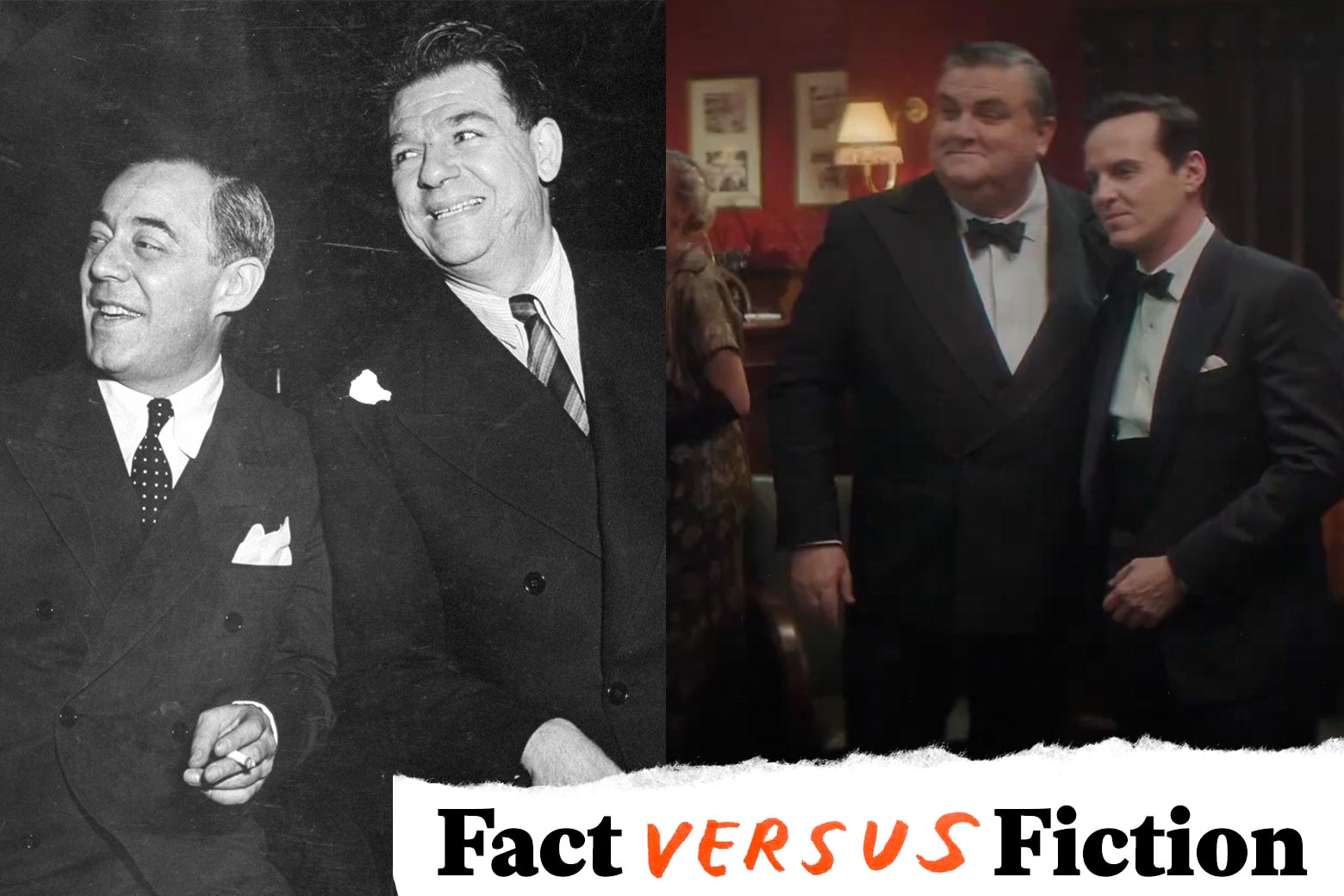
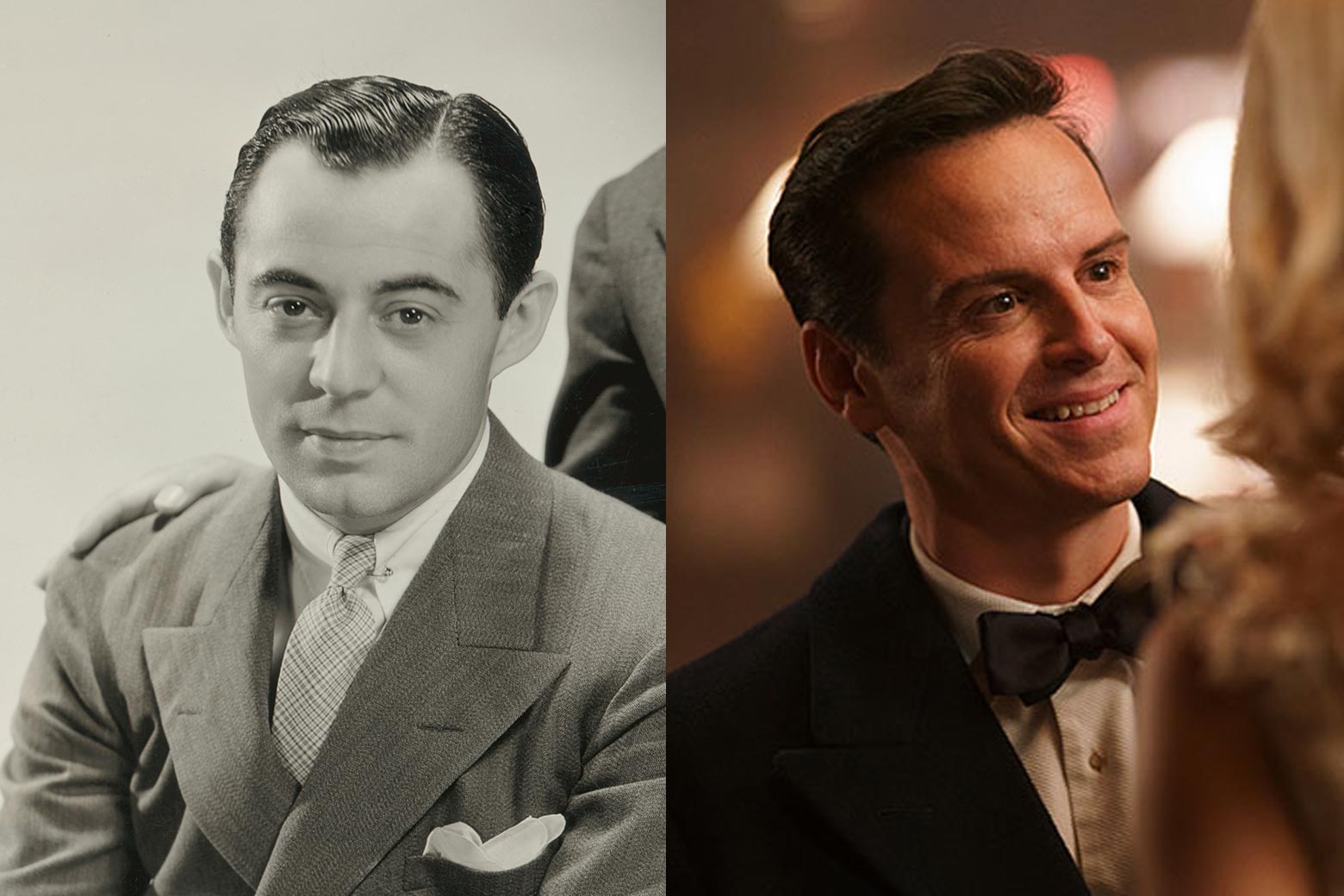
The source of Hart’s immediate unhappiness is that he has just come from the opening night of Oklahoma!, a show that he is smart enough to know will change theater history. He realizes that the first musical written by his former long-term writing partner, composer Richard Rodgers (Andrew Scott), with his new lyricist Oscar Hammerstein II (Simon Delaney), will be Rodgers’ biggest success ever. Even worse, Hart despises the show, calling it “a 14-carat hit and 14-carat piece of shit.”
At first, Hart resists depression and the lure of the bottle by entertaining a small, friendly group consisting of Eddie, Sardi’s seen-it-all bartender (Bobby Cannavale); Morty, a GI and an aspiring composer moonlighting while on leave by providing background piano music at the bar; and a quiet bar patron who turns out to be the legendary New Yorker editor E.B. White (Patrick Kennedy). But then the celebratory postshow crowd blows in for the opening-night party, and Hart has to witness the new team bathing in a flood of congratulations and rave reviews. He himself is greeted by old friends and acquaintances, but it is clear he is yesterday’s man and the spotlight has moved on.
If it sounds as if the film will be of interest primarily to theater kids past and present, it’s certainly true that Glee’s Kurt Hummel would be watching it on repeat. But if you’ve ever heard songs like “My Funny Valentine,” “Bewitched, Bothered and Bewildered,” “I Could Write a Book,” “Isn’t It Romantic?,” “The Lady Is a Tramp,” “There’s a Small Hotel,” “This Can’t Be Love,” “Have You Met Miss Jones?,” or half the Great American Songbook, you know the work of Rodgers and Hart.
In any case, beyond its appeal to theater buffs, the film is also a moving snapshot of the end of a long marriage, in this case a creative marriage. (When it comes to divorces, there are few more tormented than the breakup of successful songwriting teams—think of Lennon and McCartney or Oasis’ battling Gallagher brothers.) We look at what’s fact and what’s fiction in Blue Moon.
Was Larry in Love With Elizabeth Weiland?
Before the party arrives, Larry tells Eddie and Morty about a 20-year-old college student and “poet” he is in love with, calling her “ethereal.” This raises some eyebrows, as Larry is 47, and … let’s just say he makes RuPaul look a bit butch. The down-to-earth Eddie asks the obvious question, but Larry, who describes himself as an “ambisexual,” goes into a long rhapsody about a weekend he and Elizabeth spent together just talking while he admired the beauty of her clavicle, claiming that his feelings for her are “beyond sex.” When the willowy Elizabeth (Margaret Qualley) finally shows up, she accepts Larry’s adoration as her due and is interested primarily in whom he can introduce her to, largely incurious about his welfare. He showers compliments on her and quizzes her about her love life, encouraging her to confide in him about her sexual and romantic misadventures with college boys.
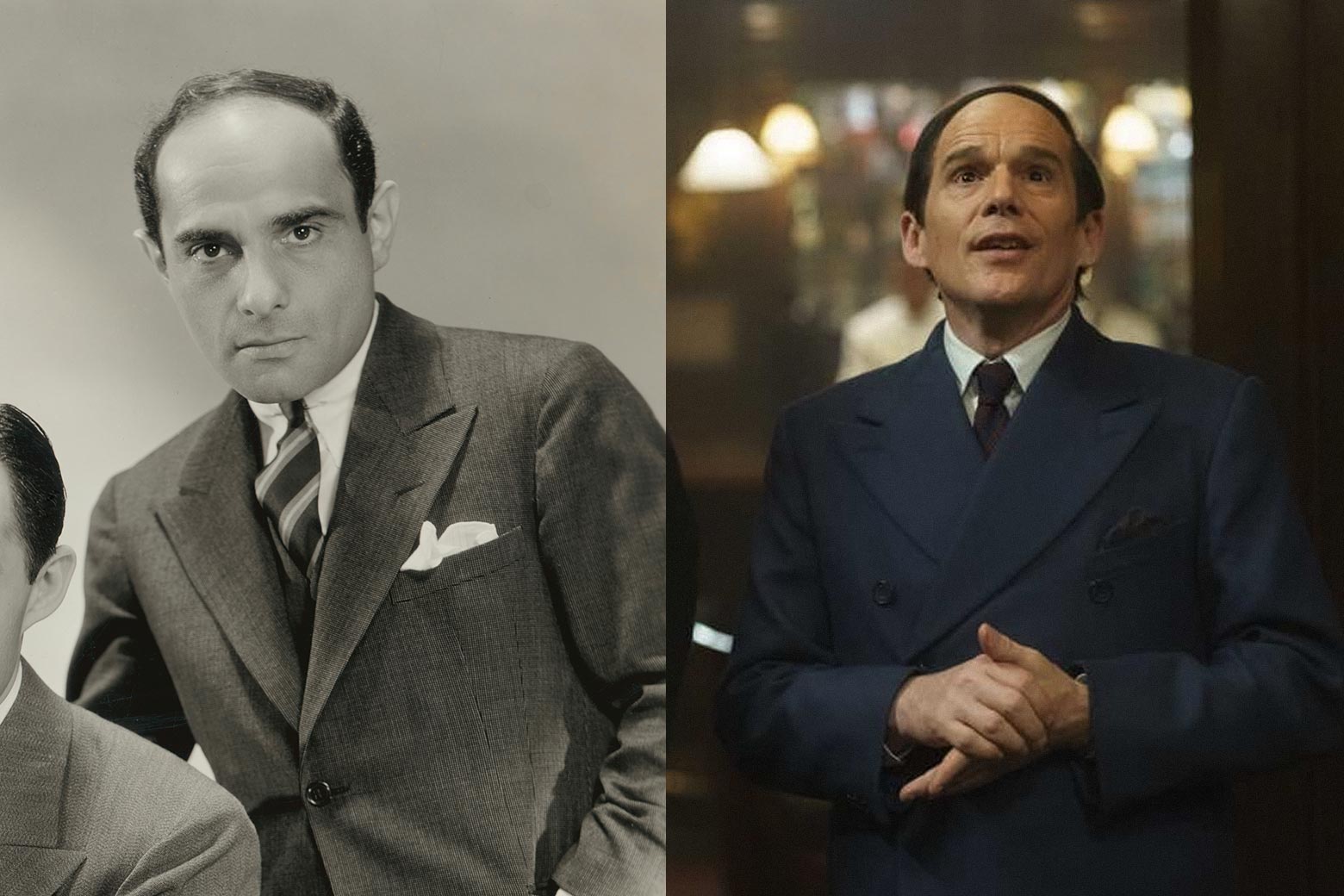
Hart’s homosexuality was an open secret in New York showbiz circles—Richard Rodgers’ daughter Mary is quoted in the composer’s ghostwritten autobiography Musical Stages as saying, “Although I don’t think the public was aware of Larry’s sexual preferences … it was pretty generally accepted by all who knew him that he was a homosexual”—but, like many of his gay contemporaries, he was deeply closeted and kept his private affairs private, never admitting his orientation. He was more public about his crushes on elegant, intelligent women and in fact proposed to three of them.
One was a story editor for Columbia Pictures who turned him down because of his heavy drinking. Another was an opera singer, who also said no. The third was his dear friend Vivienne Segal, one of the best interpreters of his songs, who starred in the original Pal Joey as Vera, a rich older woman who falls in love with a small-time con man and hustler. He asked Segal more than once, and she turned him down each time, ostensibly because her divorce had put her off marriage in general, but in reality because she must have realized that the man who wrote the verse she’d sung in “Bewitched, Bothered and Bewildered” that goes “I’ll sing to him, each spring to him / And worship the trousers that cling to him” and who had never so much as kissed her might not be the best prospect. (She was also aware of Hart’s alcoholism.)
It’s possible Hart made these unlikely proposals because he had in mind a sexless but committed and caring marriage, like his friend Cole Porter (who was much more unapologetic about his homosexuality) had with the millionairess Linda Lee Thomas. Or he may have wanted to convince his mother, with whom he lived devotedly most of his life, that he was “not that way” and would produce grandchildren.
Or, believing he was ugly and unlovable (Segal thought “My Funny Valentine,” with lyrics like “Your looks are laughable, unphotographable / But you’re my favorite work of art,” was an expression of how Hart wanted someone to feel about him), he might have been most comfortable with relationships that would be forever unobtainable and never face the test of reality, an attitude that informs one of his most self-revealing songs, “Glad to Be Unhappy.” His friend and fellow lyricist Alan Jay Lerner said as much, recalling that this master evoker of the joys and sorrows of love was someone he “came to know well enough to love him, feel the pain of his loneliness, and silently weep for a man who seemed deprived of the happiness his lyrical gifts gave to others.”
So while it is not out of the question that Hart would have a giant unrequited crush on a well-connected, sophisticated young woman half his age, it would not have been Elizabeth Weiland, because it seems she is an invention on the part of screenwriter Robert Kaplow, who has said the character was inspired by some correspondence between Hart and a young woman named Elizabeth that he discovered during his research.
Several partygoers mention that Elizabeth’s mother Theresa is active in the Theatre Guild (the producing organization behind many notable Broadway original productions, including Mourning Becomes Electra, The Iceman Cometh, Porgy and Bess, and The Philadelphia Story). While there was no Theresa Weiland connected to the Theatre Guild, one of its co-founders was Theresa Helburn, who had started out as a poet and short story writer.
In fact, it was Helburn who came up with the idea of turning an earlier guild production called Green Grow the Lilacs, a play about cowboys, into a musical about cowboys after seeing a 1940 summer-stock production with folk dances choreographed by Gene Kelly.
She enlisted Rodgers, with whom the guild had worked before, but when Hart said he wasn’t interested, Rodgers approached Hammerstein, who himself had considered turning the play into a musical but couldn’t persuade his usual writing partner, Jerome Kern, to become involved.
Helburn never had any children, so it seems Elizabeth may have been based on her younger self embodied in a woman of the next generation. In her autobiography, Helburn wrote of that opening night: “I have always believed that it was seeing the play [Oklahoma!] on opening night that broke his heart and hastened his death. Poor Larry, so warm and exuberant and sweet in spite of his underlying sadness. Larry, who was never quite in tune with life.”
Did a Young Stephen Sondheim Really Come to the Sardi’s Party?
Surrounded by well-wishers, Oscar Hammerstein II turns up at the party with a stone-faced, precocious young teenager in a tuxedo whom he calls “Stevie” and introduces as his neighbor. Little Stevie turns out to be a formidable musical theater nerd, with facts about any given show’s number of performances and venue at his fingertips. Larry makes the mistake of asking Little Stevie what the child thinks of his work. “Funny,” Stevie replies judiciously, “but sloppy,” at which point Hammerstein mutters that Stevie is tired and hustles him away.
Future composer/lyricist Stephen Sondheim moved with his mother to Bucks County, Pennsylvania, when he was 10. He enrolled at a Quaker school, where he became friends with Oscar Hammerstein II’s son James, who lived nearby. Sondheim lost contact with his father after his parents’ divorce, and Hammerstein, who had taken the boy under his wing, became a sort of surrogate father. However, it wasn’t until Sondheim was 15 that Hammerstein started mentoring him as a songwriter, after Sondheim brought him a score he’d written for a school play. The older man said that it wasn’t very good but offered to show him how to improve it, a creative relationship that continued until Hammerstein’s death.
Perhaps out of loyalty to his mentor, Sondheim was known to be somewhat dismissive of Hart. In his 2010 book Finishing The Hat, Sondheim called Hart “the laziest of the pre-eminent lyricists. ” Ironically, Sondheim’s own sensibility—metropolitan, ironic, melancholy—is much closer to Hart’s than Hammerstein’s. Like Hart, his appeal was never to the heartland, while Rodgers and Hammerstein’s true successors are the uplifting likes of Wicked or The Greatest Showman—productions that tourists flock to when they want to see a Broadway show.
So while it’s possible Hammerstein drove up from Pennsylvania with his son’s friend, then 13, to take him to the opening night of Oklahoma! and a party at Sardi’s, it’s unlikely. But adherence to reality would have deprived the movie of a hilarious scene.
Did U.S. Soldiers Change the Words to “Over There”?
After White recalls a recent photo in Life magazine that showed soldiers skipping silver dollars over the water instead of stones before the battle of Guadalcanal, quietly noting that this was because they knew they weren’t coming back, he, Larry, and Morty get into a discussion of patriotic songs and George M. Cohan. After a rousing rendition of Cohan’s “Over There,” Larry, oblivious to the feelings of Morty, a serving soldier, mordantly recalls that what the U.S. troops really sang instead of “And we won’t come back until it’s over over there” was “And we won’t come back, we’ll be buried over there.”
This is true. Cohan composed “Over There” the day after America entered World War I. It was a big pro-war propaganda success, selling 2 million copies of sheet music and 1 million recordings by the time the war was over. But once the soldiers were actually in the conflict, they came up with an alternative to the upbeat ending. The revised version was featured in the anti-war revisionist revue Oh! What a Lovely War.
Was Larry Really That Short?
In almost every shot, Larry appears to be shorter than anyone he’s standing next to: Eddie, Elizabeth, White, Hammerstein, Rodgers, the cloakroom attendant—in fact, everyone except Little Stevie.
This is true. Hart is generally thought to have been about 4’10”, and was acutely conscious of that fact, his short stature and large head contributing to his poor self-image. As shown in the film, his partner Rodgers tried to support him by getting him to moderate his drinking and lead a more regular life that involved getting up before noon and not hitting the bars until closing time. (There was some self-interest here, as Rodgers, who had a prodigious work ethic and output, was frustrated by his collaborator’s absenteeism.) He also bolstered Hart’s self-esteem by praising his talent.
But another side of Rodgers led him to put down Hart by calling him “the shrimp” while he was alive and “that little fag” after the lyricist’s death. Similarly, in the film, Hammerstein is gracious to his predecessor, telling him, “You liberated us all.” However, in his foreword to a 1951 collection of the team’s sheet music called The Rodgers and Hart Song Book, recalling a Columbia University student variety show that all three songwriters worked on when they attended college together, Hammerstein somewhat less graciously compared Hart as a performer to “an electrified gnome.” Lerner, more sympathetically, called him “a diminutive giant.”
The true mystery is how the lanky, WASPy Hawke was made to look so short throughout the film. One can only assume that everyone else was standing on a box or he was standing in a hole.
Correction, Oct. 18, 2025: This article originally misidentified Rodgers’ daughter Mary as his wife. Additionally, the piece mischaracterized a quote of Sondheim’s as being about Hart when, in fact, it was referring to Hammerstein. It has been removed and replaced.