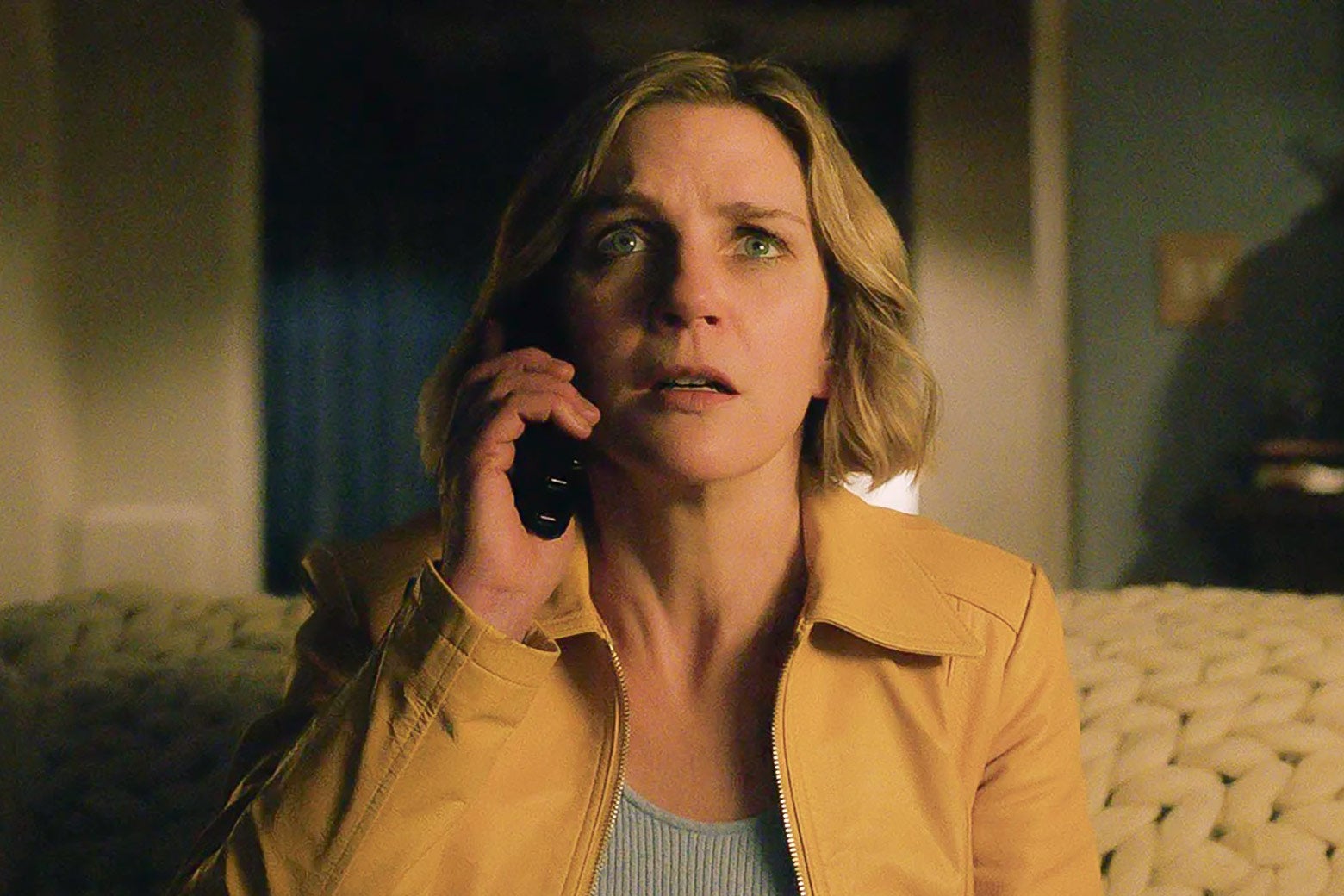
Not every new TV series starts with such a clear-cut sense of purpose that you can see precisely what idea got the network on board, but in the case of Pluribus, it boils down to a sentence: What if the body snatchers were right?
To be sure, it could have been any one of a handful of sentences, including “Vince Gilligan has a new idea” and “Rhea Seehorn is playing the lead.” But the show, whose first two episodes drop on Apple TV+ this Friday, has more to offer than the tantalizing prospect of reuniting the creator of Breaking Bad with the breakout co-star of Better Call Saul—namely that it brings Gilligan, who made his name with the paranormal sci-fi of The X-Files, back to the genre for the first time in more than 20 years.
Although she’s the author of a string of successful romantasy novels, Seehorn’s Carol Sturka isn’t wild about genre fiction herself. As she and her agent, Helen (Miriam Shor), head back to the hotel after a book signing full of rabid fans and inane questions, their driver apologetically asks if he should know who Carol is. “Depends,” she deadpans. “You a big fan of mindless crap?”
Carol isn’t indifferent to success. As they travel through an airport, she gives Helen a subtle nod in the direction of the nearest bookstore, and Helen obligingly sneaks in and shifts the fat hardcovers of Carol’s latest novel, The Wings of Wycaro, to the top shelf, discreetly relocating a few Diana Gabaldon tomes to floor level. But Carol has clearly come to regard both her fans and her own books with contempt, a distraction from the serious writing she keeps meaning to attempt. Helen is more diplomatic and more practical. As the two share an end-of-tour drink, she muses, “I figure, you make even one person happy, maybe that’s not art—but it’s something.”
Happiness, unbeknownst to either of them, is about to stop being an issue. As the pair down their drinks, a virus of alien origin is spreading across the world, infecting all but a tiny handful of humans. But this virus doesn’t kill people or turn them into zombies. It brings them together. More specifically, it fuses every human on the planet into one collective consciousness—every human, that is, except Carol, and about a dozen others. The transition isn’t bloodless; in fact, as later installments of Pluribus’ nine-episode first season make clear, it comes at a terrible cost. But it happens almost instantaneously. One moment, Carol is surrounded by twitching bodies as everyone around her succumbs at the same time to the virus’s effects. The next, they’re speaking in eerie, monotonous unison, telling her, “We just want to help, Carol.”
The members of this hive mind, whom Carol eventually takes to calling “the Others,” are uniformly sanguine about their transformation. They’re uniform about everything, because while their memories and emotions are still accessible—they can, for example, call up the consciousness of an assembly-line worker to reassure Carol that the specific bottle of water she’s about to drink left the plant without incident—they can’t be separated from the whole, any more than you can retrieve a specific drop of water from the ocean. The people they once were are gone. “Nobody’s in charge or everybody’s in charge,” one emissary explains to her. “Really, there’s no such thing anymore.”
For the unlucky individuals who remain, it’s as if humanity has died—not just the people, but the concept itself. The Others are eager to put Carol at ease, almost pathologically obsessed with meeting whatever needs or desires she has. (That dessert you loved on vacation 12 years ago? The collective knowledge and skill of every chef on earth is on it.) Her negative emotions cause the collective to short-circuit, like someone yelling into a stethoscope. But Carol’s discontent seems to bother them in other ways too. In a world where everyone agrees, she is a lone dissenter, an I severed from the us. And because she is set apart, Carol feels something that the Others can longer comprehend: grief. Helen, we gradually learn, wasn’t just Carol’s agent; she was her partner, the inspiration for the dashing corsair the heroine of Carol’s novels swoons for—at least until Carol got cold feet and turned the character into a man. And now that person is gone. The hive has all of Helen’s thoughts. It knows, one emissary assures Carol, just how much Helen loved her. But it can’t know how much Carol loved her back, or what it feels like to be so suddenly and thoroughly alone.
Over the course of Pluribus’ first season, Seehorn gets to express a far wider range of emotions than she did as Better Call Saul’s buttoned-up Kim Wexler. As a self-loathing artist with a history of addiction issues, Carol is all over the map. (In addition to freeing her from Kim’s habitual ponytail, the show also liberates Seehorn from the strictures of basic cable, which means she gets to drop f-bombs aplenty—reason enough to watch, honestly.) But one of the season’s saddest moments is also one of the quietest. As Carol and Helen stand outside a bar, scrolling through social media reactions to the new novel, Helen suggests they answer a few of Carol’s readers’ questions. Who, for example, was the model for the books’ dark and mysterious hero? Helen wryly suggests that Carol tell the truth—if she’s so sick of success, what better way to free herself from her fandom than by abruptly coming out of the closet? But Carol tells Helen to simply answer “George Clooney,” because “it’s safer.”
There’s a lot of quiet in Pluribus—sometimes, frankly, too much. Because the Others don’t need to converse and Carol is often alone, long stretches, occasionally whole episodes, pass without much in the way of dialogue, and without the periodic interruption of commercial breaks, there’s nothing holding Gilligan back from indulging his love of process sequences and arty cold opens. It was thrilling when Better Call Saul’s Mike Ehrmantraut spent three minutes disassembling a car in the search for a hidden tracking device, far less so when a character we’ve never seen before spends eight getting a cargo plane off the ground. Nearly every episode features some such distended passage, stretching onward toward infinity. Who knew that the end of life as we know it could be such a drag?
That Pluribus’ first episode finds the initial group of Others spreading the virus by mass-mailing petri dishes full of alien RNA leaves little doubt that the show was forged in the fires of COVID-19, but like the original Invasion of the Body Snatchers, its politics are paranoid, not partisan. Carol could be a holdout anti-vaxxer watching her neighbors swallow deep-state propaganda and get shot up with 5G chips or an anti-fascist incredulously watching people go about their normal lives as the country falls apart. But either way, she feels as if she’s the alien. Happiness is right in front of her, and all she has to do is give up thinking for herself.