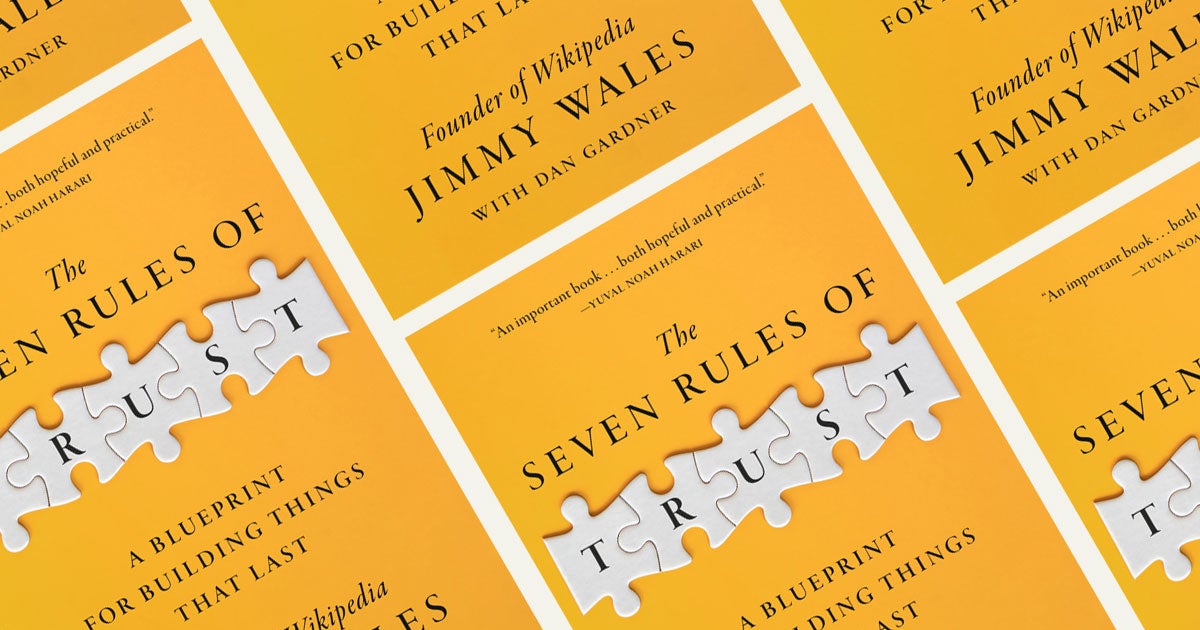
Gabfest Reads is a monthly series from the hosts of Slate’s Political Gabfest podcast. This month, David Plotz talks with Jimmy Wales, co-founder of Wikipedia and author of The Seven Rules of Trust: A Blueprint for Building Things That Last. They discuss how purpose, civility, and trust can power collaboration at scale — and how those same principles can help rebuild the institutions that connect us.
This partial transcript has been edited and condensed for clarity.
David Plotz: Your book came out interestingly at a time when Wikipedia faces arguably the most significant challenges to its authority since its early days. Your co-founder who was at Wikipedia for a minute in the earliest part of Wikipedia, has urged a “reformation,” abolishing what he calls blacklists of sight of sources. You have a lot of conservatives—Ted Cruz has been attacking Wikipedia for its ideological bias; Elon Musk, of course, has started Grokipedia, which is his own AI-powered alternative to Wikipedia—how does Wikipedia maintain trust with a concerted ideological assault being leveled against it?
Jimmy Wales: Yeah, no, I think it is a real challenge. And my first hat tip to Elon is, thanks for helping my book sell more, because I think it’s keeping me in the news, and people are very interested in this whole discussion and debate.
First of all, I think one of the things that we always have to do when we get criticism or proposals for reform or change or whatever, is take it seriously. To say, “Okay, hold on. Is this right?” and if it is right, because there’s something we should fix and change and so forth. So the idea that we have blacklists or should eliminate that, it’s a very confused objection. Yes, there are some sites that you cannot post on Wikipedia because they have malware, SPAM, et cetera. We’re not going to change that. There are some sites that we regard as very poor sources because they are very poor sources, and you should always try and find a better source.
There was one think tank that put out a thing saying, “Well, now Wikipedia has banned all conservative sources.” And it’s like, well, okay, if you think the Wall Street Journal is a left-wing communist mag, then yeah, maybe so. But actually, most people who look at the list of sources and the list of cautions around different sources would say, “Oh, actually, this isn’t terrible.”
Could it be improved? Yeah. Are there ways, elements on the list that we need to look at? But also, keep in mind the list is only a guideline. It’s advice to editors that summarize past discussions and things like this. And for certain things, like if we think about our entries on medical topics, it’s like, “okay, well why do we treat the New England Journal of Medicine with more respect than we treat a social media influencer?” Well, we’re not apologizing for that, that’s actually meaningful. Tabloid newspapers who are touting the latest cancer scare or whatever is not really as good as more peer-reviewed, thoughtful research. I think that sort of thing, broadly, I think we’re in the right place. Details? Yeah, let’s have a discussion. What are some things we should change?
David Plotz: But can Wikipedia survive? If all information is somehow now coded in a partisan fashion. If there’s no consensus that there can be something fair and trustworthy, can Wikipedia survive?
Jimmy Wales: Well, I mean, clearly we can survive. We’ve got a budget and we’ve got reserves and we’ve got community members, and we’ll just carry on doing what we do because we’re Wikipedians and it’s our hobby and we love it, so we can survive. I do think the broader question is still valid. If we say, “Okay, what does it mean if our information ecosystem is broadly becoming more partisan and politicized in ways that are unfortunate?” And that we have what ended up being political signaling around issues that have nothing to do with politics.
My favorite example here is masks and masking. The actual science and the question of masks is, in a hospital setting, healthcare-trained healthcare professionals wearing an appropriate N95 mask, there’s clear evidence that reduces transmission. So people on the subway wearing a cloth, random mask, half-assedly, in a public health setting, was it really helpful? The evidence is not as clear. This is not a political topic. This is just like, “Oh, okay.”
But it became politicized partly because first we were told, “Don’t wear a mask. Don’t bother about masks,” because they didn’t trust the public not to panic and go out and buy them.
And then a few months later, it’s like, “No, everybody has to wear a mask, mandatory everywhere.” That reduced trust, and then it became politicized. It was a nice flag on your face—or not—to show that you either were of the left or of the right on these issues.
And I’m like, “Yeah, let’s all, everybody please relax a notch or two!” Not everything is political.