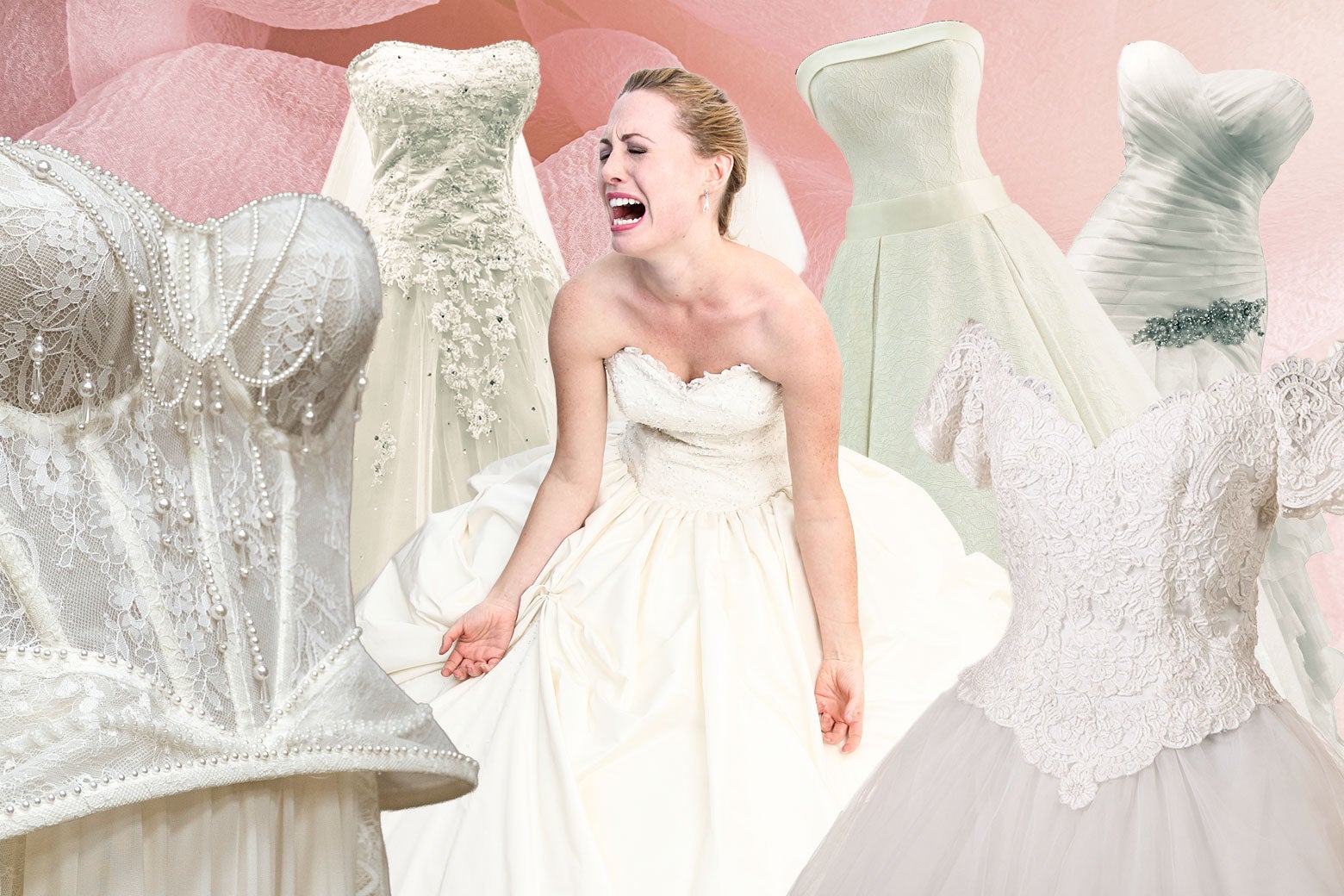
Courtney didn’t plan on purchasing 13 wedding dresses.
According to a March 13 TikTok video that has garnered more than 1 million views, she got engaged in October of 2023. Her wedding date was 20 months later, in June of 2025. Plenty of time to find a wedding dress, she thought. What followed was a multiyear stampede of sequins, stitching, and stress as Courtney bought one dress—then another. And another.
In the end, Courtney spent more than $3,500 in pursuit of The One. She was eventually wed in a $130 dress she ordered online. Now, she’s left with 12 rejected dresses—most of them custom-made, and therefore nonreturnable—in various states of resale limbo.
“How does this even happen,” wrote one commenter. Another sagely advised that Courtney “start journaling.” Personally, I’m reserving judgment. Had I consumed a Red Bull at the right point in my menstrual cycle, I could have ended up just like her.
I got married in October of 2025. Eight months prior, I left a Manhattan bridal showroom having just shelled out two grand for a strapless dress that made me look like Jessica Rabbit taking her First Communion. I took the subway home, ate a burrito bowl, and watched the Eagles win the Super Bowl—all while nursing a profound sense of discomfort burbling in my gut. I’d found a bitchin’ dress. I was engaged to marry the love of my life. Why did I feel completely insane?
Like Courtney, I’d been smacked with a wave of “dress regret,” a term that, as far as I can tell, emerged from the rugged hinterlands of wedding-planning Reddit (”Weddit,” to those in the know). Dress regret does not discriminate—it covers all levels of uncertainty with one’s chosen bridal frock, from the mild (wondering vaguely if you made the right choice) to the extreme (spending thousands of dollars on 12 dresses that you ultimately will not wear).
According to bridal stylist Alysia Cole, it’s a natural consequence of wedding planning in the social media age. “It is so easy at any stage of the wedding planning process to open your phone and immediately be inundated with a million other dresses,” Cole told me. “The newest trends, people talking about what’s in and what’s out—it is so easy to immediately put into a mindset of comparison.” That’s especially true given the time-sensitive nature of wedding dress shopping, which requires brides to select a dress months in advance. On that schedule, you have a long time—multiple trend cycles—to change your mind.
And, unlike other wedding-related decisions—food, decor, music—a dress goes on your body. A body that is already being directly targeted by the bridal-industrial social media gauntlet: the endless ads, the snappy reels from influencers who make their living peddling Skinny Arm workouts and supplements. Compared with table linens, there’s much more room for existential dread.
Even I, a quasi-tomboyish, tater tot–shaped thirtysomething several decades into a self-acceptance journey, fell prey to bridal self-loathing. Wedding planning turned me into a Death Becomes Her–style caricature of vanity. I got a lash lift, which made my eyelashes look like pubes. I got a second lash lift to fix the pubes. I went all in on Russian cuticle extermination until my fingernails were too brittle to open a can of cat food.
And the dresses. Oh, the dresses. As soon as the Instagram overlords got a whiff of my wedding planning, I was blasted with bridal content. My feed served me dress after dress, overwhelming my senses with necklines designed to ensnare the imagination. I was paralyzed with possibility. With every dress designer in the world at your fingertips via social media, how do you choose?
In the end, my budget chose for me. I couldn’t afford the Danielle Frankel dress that, pre-tax, cost thousands more than our two-week honeymoon to Japan. I also couldn’t fit my midsize frame into the unforgiving silhouettes hand-sewn by the obscure Welsh designer. And I certainly couldn’t haul ass to Canada to try the brand my algorithm continues to feed me today, six months after my wedding.
So I bought a dress. It was a beautiful dress. It fit me nicely and did not cost a million dollars. I got married in the dress. I had the time of my life in the dress. But as wedding dresses continued to dance through my feed in the weeks leading up to—and following—my wedding, I had a nagging question in the back of my mind. What if I’d somehow missed out on the One True Dress? What if I’d kept shopping? What if I had hauled ass to Canada?
Social media is awash with women who, like Courtney and me, were rational people prior to wedding dress shopping. In search of reassurance, many brides turn to the Wedding Dress subreddit. “I have dress regret and I feel sick,” wrote one bride. “Help! I’m still feeling regret about my dress,” wrote a bride who initially purchased a dress almost two years before her wedding date. “I’ve literally been questioning my decision for a year now,” she wrote in the post. Two months later, an update: “I ended up getting a new dress and I’m so happy.”
That bride represents a contingent of women who, like Courtney, give in to the impulse to “cheat” on their original gown. For some of them, that means attempting to sell the first gown. “I had initially planned a wedding dress shopping trip with my girlfriends at a highly recommended shop,” U.K.-based brand strategist Abbianca Nassar told me. “At the last minute, we heard about a shop that was closing down, with dresses priced between 300 and 950 pounds—a real bargain. While the dresses were nice, I didn’t feel anything special.” Eventually, she says, she “settled on one just to stop wasting time.”
The dress was nonrefundable. Still, out of curiosity, she visited another shop and tried on one last dress. “I knew immediately it was the one,” she said. “It was more expensive than we could afford, but a close friend saw how much I loved it and paid for it, and we reimbursed her over the next three months.” She’s still trying to sell that first dress.
I never felt that magic “Say Yes to the Dress” moment—the spine-tingling, tear-jerking sensation when you find the dress you’re destined to wear. Neither did Fallen Halabou, who also found herself seeking reassurance on Weddit after selecting a gown different from the one she’d visualized when she started wedding planning. She told me: “I am a very decisive person—I know exactly what I want, and if I don’t know what I want, then I won’t make a decision. But I’ve noticed through this wedding planning process, I’ve second-guessed every decision I’ve made.” Like me, Halabou ultimately decided to stick with her original dress. Like me, she’s not sure that magic moment exists. “I think it really is about when you put that dress on and your shoulders are relaxed,” she said.
Cole, the bridal stylist, confirms that the magic moment is rare. It’s also unnecessary. “Don’t put that pressure on yourself,” she said. “If you feel good in a dress—it’s comfortable, it matches the vibe, it’s something you can get in time and in your budget, you found a dress.”
She encourages brides to relieve some pressure by ditching the idea that a wedding dress should be timeless: a perfect encapsulation of the past, present, and future You. “I think letting your wedding be a snapshot is one of the greatest gifts you can give yourself,” she said. “It really is a slice of a moment; it’s a beginning. It doesn’t have to represent who you are always. You probably want to evolve as a human.”
The idea of the One True Bridal Gown isn’t just fantastical—it’s also very modern, and very Western, said Linda Pisano, a renowned costume designer and the head of Indiana University’s MFA program in Costume Design. Pisano explained that, for most of modern history, only the ultrawealthy would dare dream of a single-wear wedding gown. “Into the 20th century, most people would have just worn their best dress—or, if they had a wedding dress made, it would then become their best dress,” she told me. The white gown didn’t even take the bridal stage until Queen Victoria’s 1840 nuptials; even then, Pisano said, “maybe 2 to 5 percent of the population” actually wore white bridal gowns until roughly the middle of the 20th century. That’s when middle-class brides began mimicking the elite nuptials showcased in Brides magazine, which launched in 1934.
“It’s really unheard of, this consumption, this selection that we have,” Pisano continued. “It’s unique, I would say, to the 21st century. It’s not that there wasn’t selection—we’ve had David’s Bridal for a long time, and the ‘80s was all about consumption. But, in my assessment of history, it really is the influencers and the reality-TV shows that make it a very dramatic thing.”
Wedding influencers and reality-TV dynasties perpetuate the idea that if you don’t get your wedding dress exactly right, you’ll regret it for the rest of your life. That this single dress must represent every facet of your personhood, your next chapter, your relationship with your new spouse. That you’ll never do this again, so you better nail it.
That last bit is true. I’ll likely never buy a wedding dress again. If my spouse dies or divorces me, I will simply sequester myself in a Grey Gardens–style Victorian with 7 million horrible chihuahuas and wildly swinging upper arms that I will have to tuck into a cummerbund. But the idea that brides must leave no stone unturned? That we must embark on a soul-searching mission while also cramming ourselves into a fabric tube that we’ll ultimately wear for, like, five hours? That’s a 13-dress disaster waiting to happen.