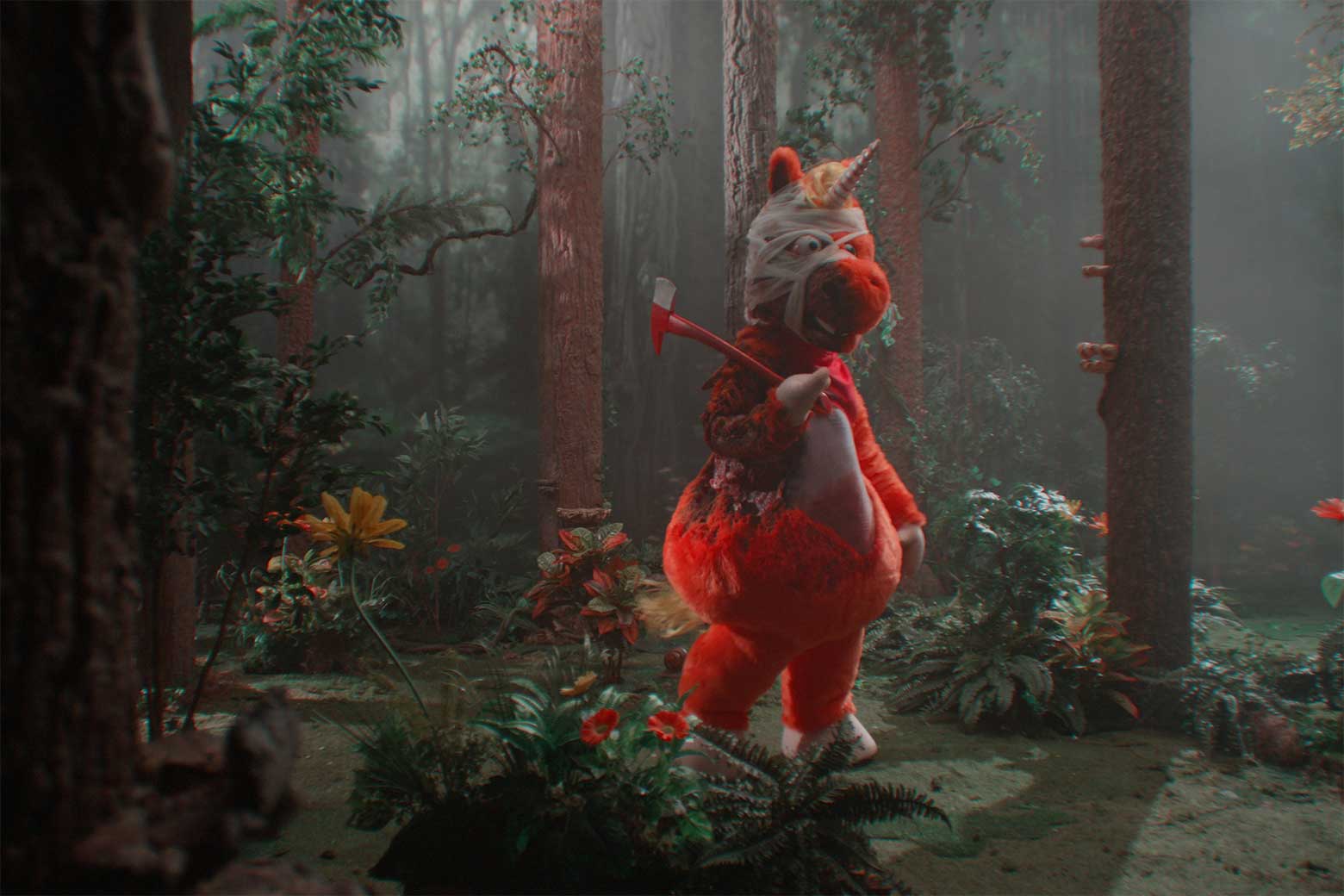
Sundance’s catalog descriptions are notorious for a certain kind of goopy overselling—is “a rippling reflection on westward motion” a good thing?—but the blurb for Casper Kelly’s Buddy is enticingly opaque: “A brave girl and her friends must escape a kids television show.” Combined with the photo of an orange, axe-wielding unicorn that bears a pointed resemblance to a certain purple dinosaur, that might be all the description anyone needs, especially if you’re aware that Kelly is best known as the creator of the creepy viral smash Too Many Cooks, which managed to generate bone-gnawing dread with a campy parody of classic sitcom credits.
Although Kelly, at the film’s midnight premiere in Park City, described the movie as “Barney horror,” the world its forcibly cheery children inhabit is more strongly reminiscent of Pee-wee’s Playhouse, with a talking couch serving as a jittery Greek chorus and a friendly mail carrier popping by to deliver party invitations. And while it digs deep into the eerie insularity of mediocre TV, Kelly’s movie is also informed by the understanding that some of the best children’s entertainment is driven by a powerful sense of the uncanny. It wouldn’t be wrong to describe Buddy as Pee-wee’s Playhouse meets Child’s Play, but you need to throw in a handful of Mulholland Dr. as well.
Kelly takes his time letting us spot the first fractures in the world of It’s Buddy, a garish, gratingly peppy pocket universe ruled by a fuzzy magical beast who towers over even the few grown-ups who appear on-screen. As voiced by Keegan-Michael Key, Buddy is a cuddly creature who just wants to spread love and teach life lessons, but there’s a note of foreboding in one of the first morals we see him impart: “You gotta be scared to be brave.”
The cracks widen when one of the show’s children declines Buddy’s invitation to a dance party, insisting that he’d rather stay in and finish reading his book. Buddy gifts him with a pair of “magic dancing shoes,” which make it impossible for the child to take a step without breaking into a dance, but the kid simply slips out of his sparkly new sneakers and refuses to take part—and Buddy really, really doesn’t like that. It turns out Buddy is a kid’s best friend only when that kid does exactly what Buddy wants them to do. If they diverge from his agenda, the “king of fun and games” becomes a fearsome tyrant, and the malcontent child is simply replaced with a new one as soon as the credits have rolled.
Given that Buddy doesn’t yet have plans for a wide release (buyers from several hip distributors were in the room for the screening), I’m reluctant to explain too much about just how Buddy procures replacements for his wayward child co-stars. Suffice it to say that the movie eventually finds its way to the real world, where Cristin Milioti plays a suburban mom who begins to feel that there is something inexplicably but terribly wrong with her picture-perfect family of four, and her drive for answers and the children’s increasingly desperate attempts to flee Buddy’s dominion eventually coincide.
As Too Many Cooks fans already know, Kelly has a knack for simulating the placeless homeyness of multicamera television, and he knows that he doesn’t have to turn the dial too far to make TV’s idealized version of uncomplicated bliss feel oppressive and unnatural. Like Twin Peaks, whose influence Kelly acknowledges by occasionally turning out the lights and framing scenes in the glare of an unmotivated spotlight, Buddy suggests that the incessantly upbeat tone of children’s TV is built on a profound denial. When adults brush off the children’s concerns about Buddy’s threatening behavior, or when Milioti’s husband (Topher Grace) tells her that she’s starting to sound a little crazy, Kelly doesn’t need to hammer home the point that they’re essentially reporting abuse and being told that there’s nothing to worry about. Sweet, caring Buddy would never hurt anyone, right?
Spoiler: He could, and in brutal, even gory fashion. (That horn atop his fuzzy orange head is not just for decoration.) Yet even when Buddy is at his most sinister, Key never drops the aw-shucks lilt from his voice. Nor does Patton Oswalt, as the voice of an anthropomorphic backpack named Strappy, abandon character when Strappy is being tortured to draw the children out of hiding. The movie’s hilarious and unsettling disjunctions come from the way it introduces genuine menace into Buddy’s world without needing to rewrite its rules, because the menace was already bubbling just under the surface.
Premiering in the same theater in the same time slot, Buddy also conjured memories of I Saw the TV Glow, although it tilts more toward gross-out humor than gender-bending surrealism. Like Jane Schoenbrun, Casper Kelly seems to be driving at the idea that the popular culture we consume in our childhoods teaches us more than it intends to, and not all the lessons are good ones.