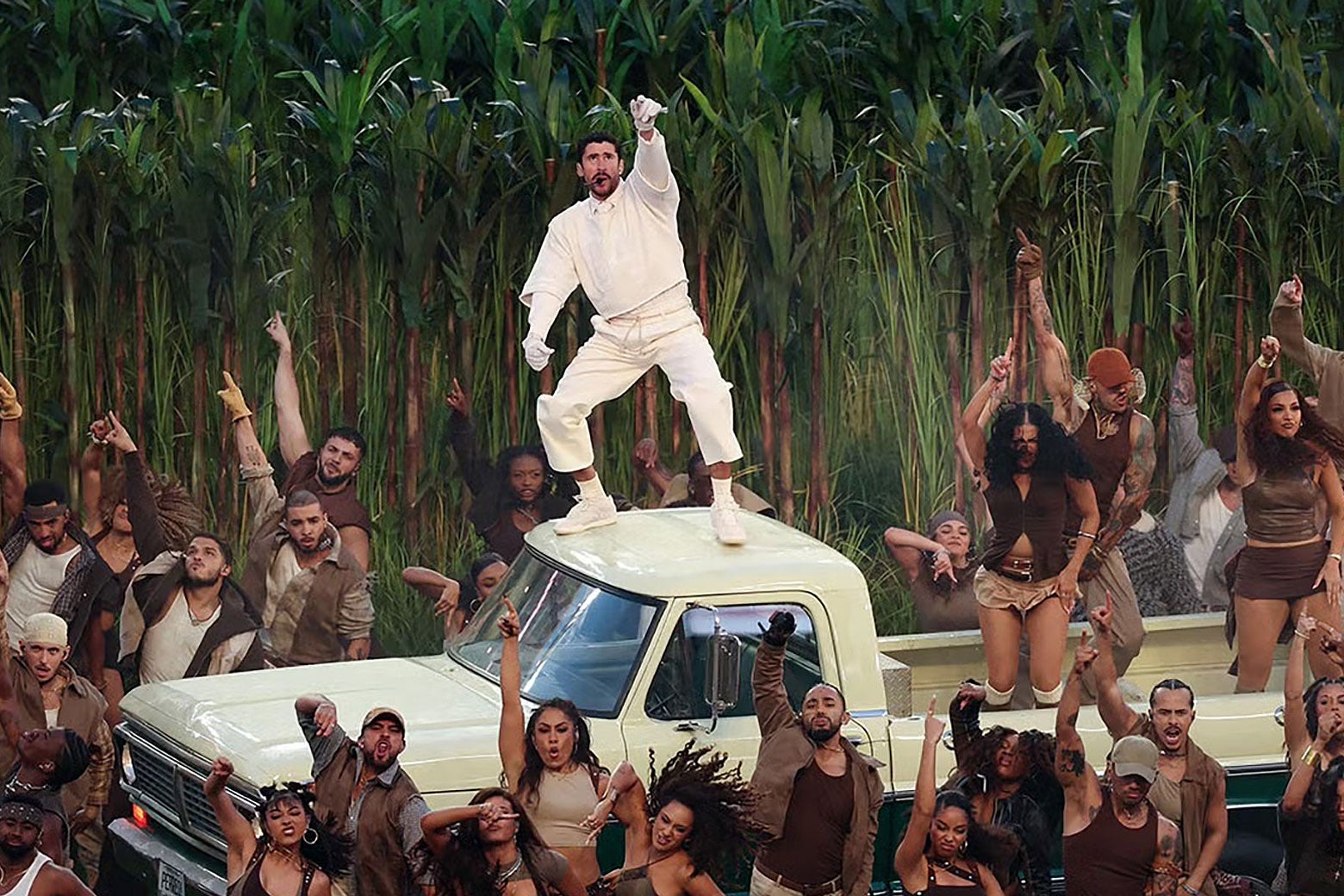
When you make history, it only makes sense to throw a party—and when it comes to parties, there are none bigger than the Super Bowl halftime show. Going into Sunday night, Benito Antonio Martínez Ocasio, better known to the world as Bad Bunny, was fresh off a historic Album of the Year win at last week’s Grammy Awards, the first for a Spanish-language artist. It was the latest in a long list of remarkable achievements for the Bayamón-born recording artist, whose dazzling ascent to record-breaking touring act and the most streamed artist on Earth has made his career a point of pride for Latin Americans everywhere, and Puerto Ricans especially. And again: It’s meaningful that he’s done this as a Spanish-language artist, something once deemed impossible and still considered controversial.
Everyone, however, knows what to do at a party, Spanish or not: You dance. You dance salsa and perreo, you soft-shoe and twerk, in sugarcane fields and in parking lots and on rooftops, all lovingly reproduced midfield at California’s Levi’s Stadium as Benito took the world on a grand tour of Puerto Rican history in a breathtaking 13-minute extravaganza. It was a show that gave viewers the sort of surprise appearances they might expect from a Super Bowl halftime show (Lady Gaga! Pedro Pascal! Cardi B! Karol G! Alix Earle, for some reason!), plus a palpable intimacy that spectacles of this sort rarely seem to have room for. (That wedding you saw? Real!)
It was also a watershed moment in pop culture history: The world has changed, and this is what our pop culture looks and sounds like now. The idea of U.S. cultural hegemony as represented by a lily-white, English-language media, is on the decline. And: good! This is the Gospel of Benito, proclaiming “God bless America,” then reciting the names of nearly every country in the Americas, marching with their flags flying behind him, on a literal level playing field.
The days of an imagined safe white English-speaking median audience, if it ever really existed, are over in the United States, and the appetite abroad for entertainment catering exclusively to that audience is waning. The idea of this default audience is not even a useful fiction anymore. This is a world where an anime film can win the top spot at the U.S. box office, where the highest-grossing movie of the year is Chinese, where the most-watched Netflix show of all time is Squid Game, and where the longest-reigning No. 1 song of the past year is by a group of K-pop demon hunters. Six years ago, as Parasite was on its way to becoming the first non-English-language movie to win the Academy Award for Best Picture, Bong Joon Ho talked about the riches that await viewers willing to overcome the “1-inch-tall barrier of subtitles,” and it would seem that most of the world has cleared it.
Once upon a time, Latin artists were said to “cross over” to mainstream acceptance. During the 1999 Latin explosion, acts such as Ricky Martin (given a powerful halftime moment here, belting the chorus of Benito’s furious anti-colonization ballad “Lo Que Le Pasó a Hawaii”), Enrique Iglesias, and Christina Aguilera crossed over largely by singing in English. This worked well: Iglesias and Aguilera themselves played the Super Bowl the following year, in a Disney World–themed performance titled Tapestry of Nations, alongside Phil Collins. And by then, Gloria Estefan had already played the Super Bowl twice, both in 1999 (alongside Big Bad Voodoo Daddy and Stevie Wonder) and in 1992 (alongside figure skaters, in a tribute to the Winter Olympics). Even Bad Bunny has played the Super Bowl before, as a special guest, in 2020, under co-headliners Jennifer Lopez and Shakira.
But Benito, who has grown several times more popular since then, is leading a new wave of Spanish-language musicians that doesn’t have much interest in crossing over anymore. Instead, these performers are focused on luring audiences over to them. A generational shift is happening. And often, this generation is harking back to the sounds of their parents and grandparents. The corridos tumbados of artists like Natanael Cano and Peso Pluma are putting a modern trap spin on the rich Mexican (and American) tradition of the corrido, to critical acclaim and viral success. Cumbia, the unmistakable rhythm that Central and South American country folk have danced to for generations, is once again in the spotlight, after bands like Son Rompe Pera catapulted to COVID-era viral fame, bringing rock star energy to an eclectic blend of decades-old sounds. This new strategy, too, is working well, both within the U.S. and without: Peso Pluma just headlined a major U.S. concert of his own at the College Football Playoff. Bad Bunny playing Levi’s Stadium is a victory lap for a long struggle for Latin American mainstream acceptance that started before Benito Antonio Martínez Ocasio, or many of his fans, was born.
This is cause for celebration. How could anyone watch that show and think otherwise, with it choreographed to consistently surround Bad Bunny with performers and dancers who represented the diaspora’s perseverance in the face of adversity, from the pointed power-grid staging of “El Apagón,” and the Nuyorican legend Toñita serving shots next door to a barbershop, to the tender moment when Bad Bunny gave his Grammy to a kid watching his acceptance speech from the week before, saying it was for him too?
Yet because he’s a Puerto Rican artist whose songs are almost entirely in Spanish, his elevation to such a position is a subject on which culture war can be waged. Turning Point USA, the conservative activist group headed up by Erika Kirk, went so far as to organize a protest halftime show, an “all-American” event headlined by Kid Rock and three other white country singers (Brantley Gilbert, Lee Brice, and Gabby Barrett). Secretary of Homeland Security Kristi Noem threatened to sic ICE on the Super Bowl—an empty threat, from the looks of things.
To conservatives in power, Puerto Ricans are no different from any other brown or Spanish-speaking people: potential criminals one and all, here to take something from good (white) Americans. To their liberal opposition party, they are taken for granted as a demographic that has no choice but to be aligned with them, with families on the mainland expected to vote blue alongside other Latino citizens, without much more than the most feeble outreach.
So of course a Super Bowl halftime show full of exuberant, inclusive joy is an existential threat to proponents of the current regime. It’s a vibrant display of everything they are fighting to erase from public life. It is violence to them, that so many might love art that affirms they can no longer assert a claim to the cultural mean. It is a reminder that their deadly, state-sponsored tantrum is ultimately futile. Our government, and the culture warriors it sees as its sole constituency, is trying to push back the tides and is destroying anything that the world wanted from the United States to begin with, as tourism to the U.S. dips and the nation finds itself politically isolated from the rest of the free world.
What if it didn’t have to be this way? What if the United States could proudly list itself with its neighbors in the Americas, and what if we could all sing in Spanish, dance to the horns in “Baile Inolvidable,” and “dance,” as Benito said in Spanish during his performance of the song, “without fear. Love without fear.”
It can be trite for artists to trot out a message of love and hope when the world’s eyes are on them. It can be an easy and agreeable moral, readily given to hollow platitudes without demonstration of what that love looks like. But Benito Antonio Martínez Ocasio did the work: showing that love to nail salons and piragua stands, marquetas and trucks with kick-ass sound systems. He did it with protest songs and love songs and songs about getting down in ways you can’t talk about in front of your mother (but maybe in front of your tití). He did this in front of an audience that included people who have no shame in saying they want him gone, want me gone, want you gone, sooner or later. But it’s too late: We’ve changed everything. God bless America. Seguimos aquí.