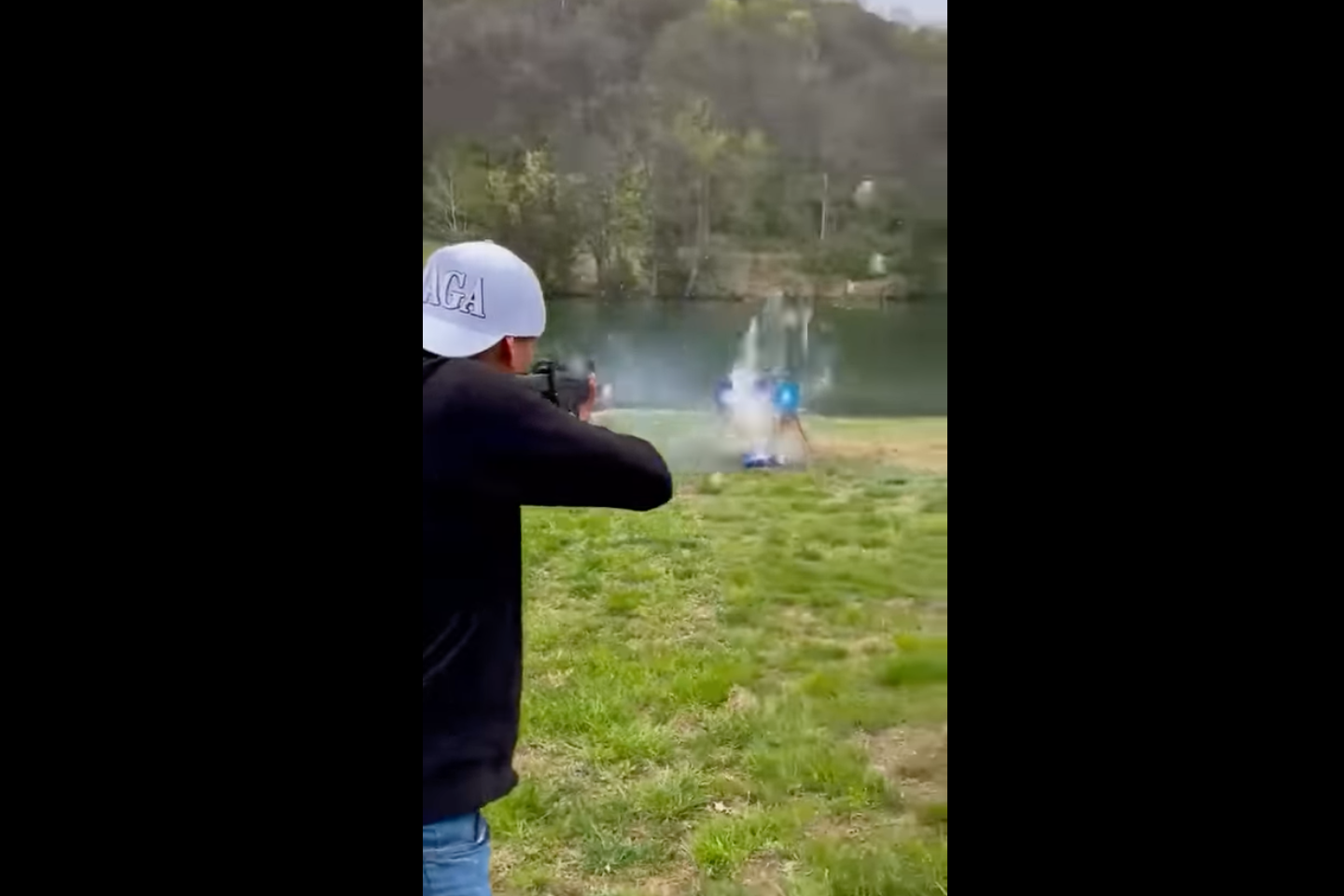
Bud Light came under fire this week—both literally and figuratively—after the brand announced a partnership with a trans influencer named Dylan Mulvaney. Not a few right-wing social media personalities, celebrities, and politicians responded with outrage: One man recorded himself emptying beers into a sink, and Kid Rock, the Michigan singer, shot up Bud Light cases with a rifle. Why? The brand has suddenly gone “woke,” they say, and doesn’t understand its real consumers.
In one sense, it was a typical script of public outrage that is reenacted whenever a corporation takes any supposedly political stance these days. But this particular fracas over Bud Light grows from a deeper history of consumer politics, and it has an amusing resonance given the crucial role beer—or not drinking beer—has played in the past successes of the LGBTQ movement. In fact, part of the reason Bud Light (and its parent company, Anheuser-Busch InBev) embraces—and is embraced by—queer beer drinkers is thanks to a historic boycott of one of its rivals, Coors Brewing Company.
As I explain in my 2021 book Brewing a Boycott, the Coors boycott was one of the longest-running consumer boycotts in modern U.S. history, stretching from the 1950s to the 1990s. It began in 1957, when brewery workers went on strike at the flagship Coors facility in Colorado and asked allies to boycott the beer in support. Over the next decade, Black and Mexican American activists in Colorado and the West also boycotted the company’s products for its allegedly discriminatory hiring practices.
Then, nearly 50 years ago, in 1973, Teamster beer drivers in the San Francisco Bay Area joined the ranks of boycotters as they struck Coors’ local distributors. For the next two years, these drivers faced off against strikebreakers and anti-union Coors representatives in a tense and often violent environment. Fearing that they would lose momentum (and ultimately lose the strike), lead organizers Allan Baird and Andy Cirkelis built coalitions with other Bay Area activists. Baird, notably, reached out to his gay neighbors on Castro Street, key among them a radical labor activist named Howard Wallace and a local camera-shop owner and aspiring politician, Harvey Milk. Both were at first hesitant to lend their support to the union—and each asked for something in return. Wallace wanted the Teamsters to join picket lines in support of striking farmworkers. Milk told Baird that he had to get union jobs for openly gay men and women. Baird agreed to both, and a historic gay–labor coalition was born.
The boycott thus took off in San Francisco’s LGBTQ communities. In particular, queer activists were angered by allegations that Coors used preemployment polygraph tests in its hiring processes—tests that included probing questions about one’s sex life. (The company has consistently denied this, but the charges stuck in the discourse.) “That’s all we needed,” Wallace later said. “It united us.” He and others “would go out and hit every bar in town with leaflets and stuff. And say ‘Hey, get rid of that shit!’ ” Owners and patrons complied, and Coors became a rare sight at gay bars and clubs.
Even as labor unions at Coors—first the Teamsters in California and later, in 1978, brewery workers in Colorado—lost their strikes against Coors, LGBTQ consumers continued to back the boycott. By the late 1980s, the queer boycott of Coors had spread from California to Chicago, Boston, and New York. These consumers kept at it not simply because of the polygraph tests or the appeal of coalition-building, but also because of the public politics of the Coors family itself, especially third-generation Coors executive Joe Coors.
Joe Coors was a busy man in the world of conservative politics. He co-founded the right-wing Heritage Foundation, launched a short-lived conservative news network called TVN, and was a loyal backer of Ronald Reagan’s national political ambitions from 1976 onward. By the 1990s, Joe and other family members were also linked to Moral Majority and anti-gay, family-values candidates and causes. Boycotters thus rejected Coors beer as a way of protesting these broader politics. As one boycott leaflet noted in 1997, “When you support Coors, they fight against your rights.” It was, the leaflet said, “Trickle Down Homophobia.”
All this boycotting had the unintended effect of making queer beer drinkers legible as a distinct consumer market. As Joe’s brother Bill put it in a 1977 meeting with gay activists in Los Angeles, “We found out that the gay community was having a boycott of our product, and this was the first time that we knew there was a very well-defined gay community.”
And so the company began to appeal specifically to them through ads and public, well-funded gestures of goodwill, thus convincing some to drop their boycott. In 1979 Coors added sexual orientation to its nondiscrimination clause and began paying for ads in gay publications. The brewery also generously supported AIDS walks and research organizations, and to this day it sponsors Denver’s annual Pride Parade. In fact, Molson Coors is now an industry leader in its support for LGBTQ consumers and causes.
Many gay activists refused to see these efforts as anything more than disingenuous payoffs and have vigorously protested Coors’ sponsorships over the years. Conservatives also protested, insisting that Coors had gone too far. In 1979, when the company sought to open a second brewery on the East Coast, in Virginia’s Shenandoah Valley, locals worried that their home would become “a haven for homosexuals” because of Coors’ advertising campaigns. The threat of a “Queer Beer,” as one fearmongering headline put it at the time, placed Coors’ plans for expansion in danger. It ultimately took the company two years to secure the land for its new brewery, all while delicately balancing overtures to both conservatives and gay consumers.
In spite of Coors’ efforts, many queer people have continued to stay away from the Rocky Mountain brew. As one consulting firm concluded after running a series of focus groups in 1988, most queer beer drinkers could not “identify any scenario under which they would begin to drink [Coors] products.” It simply wasn’t worth it to try to win them over, suggested the firm: “The gay community’s negative feelings run deep.” As a result, these consumers flocked to imports like Corona and Heineken, as well as domestics like Budweiser—and yes, Bud Light. These and other brands have worked hard to win over these consumers through marketing blitzes, sponsorships, and colorful Pride-themed cans.
In other words, the current anti-trans uproar over Bud Light’s brand ambassadors is more than a little undercooked. To allege that Anheuser-Busch does not “know” its consumers ignores nearly half a century’s worth of brewers’ efforts to fight boycotts and win over newly visible and activist segments of the market. Bud Light—as well as Coors, Miller, and other competitors— now market openly and creatively to queer consumers because they have long been a source of both protest and profit. With apologies to Kid Rock, there is no reason to believe that they will step back from any of these long-held practices. Whether these efforts are genuine is another matter. It will be especially instructive to see how Anheuser-Busch and its competitors, like Molson Coors, engage with this latest chapter. They’ll have a long playbook.