Sign up for the Slatest to get the most insightful analysis, criticism, and advice out there, delivered to your inbox daily.
The Trump administration doesn’t do “fall guys.” The need for a fall guy rests on repairing the damage from a mistake, and the Trump administration does not make mistakes.
So it’s been interesting, since the Atlantic’s explosive story about how its editor in chief was inadvertently added to a text thread of national security officials planning an attack on the Houthis, to see one of those principals twist in the wind.
That principal is national security adviser Michael Waltz, the organizer of “Houthi PC small group.” It was Waltz who invited the Atlantic’s Jeffrey Goldberg to the text chain, though he was hardly the only one on the chain to err: Defense Secretary Pete Hegseth blasted sensitive operational details in advance; Vice President J.D. Vance questioned Donald Trump’s decision and his understanding of it behind his back. All of them had an obligation to flag the chat’s very existence as a problem. But in the aftermath of the article, there was rare speculation, by Trumpworld standards, that someone might have to face the consequences of his actions. There’s a first time for everything, and the responsibility seems to be falling to Waltz.
After the news first broke on Monday, a senior administration official told Politico “that they are involved in multiple text threads”—sigh—“with other administration staffers on what to do with Waltz,” and that many of them are insisting he needs to go in order to protect the president. “It was reckless not to check who was on the thread,” the official said. “It was reckless to be having that conversation on Signal. You can’t have recklessness as the national security adviser.”
There’s no question that Waltz committed a fireable offense. But so did Hegseth, and no Republicans were out gunning for him. Meanwhile, the Trump administration has acted with reckless abandon from sunup to sundown and through the night for two long months, but no Republicans have so much as broached the idea of offering a sacrifice as atonement for anything until this.
If Waltz is forced to resign—Trump is standing by him, for now—it will have more to do with the internal politics of the Trump foreign policy team and the knife fighting within.
And the internal politics of the second Trump administration’s foreign policy team are fascinating. They could be studied for a long while. For the first time in generations, there’s a rethink of grand strategy underway at the top tiers of the executive branch. No longer is American primacy across the world—in Europe, the Middle East, and the Pacific—the de facto strategy. There are powerful factions that want the U.S. to either retreat from its global obligations and tend to its own neighborhood, or to prioritize countering China while leaving Europe to stand up for itself. This “America First” faction is the one trying to use the Atlantic story as an opportunity to coalesce power.
At the other end of the spectrum are Waltz, Secretary of State Marco Rubio, and other scattered figures, like envoy Keith Kellogg, who are more traditionally supportive of maintaining American primacy across the world. Before they were tasked with charming Vladimir Putin, they had long been hawkish on Russia. They view a free Europe as vital to U.S. interests and, while they may want Europe to boost its own defense capabilities, they aren’t naturally hostile, as Vance is, to the concept of taking actions that might benefit Europe.
Right now, Waltz, like Rubio, is in an unstable position. His survival depends on presenting a convincing impression that he’s updated his views. In February, Waltz distanced himself from an op-ed he wrote in 2023 in which he squarely and repeatedly laid the blame on Putin for his invasion of Ukraine, noting, “What I wrote as a former member of Congress was as a former member of Congress.”
As a February piece in Politico noted of the power struggle, “Given their past lives as Russia hawks, Trump’s own secretary of State, Marco Rubio, and national security adviser, Michael Waltz, are under intense internal scrutiny inside a White House where deputy chief of staff Stephen Miller and Sergio Gor, who oversees personnel decisions, have shown little tolerance for anyone who diverges from the MAGA mindset.”
For many with “the MAGA mindset,” the issue was not so much that Waltz had inadvertently added the wrong “JG” to the chat—it was that he had Goldberg’s contact in his phone to begin with.
Goldberg is a foreign policy establishmentarian through and through. Trump also has a personal vendetta against him for his reporting about how Trump called Americans who died in war “suckers” and “losers.” Explaining away any sort of connection with Goldberg, then, was Waltz’s first priority as he tried to save his job. He assured Trump—in a meeting that was described to CNN as “unpleasant”—that he didn’t know Goldberg, would never know Goldberg, wouldn’t want to ever meet Goldberg. How did he make it into Waltz’s contacts, then? According to Trump, some “lower level” staffer must’ve added Goldberg to Waltz’s phone.
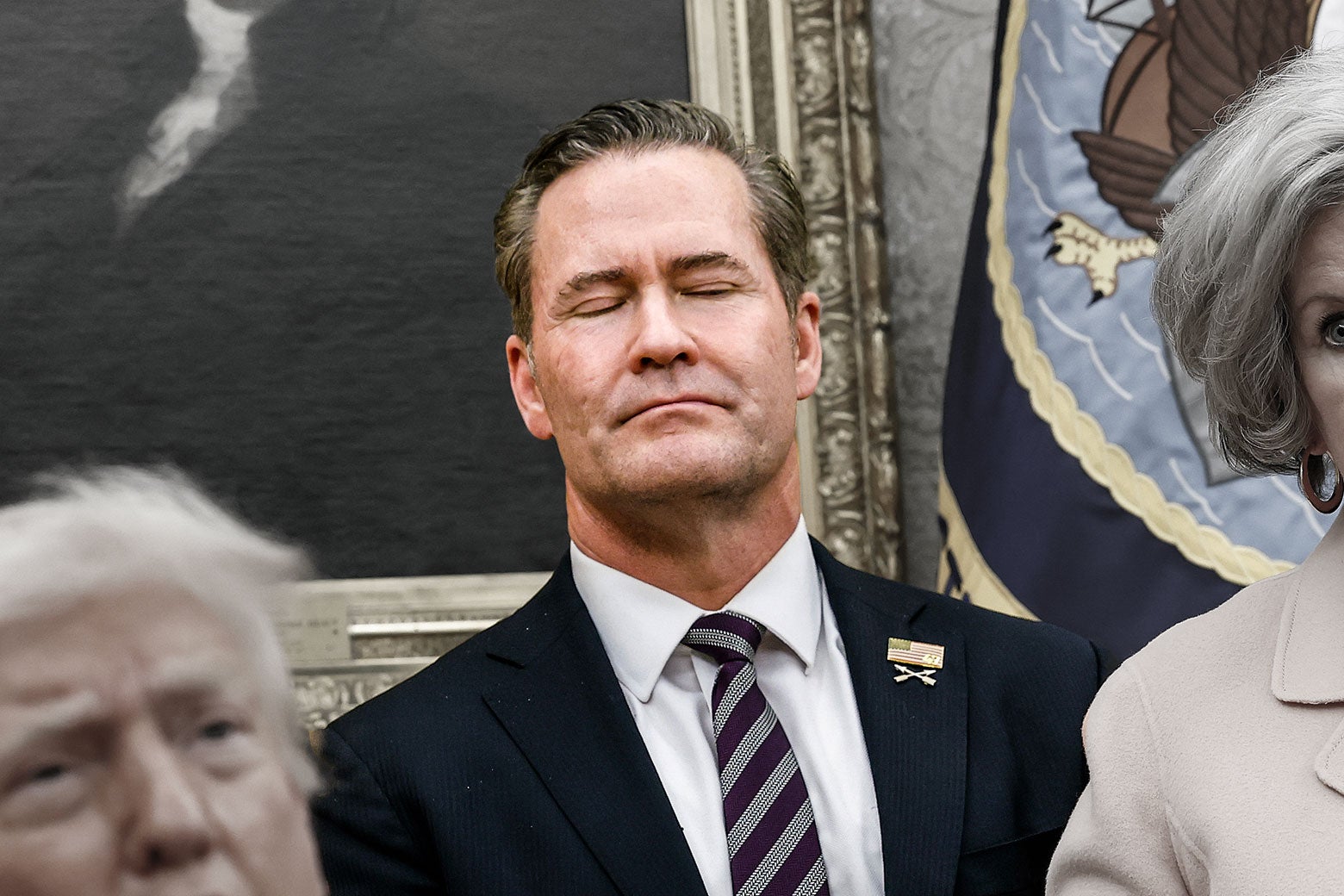
If that weren’t risible enough, consider Waltz’s explanation for how Goldberg may have, somehow, sneaked his way into the group chat: “I’m not a conspiracy theorist,” a dreadfully nervous-looking Waltz told Fox News Tuesday night. “But of all the people out there, somehow this guy who has lied about the president, who has lied to Gold Star families, lied to their attorneys, and gone to ‘Russia hoax,’ gone to all kind of lengths to lie and smear the president of the United States—and he’s the one that somehow gets on somebody’s contact and then gets sucked into this group.” He added that he would have “Elon” and the “best technical minds” look into this.
Why would Goldberg be in Waltz’s contacts? It could simply be that Waltz and Goldberg casually knew each other by being prominent Washingtonians with foreign policy views in the same ballpark, and with overlapping embassy party invitations. Or that they did an interview once. Or that Waltz is a source. Admitting any of this, though, would be fatal to Waltz. And so we get the gibberish of a sixth grader explaining how the dog put Jeffrey Goldberg’s number in his phone.
Recognizing the push to oust Waltz and the potential coming shift in the balance of power at the White House, Republican defense hawks on the Hill rose to his defense. Sen. Lindsey Graham specifically, Trump’s chief hawk whisperer, lives for this sort of action.
Barring further revelations or unearthed photos of Waltz and Goldberg sipping spritzes in the heart of ungrateful Europe, Trump seems to have reverted to letting it slide for now: This was nothing more than a “glitch,” he said. He thinks Waltz is a great guy and doesn’t need to apologize. Waltz, for good measure, did say Tuesday that he “took full responsibility” since he had “built the group,” but stopped well short of tendering his resignation. (One couldn’t help but notice that Director of National Intelligence Tulsi Gabbard, who’s on the other end of the Trump foreign policy spectrum from Waltz, emphasized in her House testimony that day that Waltz had taken “full responsibility.”)
If Waltz survives this episode, though, that doesn’t mean that he’s in the clear. Now MAGA is watching more closely than ever.