Sign up for the Slatest to get the most insightful analysis, criticism, and advice out there, delivered to your inbox daily.
Update, Nov. 22, 2025, at 9:15 a.m.: On Friday night on X, Rep. Marjorie Taylor Greene announced that she will be resigning from Congress in January.
A year after the most openly misogynist presidential candidate in modern U.S. history defeated, for the second time, an ultracompetent woman and brought a politics of unabashed male dominance to the White House and country writ large, it can feel like something of a quaint throwback to remark on why it’s important to have women in positions of power.
The man sitting behind the Resolute Desk recently snapped “Quiet! Quiet, piggy” at a female reporter after she asked him about his refusal to release the Epstein Files, simply the latest in his career-long impulse to hurl sexist insults at women who challenge or question him. His secretary of defense has tweeted a video of his own pastor arguing that women shouldn’t have the right to vote. His White House intervened on behalf of accused rapist and sex trafficker (and self-identified misogynist) Andrew Tate and his brother after the two flew back to the U.S., fleeing human trafficking and rape allegations in Romania (Tate faces 21 similar criminal charges in the U.K.); the Trump administration official who intervened, Paul Ingrassia, faced sexual harassment allegations after a colleagues said he intentionally canceled a female co-worker’s hotel room on a work trip so she would have to share one with him. The president has pushed most of the military’s highest-ranking women out of their posts. He won election in part by catering to men who resent women’s increasing economic and social power.
But his administration and the coalition that supports it is far from exclusively male. And the women in it tell us a lot about women in power—how some replicate and perpetuate the same misogyny that limits their opportunities; how many women, including conservative ones, really do have unique life experiences that can shape their leadership in surprising ways; and how electing women is certainly not by itself sufficient for feminist change, but is absolutely necessary for it.
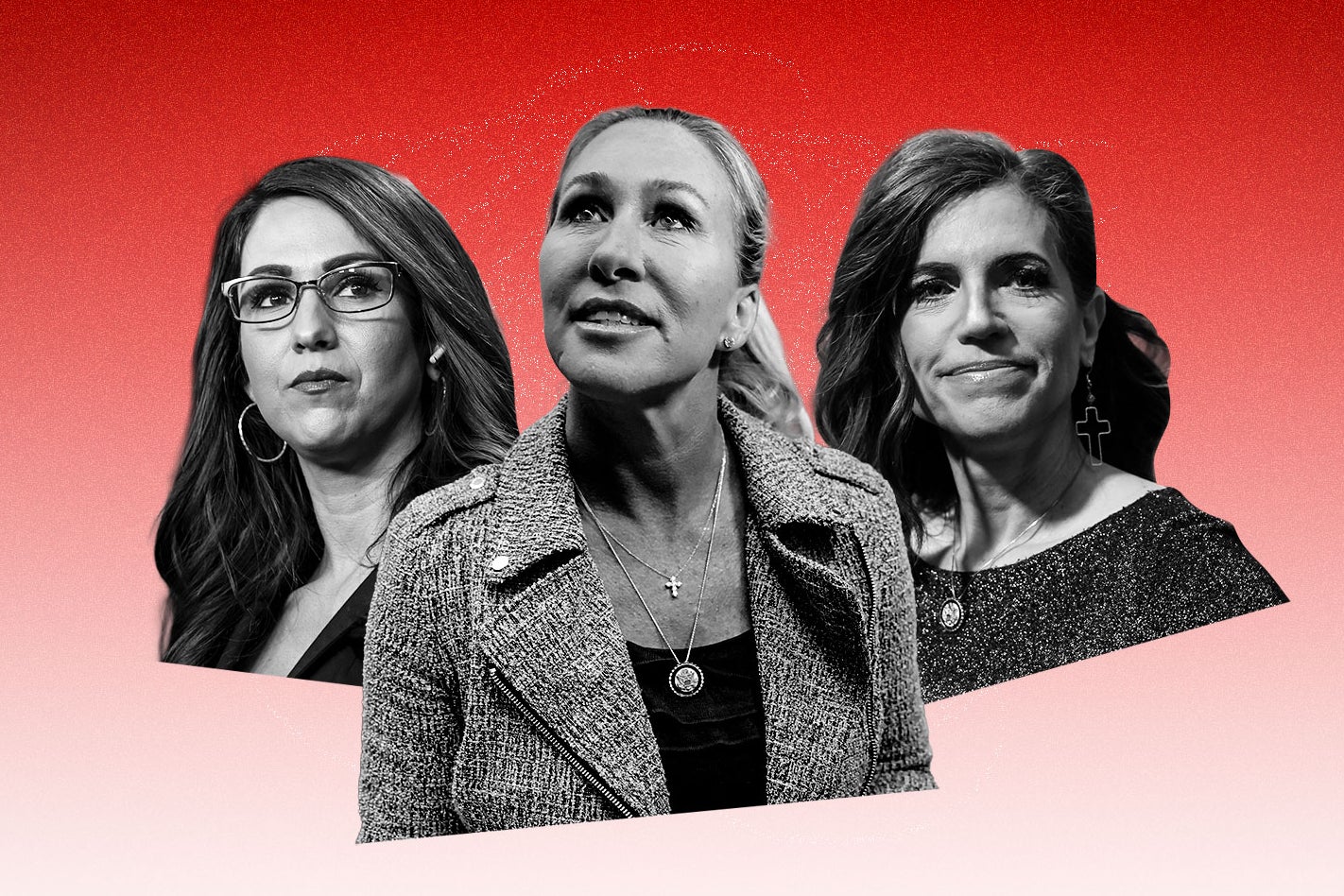
The MAGA women who broke ranks to successfully force the release of documents related to Jeffrey Epstein are illustrative. Reps. Marjorie Taylor Greene, Lauren Boebert, and Nancy Mace aren’t exactly feminist firebrands or social justice warriors. But it does seem like something more than coincidence that three of the four Republican members of Congress to support the discharge petition to release the documents were women. The fourth, Thomas Massie, is a longtime Trump antagonist; the three women, though, have been among the most loyal MAGA acolytes in Congress. They’ve defied the president to whom they have historically catered over Epstein: a man widely known to be an abuser and exploiter of women and girls.
On Tuesday, the House voted almost unanimously to release the Epstein files held by the Department of Justice—but only after Donald Trump told his party members that it was OK. For months before this moment, Epstein survivors and Democrats had been pushing for the documents’ release, while Trump and most of the GOP alternated between stonewalling and lashing out at those advocating transparency. When the issue simply refused to go away and media coverage of it was unceasing, Trump grudgingly relented.
When the House voted to release the documents, Mace told a reporter, “I see this as a very symbolic day, and it’s a very emotional day for me because of the fight that this symbolizes, not just for [Epstein survivors] but for so many of us that’ll never get justice.” The “us” there is meaningful: Mace has taken to the House floor to identify as a sexual assault survivor, and while she’s far from an abortion rights advocate, she at least supports expanding contraception access and exceptions to abortion bans—positions that are far from mainstream in today’s extremely abortion-hostile GOP.
Greene—who announced her resignation Friday night on X—and Boebert have not made the issue quite so personal, but it’s clear that Epstein’s victims have had an effect on them. It’s far from a universal truth that women feel a visceral empathy for sexual abuse and rape survivors. But it is also the case that nearly all women have experienced something on the sexism and sexual abuse spectrum, whether that’s being catcalled, hit on as a young girl by an older man, sexually harassed at work, sexualized as a child, groped, forced into sex by a partner, or worse. And nearly all women have, at one point or another, taken steps to prevent our own victimization, whether that’s being careful to park in a well-lit area, not walking outside after dark, carrying our keys between our knuckles as a weapon, taking a self-defense class, covering our drink with a napkin, or texting friends details before dates. Men, of course, may take precautions too. But it really is only women who live with the pervasive threat of rape and assault in the backs of our minds. That clearly doesn’t shape the politics of every female elected official. But living as a woman in the world comes with its own unique humiliations and particular pockets of power. Those experiences shape us—including those women who run for office.
Women’s life experiences don’t always shape us toward the feminist. Those who live in conservative communities tend to be conservative themselves, rather than chafing at the strictures put upon them, perhaps because complying with sexist cultural norms affords those women some benefits like male protection and social status, and avoiding the kind of overt and hostile sexism directed at women who break the mold. That typically means taking a subservient seat to men who believe authority is their birthright, an expectation that complicates matters for conservative women who also crave the exact kind of power and influence it’s considered unladylike to pursue. And so we see the women of MAGA adopting a particular (and particularly odd) set of gender norms: a heavily feminized appearance, often with the help of conspicuous plastic surgery; a penchant for guns, so no one confuses them for those wishy-washy always-the-victim liberal women; and a general claim that they are both hyperfeminine but also not like other women. They are, in other words, as tough as men and therefore deserving to be in traditionally male roles, but not actually challenging men’s rightful dominance on behalf of womankind (and still carrying out their feminine duty to be hot).
Liberal women have to navigate complex gender politics, too, but there’s less of an inherent ideological conflict between liberalism itself and women seeking power. Democratic groups have invested significant resources to elect more women. And, unsurprisingly, given liberalism’s general support of gender equality and the Democratic Party’s more feminist policy positions, women tend to be more liberal than men. It is not a coincidence that there are almost three times as many Democratic women in office as Republican ones.
It would be absurd to celebrate Greene, Boebert, Mace, or any other MAGA women in office as feminist heroines. All three have been loyal to a president accused of many acts of sexual assault and harassment; all three are members of a party that is abjectly hostile to women’s rights and have voted accordingly; none support a woman’s most fundamental right to make her own reproductive choices; none have spent their time in Congress advocating for women, opting instead to showboat, gun-tote, and promote conspiracy theories of varying farcicality and bigotry. When it comes to actual policymaking, a Democratic man—even a moderate one—would be better for women’s rights than any female MAGA Republican currently in office.
But women’s lives and the culture we live in are not shaped by policy alone. A government made up mostly of men, even if it includes men who support women’s rights, is not a representative government. It is not a righteous government. And male monopolies on power tend to be self-perpetuating: Only when a critical mass of women run and win does it begin to feel possible that women can run for office and win. The volume and position really do matter. Take, for example, the exhaustive (and exhausting) debates over whether a woman can win a presidential election: The very question works as a tool to discourage women from running, and to warn voters and party leaders away from putting another woman on the ballot. On the flip side, more women in office—including mediocre women, including objectively awful women—normalizes having women in office, and will hopefully break us out of the pattern of any given female elected carrying the weight of womankind on her shoulders. In my ideal world, half of the people in power would be women, and all of them would be amazing. But given our current reality, I’ll settle for a world in which women who pursue power can be seen as individual people with all the flaws, inclinations toward mediocrity, and occasional bouts of insanity that seem to afflict most men in Congress, rather than being perpetually seen as avatars for their sex.
Plus, it is the case that having more women in power really does tend to be materially better for women. There is a growing body of research indicating that electing women to positions of power results in the stripping away of more barriers for everyday women to work for pay. Female politicians are more likely than their male counterparts to work on legislation related to women and children, a group that taken together makes up a huge majority of the American public.
This is, of course, in the aggregate, and doesn’t tell us much about any individual female politician. A more fundamental truth is that if we actually want a representative government, we need women represented in it—and as long as there are conservative voters electing conservative politicians, that includes conservative women.
And sometimes, as with the Epstein files, even some serially awful conservative women can surprise you.
