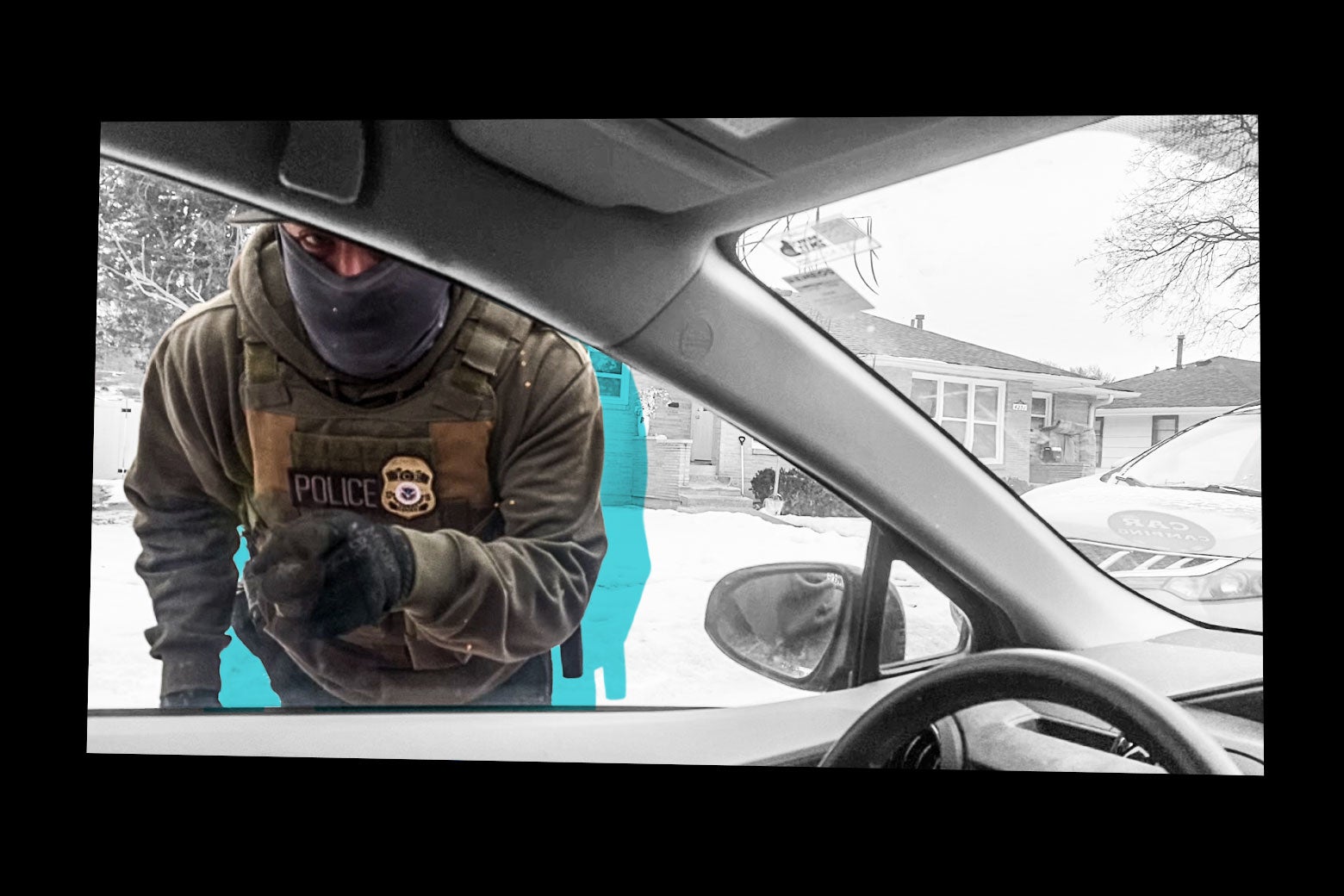
This is part of a series of on-the-ground reports from Minneapolis.
As masked men dressed for war surrounded the car my friend Patty and I sat in, all I could think about were the moments that had led to my neighbor Renee Good’s death. “I’m not mad at you,” she had told her killer. These agents, who I had to assume were from Immigration and Customs Enforcement (they never identified themselves), were already banging on our windows and recording us. Then they pepper-sprayed the intake vent of the car. They were definitely mad at us.
“You’re under arrest!” the agents yelled. Terrified, I thrust my hands in the air and waited for instruction. They did not give me any—instead, they shattered our windows and pulled me out. I was roughly handcuffed and shoved into the back of an unmarked Subaru.
I was a recent volunteer to the neighborhood group that had organized to observe and report ICE after Operation Metro Surge began here in Minnesota weeks ago. The efforts had only increased since Good’s killing. In community chats, suspected ICE sightings are reported, their license plates checked against a constantly updated public spreadsheet. If they are confirmed, people in cars drive to the scene to record what the agents are doing and warn people that ICE is in the area with car horns and whistles. Recording, a legally protected action, occurs on public streets.
Most of the time, commuting (as it’s known in activist circles) is boring. You typically drive in circles around familiar streets. Volunteer dispatchers will help coordinate where people should go, but usually they just recommend sticking around areas with lots of brown people: restaurants, community centers, the kinds of places that make Minneapolis vital. Commuting has become so popular as of late that it’s common to hear a dispatcher request that listeners “please leave the call if you are not actively commuting.” Signal calls have limited space.
Occasionally, though, commuting is terrifying. “Have y’all not learned?” an agent provocatively asks a legal observer in a video that’s been circulating among volunteers, two days after Good was killed. Her response, “What’s our lesson here?,” angers him, and he tries to snatch her phone. Agents have also been known to follow commuters to their homes to intimidate them, which means “He’s following me to my house” has become another common refrain on the Signal chat. One time, I suggested that a woman on a call drive to a nearby gas station to meet me because an ICE vehicle was idling outside her home and she was audibly terrified.
I ended up in ICE custody shortly after beginning a commute on Jan. 11. Someone in our neighborhood chat had reported that ICE vehicles were pepper-spraying an observer. Patty and I, not far away, drove there. I was keenly aware of Good’s death when we arrived on the scene—it had been just four days and was a six-minute drive from where she was killed. This was the first time I had ever seen ICE agents in my life (I wasn’t joking when I said some commuter shifts are boring), and that’s when they pepper-sprayed the interior of our car and hauled us out of it. By the time the agents shoved me into that unmarked SUV, three minutes and 30 seconds had elapsed. We didn’t understand why we were being taken in: We hadn’t blocked their cars or done anything beyond routine observing.
Patty, separated from me, was subject to humiliation on her drive in. They called her ugly, took pictures of her, and referred to Renee Good as “that lesbian bitch.” They took us both to the Whipple Federal Building, a place where, the day before, three local lawmakers had been denied access. They had been trying to ascertain the conditions within. As I was being processed, shackled, and led into a cell, I wondered if I would be able to report to the outside world what it was like in there.
In a bare yellow cell, I tried to sleep, but when I closed my eyes, I could hear screaming and crying from deeper inside the facility. My requests to use the bathroom or to drink water were routinely ignored, met only after I banged on the one-way glass in my cell and begged agents directly.
I saw other detainees only when I was finally able to go to the bathroom—presumably, they were the other people that ICE was here to hunt. The looks on their faces horrified me. Through observation glass, I saw more than a dozen people crammed into a cell, seemingly lacking energy. They stared at the ground or at the wall. They didn’t talk to one another. One man pushed his face up against the one-way glass, either trying to see out or just desperate for any kind of stimulation.
Elsewhere, I saw a woman, through an observation glass, using the bathroom. She wore a garment to preserve her modesty, but that could not protect her from three leering agents who stood watching her, making small talk and laughing. She cried on the toilet.
I was lucky—after the eight hours I spent in custody, I was released with no charges. It helped that I had a lawyer, Emanual Williams, whom my family contacted as they tried to piece together what had happened to me.
After I got out, I called Williams to thank him. I asked him if it was difficult to come speak with me. Legal counsel is supposed to always be allowed in the building, even when it’s closed. He told me that things are changing at Whipple. “We’ve started to see a process that’s more dangerous towards U.S. citizens being detained, receiving charges, and being transported to federal jails,” he said.
Often, whether someone in custody gets to see their lawyer simply depends on who is working that day. “Some people at the door have said it’s not possible to see someone unless someone has retained us,” Williams said. “One time, I drove up to the guard post outside of the Whipple building, and they told me it was closed. One of the postmen—I think they were part of the police team—approached my vehicle with pepper spray.”
A video of the arrest of my cellmate, a legal resident named Dennis, shows his body being bent forward into an unmarked van as two agents try to force him in. Dennis’ face is placid. A third agent, trying to be helpful, gropes for pepper spray on his tactical vest.
“Do you want me to spray you?” he demands, thrusting it an inch from Dennis’ eye.
“Don’t spray him, don’t fucking spray him,” the agent in the front of the car scolds his partner, swatting the pepper spray away from Dennis’ face.
“I told him, ‘Go ahead,’ ” Dennis had said to me in our cell, laughing.
Patty and I weren’t the only ones detained for trying to alert people to ICE’s presence and filming agents. We’ve since met four others who had similar experiences. I was never charged with a crime; I now assume that my detention was meant to stop me from recording ICE officers.
The effort to intimidate observers continues, but they haven’t been discouraged. Minneapolis is so organized in its observer responses that increasingly, the agency has spread its activities to the surrounding area, where there aren’t as many residents mobilized, alerted to their presence, and filming them. ICE officers don’t want people to see what they’re doing, which is why it’s more important than ever to document it. My arresting agent stole my whistle. After I got out, I bought a pack of 24 more.