Sign up for the Slatest to get the most insightful analysis, criticism, and advice out there, delivered to your inbox daily.
I am in the passenger seat of a stranger’s car in Minneapolis, four days after Renee Nicole Good was killed here. I’m riding with someone who was doing the same kind of work we think Good was doing when an Immigration and Customs Enforcement agent shot her. Right now, our work is much quieter. We’re driving in loose loops when a volunteer who is patrolling the streets as a pedestrian observer on the Signal call we’re listening to—a broad network of thousands of locals relaying up-to-the-moment intel on ICE activity—reports two vehicles near Karmel Mall, known locally as “Somali Mall.” Another volunteer fulfilling the role of dispatcher, also on the call, identifies them by make and model. Another observer cross-references the license plates against a running database. They’re confirmed as ICE vehicles, unmarked like they almost always are.
My guide for the day, who I’ll call C, sits up. “They’re going to come past us right here,” they say, accelerating toward the intersection.
Within seconds we spot them: two SUVs moving faster than the flow of traffic. Through their windows, I can see silhouettes of men with heavy Kevlar high on the neck, faces covered, sunglasses.
C begins calling out every turn, street, and direction the SUVs take—while laying on their car horn hard and continuously, like an alarm. The sound is constant and blunt. It could easily be mistaken for an expression of anger, but watching how others in the area—pedestrians, other drivers—react, it’s a signal: a warning to anyone within earshot that ICE is moving through the neighborhood. It turns what ICE hoped would be a discreet operation into a public event. One pedestrian we pass hears the horn, turns, and gives the ICE vehicles the finger.
The SUVs accelerate. We follow closely, C still honking, still relaying their movements. Then they turn onto a familiar street.
“This is my street,” C says. Their posture changes. They look at me. “Can you record this?”
At the next stop sign, the vehicles split. One SUV pauses, blocking our path, allowing the other to pull away, surging into the intersection, cutting ahead of an uninvolved civilian car, using it as a moving barrier. If C had chased through, we would have been hit broadside: “They have absolutely no respect for traffic laws.” That first SUV is gone.
“They sometimes travel in pairs,” C tells me. “You can’t follow both. They’ll break and try to shake anyone observing.”
The remaining ICE vehicle, a Wagoneer, continues through the block. C keeps honking, keeps calling turns. We circle again. “They’re letting me pass my house again,” they report into Signal.
Then: “They’re stopped in front of my house.”
The first thing I noticed when I got to Minneapolis last weekend was the new language. For example: The work C was doing has a name—“commuting”—a deliberately mundane term for pursuing, tailing, and deliberately irritating ICE agents moving through the city in unmarked cars.
As C scans windshields, front seats, and license plates, they tell me about a recent incident near their home. “Three blocks from my house, an unmarked vehicle with four agents in it roll up and just grab a guy off the sidewalk who was walking,” they said. “They violently shoved him into their car.” Their voice trembles as they describe the incident, one they managed to film, hoping that footage might be useful later. “They just snatched him.”
That verb—snatched—is another example of the new language. So is “abduction.” Both are meant to describe the force, speed, and chaos with which ICE is removing people from their city. People are taken before anyone nearby understands what’s happening.
It’s a mistake to think that this transformation started after Good’s killing. The ICE raids intensified in Minneapolis in early December, and the Signal network C volunteers in has been active since then. Minneapolis had already been in an ongoing battle between ICE and the local residents for months when Good was killed.
Her death also occurred just a few blocks from where George Floyd was killed by Minneapolis police in 2020, an area now dubbed George Floyd Square. The past five years taught this city what it looks like when official accounts collide with video evidence, with witness testimony, with what residents say they watched happen with their own eyes. People I met kept describing this as a reason the infrastructure exists at all: not as a guarantee of safety, but as a way to create a record.
Now, in this frozen tundra of a city, in a state best known for its enduring Midwestern niceness, residents of Minnesota are doubling down.
Since Dec. 1, growth in these networks had been steady. After Renee Good was killed, it exploded. Volunteer residents told me that up until the shooting, roughly 20 people would join every day. Now, it’s hundreds.
I came to Minneapolis to understand what it looks like when a city organizes not around a single protest or flashpoint, but around a daily pattern of federal enforcement that residents describe as their new normal. People kept telling me the same thing: The city has a new infrastructure now, mostly invisible unless you’re inside it. C offered to show me what that looks like in real time.
“When I started in early December,” C tells me, “it was not at all guaranteed to see an ICE agent during patrols.” They pause. “Now I see anywhere from one to upwards of 20 if I’m out for even an hour.”
That morning, C picked me up near the intersection where Good was shot and killed. Like George Floyd Square, the response here had been immediate and spatial. In the first days after her death, neighbors used debris to block the roads, closing the intersection in every direction. For a brief window, the intersection functioned the way so many Minneapolis corners have learned to function: part memorial, part staging ground—an assertion that something had happened here and could not simply be folded back into normal traffic patterns.
By the time I arrived on Saturday morning, the barricades were gone. Traffic had resumed. The memorial had been compressed into the parking lane of the one-way street, clustered near where Good’s SUV had crashed into a parked car. Flowers lined the curb. Candles flickered in the cold. Handwritten signs were fixed to fences and utility poles. The street felt reopened but not reset.
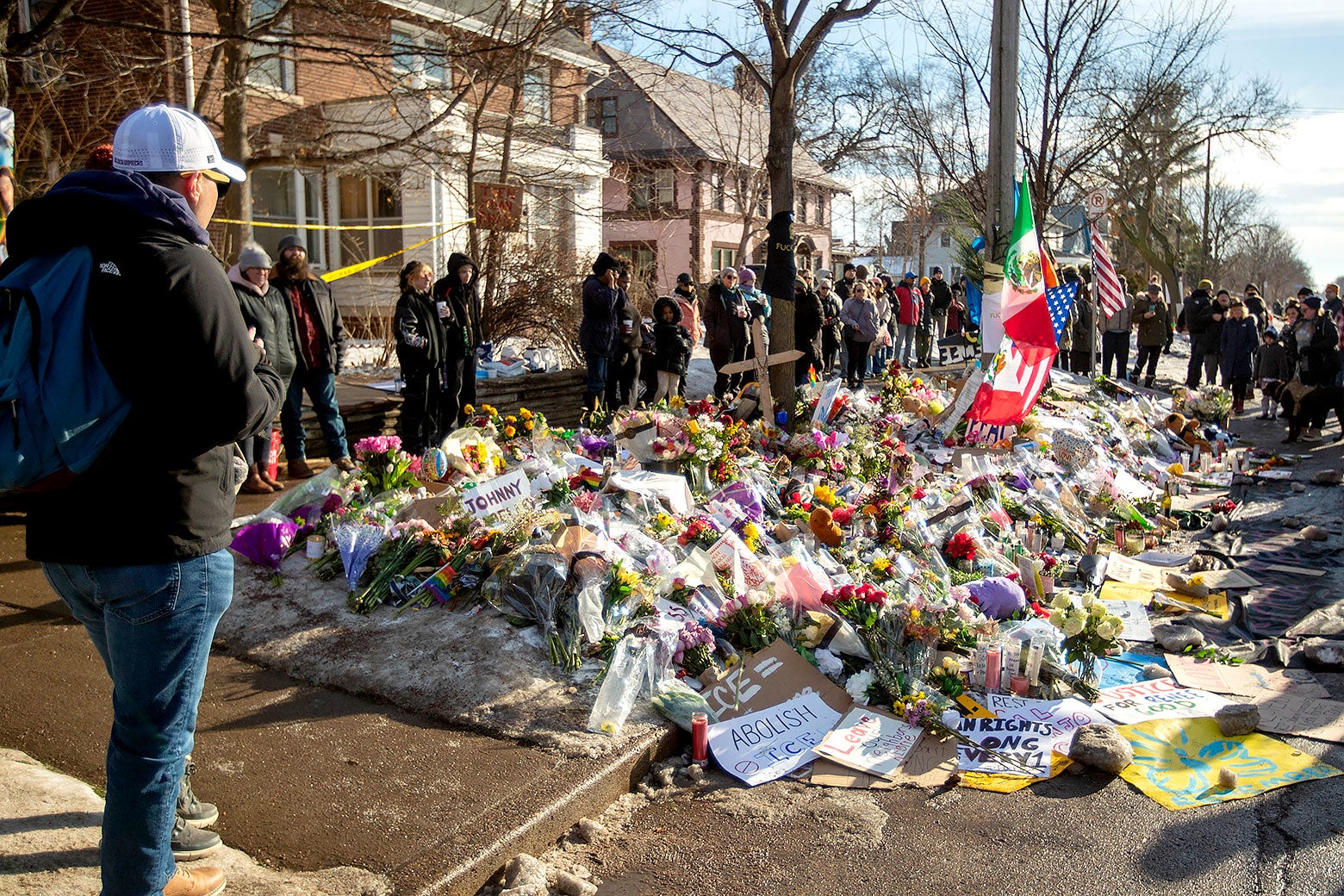
Nearby, a small group of friends arrived together, standing shoulder to shoulder as they took in the memorial. One of them, Kylie, told me she’s still in shock. “On our way here, we watched ICE take somebody from their home. Like 30 minutes ago. They broke her window and took her out of her house.”
That mourners could witness such actions so close to the scene of Good’s death is as useful an indication as any about how things are going in Minneapolis. By most accounts, tensions have only continued to ratchet higher. I flew home on Monday, and on Wednesday another altercation between ICE, a Venezuelan man, and two civilians attempting to prevent the agents from arresting the man resulted in ICE shooting the man they were attempting to arrest in the leg. The two civilians were reportedly “armed” with a snow shovel and a broom, and the incident is being held up as the reason Donald Trump is now floating using the Insurrection Act to enter the city. Meanwhile, Keith Ellison, the state’s attorney general, told residents to continue to report possible rights violations and other incidents involving federal law enforcement. People I spoke to described the escalation as cause to organize even harder.
That effort continues to be diffuse. The way anonymity is central to how this work functions makes it hard to know specifically who Good was collaborating with when she was killed. The volunteer network is also extremely local and largely homegrown, built by neighbors organizing block by block with the families who live next door. Their stories said a lot about how someone like Good may have gotten involved.
Nick is a local father in South Minneapolis. He’s also an admin in one of the neighborhood-level Signal networks that routes ICE sightings into local response. He told me that he got involved around Dec. 1, when ICE activity in his area started to feel constant. “That was the day that it really sort of got out of hand,” he told me. That day, he said, a neighbor was taken. Then ICE returned. Then they returned again. “When they came back for a third time, we were organized. We were out there watching, whistling. … It’s been like that ever since.”
He ended up at the helm of his particular neighborhood’s efforts largely by default. “I guess I’m very online,” he told me. “I know how to do some technical stuff. So I just kind of took over as one of the admins.” His chat has become an invaluable tool for locals who want to track and observe ICE. Volunteers cross-check license plates against a database of confirmed ICE vehicles, dispatchers track ICE activity, observers patrolling on foot or in vehicles give up-to-the-moment information of ICE whereabouts. He wanted one thing understood immediately: This is not a professional operation. “It is just ordinary people that are doing this,” he said. “This isn’t fun. It’s middle-aged parents who would rather be playing with their kids at home.”
Nick also wasn’t keen on comparing this moment to how he experienced the uprising that followed the killing of George Floyd. He said the two are different in that that was a single instance, and now they see videos of inhumane treatment and police brutality dozens of times a day in their neighborhoods.
Back in the car with C, as we drive in more slow loops, they give me a tour of the city they call home, and clearly love. But in almost in the same breath, they point out places that have become markers in this new geography of enforcement.
“That fish-and-chicken spot,” they say, gesturing, “that’s where [ICE] were initially staging.”
The Signal call runs constantly in the background. The cadence of volunteers is efficient and clipped. C describes what they look for: SUVs and pickups parked in alleys; heavily tinted windows; out-of-state plates; erratic driving; the outline of tactical vests and sunglasses. It has become reflexive, they say, to glance into nearly every vehicle.
Even while so much of the action seems like it is being done car-to-car, people kept telling me the system is bigger than patrols. Volunteers are doing everything they can to keep vulnerable residents from having to be anywhere ICE might be. This means doing things like getting anyone who is trying to avoid ICE’s scrutiny rides, child care, groceries. To understand this part of the work, people told me, I should talk to Anna, who is running one such effort called Neighbors Helping Neighbors.
Anna talked the way people do when they’ve been in crisis mode for too long: fast, specific, typing into her phone without interrupting. In her telling, the last two months didn’t introduce a new fear so much as spread it—turning what many immigrant neighbors have lived with for years into a shared civic atmosphere.
Her days now revolve around a simple system: a form for volunteers, another form for neighbors asking for help. “On average, I would say a week ago we were getting three to five a day,” she said. “Last night from 3 p.m. to this morning we’ve received 51.” The requests were spreading outward into the suburbs—“Farmington … Roseville, Inver Grove Heights, Eden Prairie”—and it’s still intensifying.
When I asked where Neighbors Helping Neighbors came from, she described it as improvised and immediate: “We just started brainstorming and I literally just created a Google form and we just shared it on social media and now it has just become a thing.” It stayed informal even as it grew. “People are like, ‘Who can I Venmo?’ ” she said. “And I’m like, ‘You can Venmo me.’ ” Someone would send her a receipt, and she’d reimburse them. “I don’t know who they are,” she said. “And I’m just Venmoing them.”
She talked about it as mutual aid built in real time, held together by trust and speed, and by a kind of local reflex that Minnesota has rehearsed in smaller ways for years—neighbors pushing each other out of snowdrifts, shoveling sidewalks, checking in. “You have to know your neighbors,” she said. “You need to know their names.”
Neighbors are showing up in droves. Organizers told me their Signal chats were maxing out. Trainings are full. Food pantries were being inundated. And even after the horror of Good’s killing, the new volunteers weren’t seasoned activists, they were regular people who finally reached a point where doing nothing felt worse than the risks of doing something.
Jordan Castillo attended his first training at a church in South Minneapolis on the same day Renee Good was killed. He arrived already unsettled. He remembers murmuring “Holy shit” when he got to the packed parking lot. Inside, he estimated there were “probably about 700 people.” He stopped when he walked in. “I was like, whoa. This is a moment. Like, this is history.”
But Good’s killing isn’t the only thing pulling people in—many volunteers are coming to this work after seeing ICE in their own neighborhoods. When I met Burt Muston in a park near his home, he pointed to the local market he described as “a neighborhood staple.” Two people were taken by ICE here. The market closed afterward. “They’ve been closed ever since.” That was the tipping point for him, he said.
Muston is a large white man, and with his beard and dark sunglasses, he could be mistaken for an ICE agent himself. He saw this as an advantage. “As, like, a big white dude … other than if they want to say I’m obstructing justice, they’re not going to really fuck with me,” he told me.
That doesn’t mean he doesn’t take the risks seriously—he referenced footage where an ICE agent told an observer, “Have you not learned your lesson when we kill that lesbian bitch?” He had already made contingency plans. “I’ve actually set up, if I do get detained or something like that, people to come grab my dog to take care of,” he said. Then he waved it off: “I’ll just cross that bridge if I come to it.”
I spoke to another volunteer, who I’ll call M, in a coffee shop at 7 a.m., just before she headed to another shift as a “commuter.” Responding to ICE-watch calls has become part of her routine—she’s been doing it before work, after getting training months ago. “I’m just getting out of bed in the morning and thinking, Maybe I should wake up earlier. Maybe I should leave the house at 6 a.m. so that I can help make sure that there are eyes on the road, eyes on the bus stop or by the schools.”
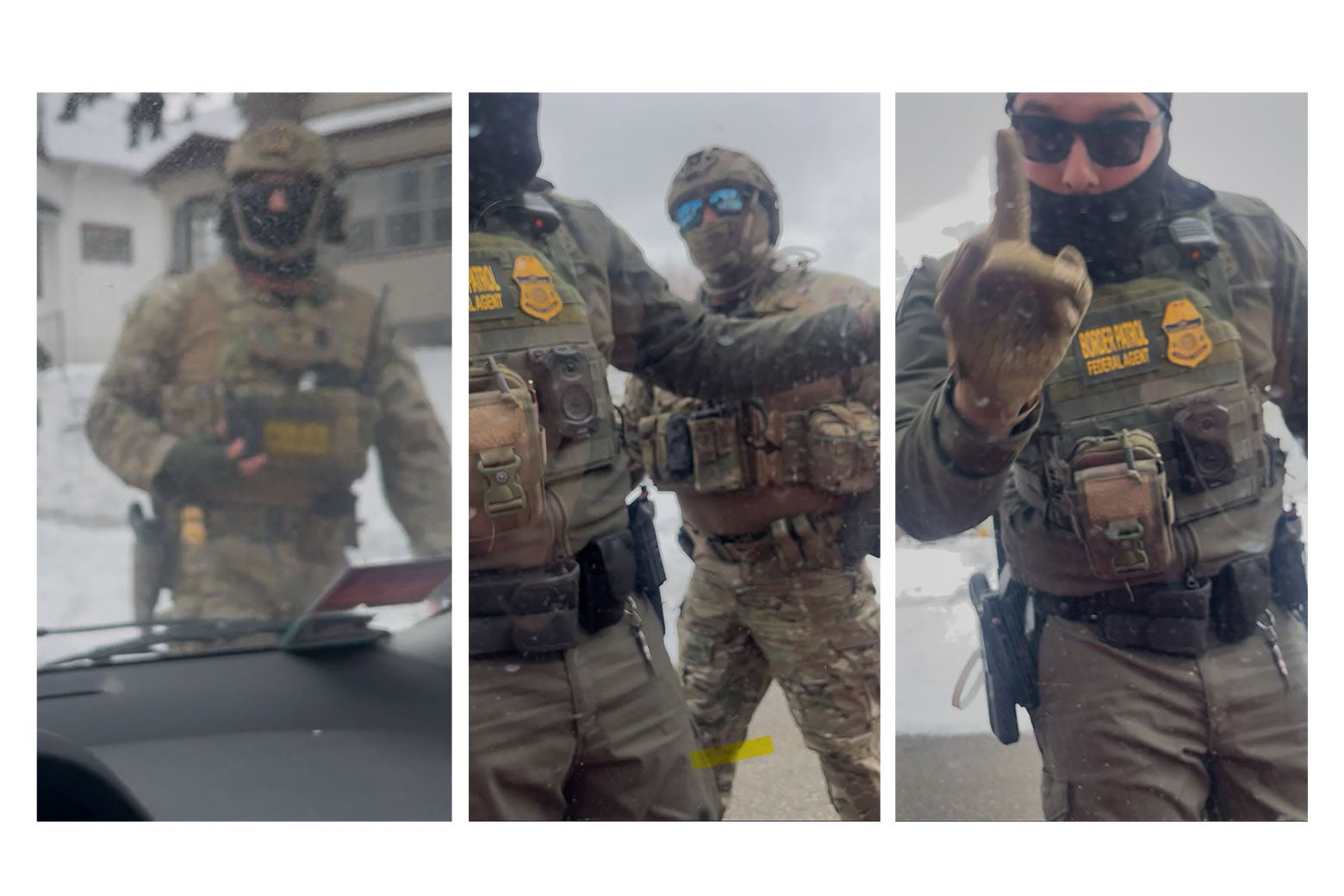
But the watching goes both ways. As I sit in the car with C after the second ICE vehicle sped off, the remaining Wagoneer idles midblock—right in front of C’s house. The message C took from it was simple: “We know where you live.” C keeps the horn down and raises a middle finger toward the windshield.
Moments later, the Wagoneer accelerates away on an icy stretch, blowing through a row of intersections with stop signs. C follows cautiously, choosing to stop instead, letting the distance span. The Wagoneer disappears. C scans mirrors, side streets, cross traffic. “I think we lost them,” they say.
“I lost it at the light,” they report to the group call. “If anyone’s further east on 31st past I-35 and can get eyes on it … ” No one does.