Sign up for the Slatest to get the most insightful analysis, criticism, and advice out there, delivered to your inbox daily.
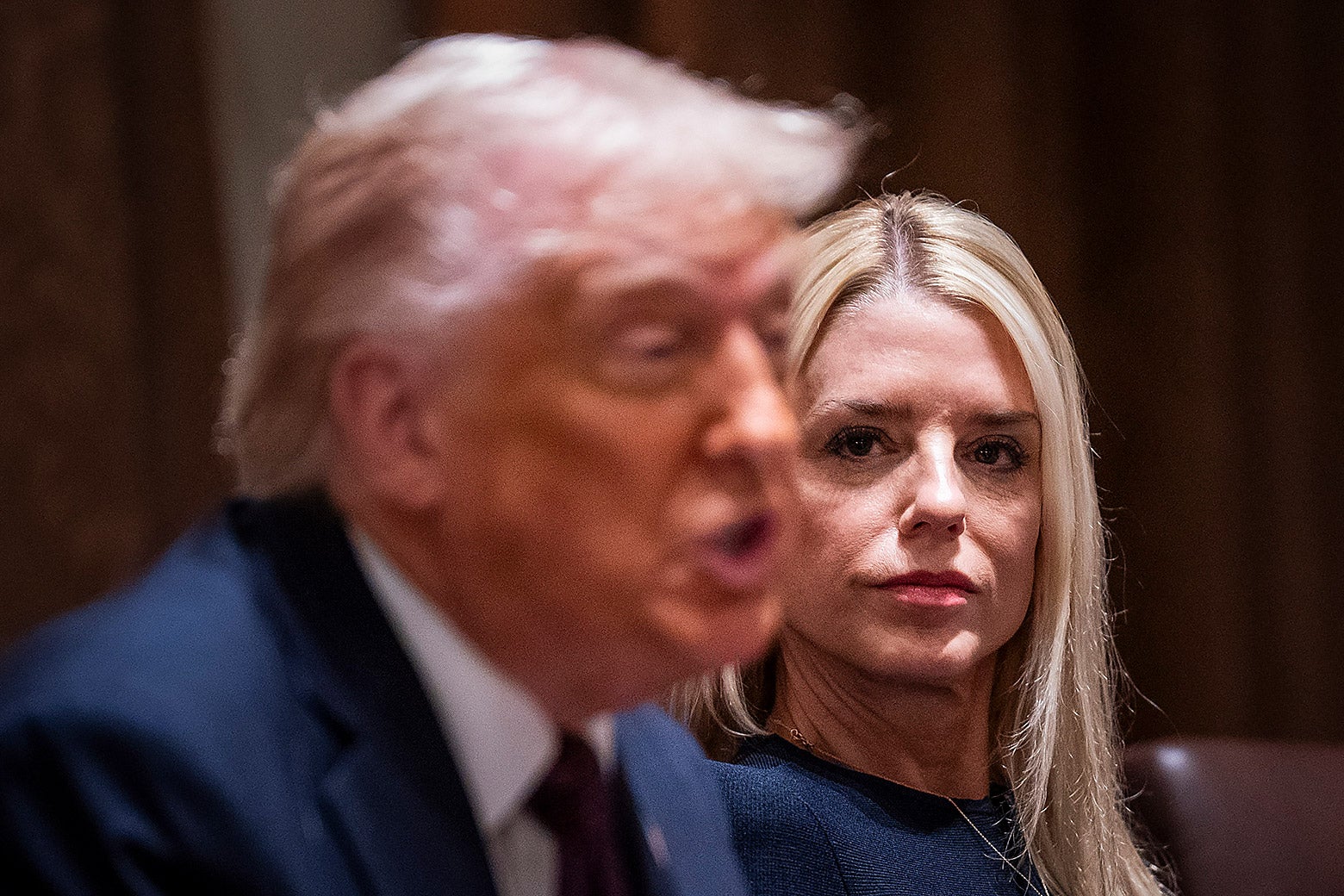
President Donald Trump fired Attorney General Pam Bondi on Thursday, ending her catastrophic 14-month reign over the Department of Justice. Bondi worked relentlessly to pervert the DOJ’s mission, immolating decades of hard-won institutional integrity as she refashioned the agency as an enforcement arm of Trump’s vindictive agenda. Yet even this subservience was not enough to save her job, as the president found her insufficiently effective as a hatchet woman for his campaign of political retribution.
On this week’s episode of Amicus, co-hosts Dahlia Lithwick and Mark Joseph Stern discussed Bondi’s corruption of the Justice Department, the abuses that followed, and the embarrassing defeats that prevented her from satisfying Trump. A preview of their conversation, below, has been edited and condensed for clarity.
Dahlia Lithwick: So what will the history books say about Pam Bondi? She is, I would speculate, certainly the worst attorney general in history, someone who makes Jeff Sessions look stellar by comparison.
Mark Joseph Stern: Bondi’s legacy was atrocious. It is always welcome to see someone so profoundly malicious leave the government, even if she got booted because she wasn’t evil enough. This is the woman who abolished the Justice Department’s independence from the White House and declared that she would be doing the president’s bidding directly. That is not how the Justice Department has traditionally operated, even under Trump’s first presidency. There was a buffer between DOJ and the White House, and Bondi immediately took that away, which led to some of the worst acts of misconduct and abuse in the history of the agency.
I won’t run down the complete list. But under her leadership, the Justice Department prosecuted Trump’s political opponents. It violated endless court orders, then slandered judges who called out those violations—I’m thinking of the unlawful deportation of Venezuelan migrants all the way through to the unlawful detention of ICE detainees. Bondi egregiously mishandled the Epstein files, illegally withholding vast troves of materials that she had a legal obligation to release. Then she treated Congress with snide hostility when it asked her to answer basic questions about it. She unquestioningly enforced Trump’s heinous anti-transgender policies and anti-DEI orders. She persecuted law firms and universities and journalists. This stuff is all absolutely appalling, and it is an unqualified good that she’ll be out the door.
Another thing I’ve been reflecting on is the structural, systemic damage to the Justice Department that she inflicted. People quit in droves, they were fired in droves. This stuff doesn’t get fixed in a day. Attorney General Bill Barr also had no regard for what he was doing to the Justice Department, but looks magisterial in comparison to Bondi. She wrought real reputational harms and wrecked the presumption of regularity to the point where judges are now just saying: I just assume you lie all the time. That stuff isn’t coming back on the watch of her successor, or even the next non-ridiculous attorney general who’s appointed.
This news also made me think back to the first time I took my then–5-year-old to visit the Supreme Court. I remember him talking to a law clerk who was a friend of ours, and telling her that what he really wanted was for her to put a kid in his preschool in prison. I patiently explained that neither law clerks nor justices get to imprison people sua sponte. Well, MS NOW’s Ken Dilanian has reported that to Trump, Bondi’s cardinal sin was not putting enough toddler enemies into prison. That was her failure. Despite efforts to go after everyone that Trump wanted to see imprisoned, at the end of the day, she wasn’t good enough at it. That’s so emblematic of the smallness of Donald Trump’s vision of what justice is and what the law is. And I keep thinking that in order to actually get the kind of attorney general he would want, he might literally have to tap a 5-year-old.
Yes, but even the most competent 5-year-old would still run into the same problems that Bondi did. What ultimately led to her downfall, I think, were the separation of powers and the Fifth and Sixth amendments. She understood the mission, as you said; she did try to go after his political foes. But she kept crashing into the same barriers. She envisioned a Soviet-style government in which the executive branch is the only branch that matters, so it can indict and convict and imprison whoever it wants. The problem was that we still have an independent judiciary, at least in many federal courts. We still have grand juries, which repeatedly did their job and tossed out these prosecutions. We still have a right to trial by jury, a right to counsel, due process—all of these basic protections in the playbook that we assume everyone is working from.
But under Bondi, the Justice Department was not working from that playbook. It did not believe, for instance, in the legitimacy of grand juries, and slandered them for refusing to return indictments. It slandered jurors in criminal trials for refusing to find people guilty for alleged crimes against the government. To this administration, these constitutional circuit-breakers meant to thwart prosecutorial abuse were just an inconvenience to be surmounted. And Bondi embodied that spirit. Unless and until Trump is able to corrupt the entire federal judiciary, though, there is still going to be meaningful citizen input into the criminal justice process. There will still be opportunities for regular people to short-circuit these attempted abuses. And if Trump is using successful political prosecutions as his litmus test, he is setting himself up for a series of failed attorneys general.