Sign up for the Slatest to get the most insightful analysis, criticism, and advice out there, delivered to your inbox daily.
Next to Renee Good’s memorial sat flowers, candles, and a crumbling cardboard tray with the label “Whistles (take one).” Dozens of multicolored whistles—teal-and-pink, yellow-and-blue, and many other combinations—sat on the tray in a pile. The whistles had come from Bree Bridges, a romance author based in McCalla, Alabama. In her spare time, she has been 3D printing thousands of whistles, which she sends to any location in the country that is occupied by Immigration and Customs Enforcement, which, increasingly, really could be anywhere.
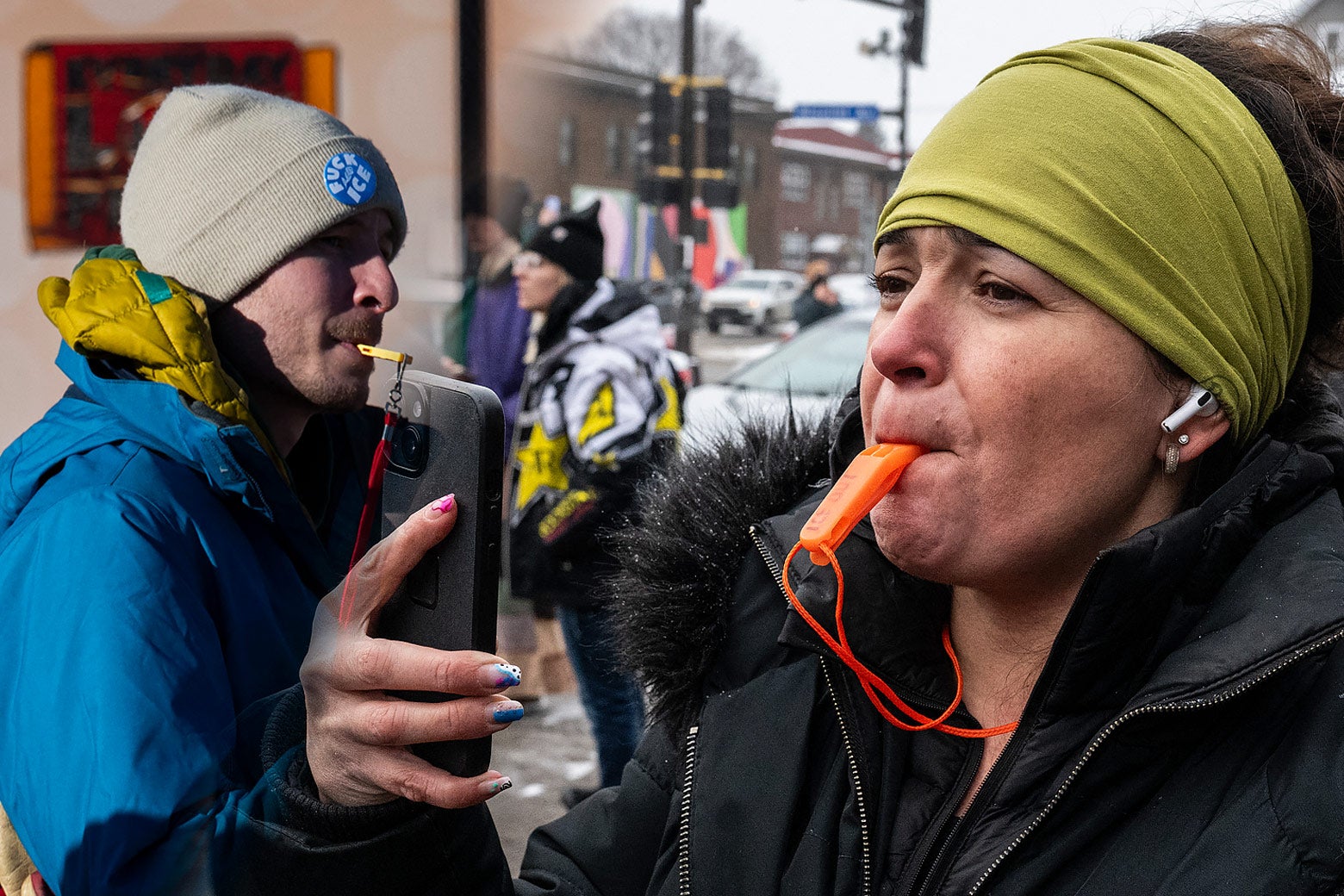
In Minneapolis, where Good was killed, whistles have become a cheap and accessible community-defense system against federal agents. Local businesses are giving them away for free. Community members are buying them in bulk off Amazon and eBay. And across the country, organizers like Bridges are mass-producing them for cheap at home. The result is a decentralized movement of people distributing hundreds of thousands of whistles.
The idea behind the whistle is simple: If you see ICE agents, you let out three short tweets to alert people in the area of the presence of federal agents. If you see ICE agents detaining someone, you let out three prolonged tweets to call witnesses to the scene. Witnesses are legally permitted to document arrests; this evidence can be used later in court or to find detainees after arrest.
People in Chicago started making whistles this fall in response to ICE’s Operation Midway Blitz. Now the DIY whistle effort has gone national: Bridges is part of a loose network of some 40 printers (they don’t have a formal name but can be found on Linktree) that ship community-protection whistles for free. Bridges’ job is to connect printers with people who want to implement or strengthen whistle systems in their communities. She had initially invested in a 3D printer, which can cost about $200, to create merch for her website, but she says some people in the movement bought their first printers just for whistles. As for those requesting whistles, Bridges has heard from everyone from large churches to concerned neighbors to PTA groups. “Organizing the requests and getting them to the people who can fill them is a lot of work, but it has also been like wading through a sea of hope,” she says.
Most of the people printing whistles don’t know one another’s real names, says Bridges, but so far, they have collectively sent out over 200,000 to 48 states. All printers either are self-funded or rely on donations to pay for whistles. (A GoFundMe set up to cover the costs has raised tens of thousands of dollars.) But, as it turns out, producing them is exceptionally cheap. According to some estimates, it can cost as little as 2 cents to 3D print one whistle.
The hope is that with enough education and enough whistles, community members will be better able to protect their neighbors from inexperienced and violent agents. As people have begun to print more and more whistles, they’ve also tacked on their own unique touches to the designs: messages of protest, information about immigrants’ rights hotlines, special filament colors.
Organizers at Migra Whistle, a Portland, Oregon–based organization fighting against ICE, say the community response to the whistles has been overwhelming. Migra Whistle offers online resources for 3D printing, coordinates whistle-packing events, and sends printed whistles to community members. “We want to make noise about the harm that’s happening to our families,” says Veronica, a member of the organization. (I got in touch with her over a secure call after reaching out to the group—members of Migra Whistle I spoke to declined to share their full names out of concern for their safety.) “Once we started conversations, it just took on a life of its own. People were so jazzed about protecting each other,” she says. Making lanyards or whistle information kits isn’t dangerous. “It’s a different thing to ask, ‘Will you show up to this protest, where police might come and tear-gas us?’ versus ‘We’re getting whistles. Do you think you could help us with some extra baggies?’ ”
Organizers say accessibility is the No. 1 reason the distribution of whistles has been successful so far. When Teresa Magaña, a founder of a local community arts center in Chicago, first saw ICE raids happening in Los Angeles, she wasn’t sure what to do. “I was really conflicted by the question ‘Do I have the capacity to be out there in person and be part of a protest?’ And the reality was that I did not have that capacity,” she says. Instead, she used her skills to create an educational zine about whistles, with simple instructions on what to do if you spot ICE; she distributes the zine to local businesses. Organizations across the country have since adapted Magaña’s zine for their own purposes.
Whistles’ simplicity is even inspiring people who left activism long ago to come back and organize. A man who identified himself as Araña told me he had been out of activism for over two decades before recently joining Migra Whistle. He says seeing people get involved so readily gives him a lot of hope. “I had been feeling pretty dejected,” he says. “But when Chicago started using whistles to push back against ICE, I saw the first really effective activism that gave me hope that we could do something worthwhile.”