Sign up for the Slatest to get the most insightful analysis, criticism, and advice out there, delivered to your inbox daily.
The megapopular digital messenger Discord is inspiring a lot of, well, discord this week. On Monday, the app announced new safety features for its many teen users—forbidding them from speaking in audio spaces, restricting their access to channels and images with mature content, and screening out any direct messages from unknown users.
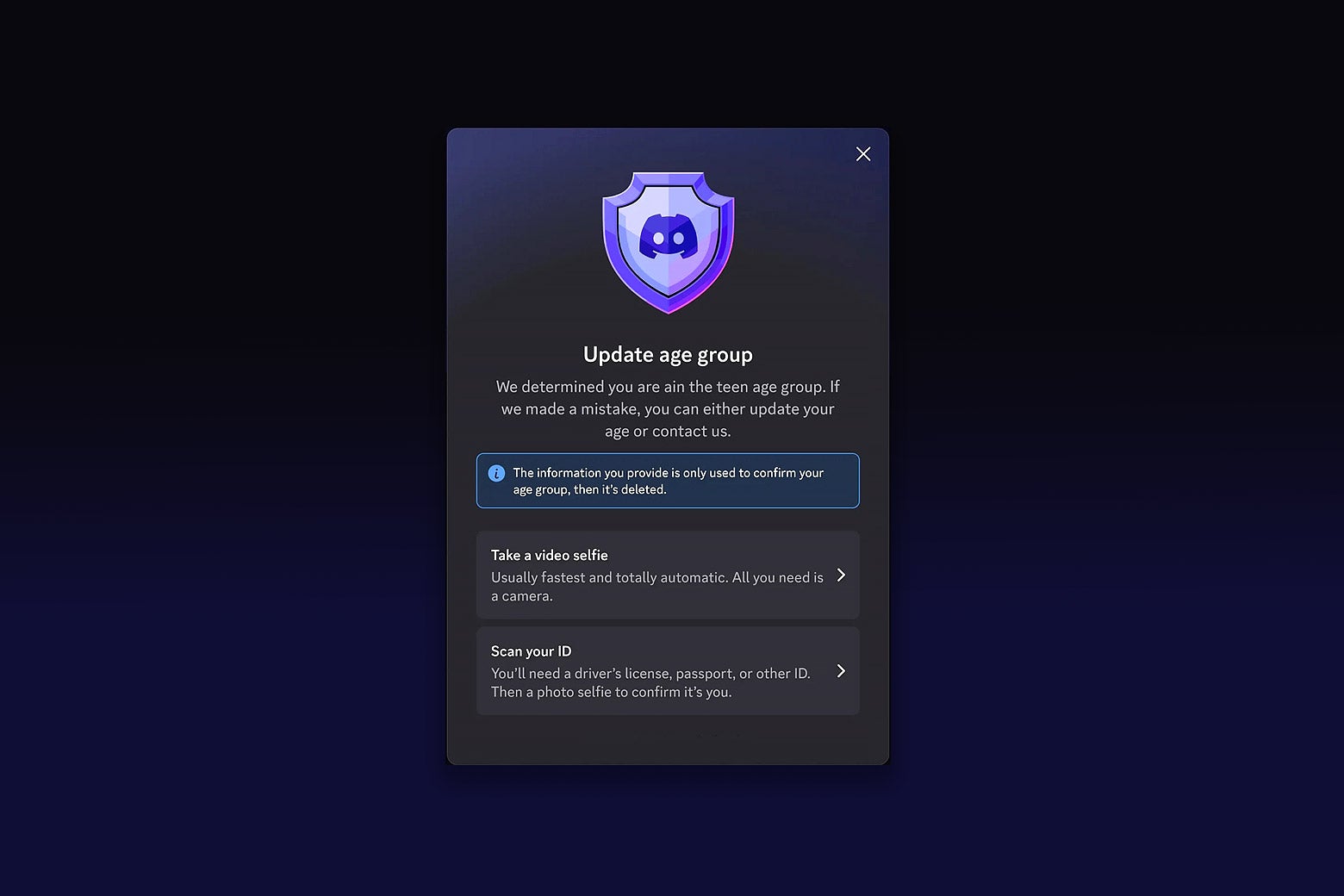
These aren’t unreasonable changes on their own, especially on an app notorious for having drawn in violent extremists and child predators. What’s fueled the recent outrage is a new ultimatum issued alongside these features: Starting next month, everyone will be treated as a “teen” user by default unless they undergo a facial recognition scan or upload a government ID for the purposes of age verification.
The press release noted that Discord’s third-party ID-scanning partner will delete documents “quickly,” scanned face photos won’t leave your device, and alternate verification methods are coming—promises that ring hollow, especially after the app’s history of security compromises including a recent vendor hack that exposed more than 70,000 users’ government IDs and private profile details. In response, users are exploring alternative platforms and canceling their subscriptions to Discord’s premium Nitro service. The app’s official subreddit was so overwhelmed with complaints that company executive Mark Smith responded, admitting that the ID requirement still “has some risk” but noting that the platform would “pre-identify” adult users based on available information, including their Discord messages. This ostensibly allows many users to avoid ID checks, but raises even more privacy concerns.
The people angered by and distrustful of Discord’s invasive verification methods are right to be. But to aim all the ire at Discord misses the point and fails to tackle the real issue: the haphazard age-verification regulations that have been passed by governments worldwide with the intent of forcing digital communities into this position. You may flee Discord if you wish, but chances are high that every viable replacement will soon incorporate such age-gating features. Discord won’t remain a pariah; instead, its moves are a harbinger of what’s coming for every major online space.
There’s a clue in the initial press release. Discord noted that it piloted this system last year in the United Kingdom and Australia, without elaborating on why. It just so happens that both countries passed and enacted sweeping, onerous social media restrictions targeting all teens within their borders. The U.K.’s Online Safety Act requires large community platforms like Discord to impose “highly effective” age-verification measures like including personal phone and bank data, in addition to government IDs and face-scanning software, if there’s significant risk an underage user could be exposed to mature content. In Australia, the Social Media Minimum Age Act bans all under-16 Aussies from having social accounts, while requiring platforms that may expose users to especially harmful content to employ government or face identification.
Last month, Discord’s Help Center clarified that it first rolled out the verification process to those two nations in response to these laws. Even though Discord isn’t subject to Australia’s act, which only applies to 10 specific apps (e.g., Facebook, Twitch), it decided to hit Aussie users with the same limits so as to express its “commitment to teen safety.”
Discord’s changes are prime examples of both the direct effect of and indirect fallout from these laws. The U.K. legislation is so sweeping, inconsistent, and incoherent that it also ranks Wikipedia as a high-risk platform on par with X and Instagram, risking its anonymous moderators’ identities. Australia’s current approach is more tailored, but it cast a wide net on the way to enforcement: Last year, the government sent letters to apps like Discord asking them to self-assess whether they should be subject to the ban, requesting a filed argument from any company that believed it should be exempt.
Discord managed to exclude itself, but decided to follow the rules anyway. That’s in part because it decided to experiment with age-verification steps in Australia long before it received the government’s letter, as a preparatory step. But it’s also in part because Discord understands the U.K. and Australia aren’t the only jurisdictions with such stringent oversight. Brazil, France, Malaysia, and Norway all have verification laws on the books, and at least a dozen major countries (along with the entirety of the European Union) are marking up legislation of their own. Multiple U.S. states, from Virginia to Mississippi, already require social media age-verification software, and a national law is being considered with bipartisan approval.
For many platforms, the easiest solution is to either impose all-around standards or outright block regional access, instead of geofencing restrictions to specific borders. Discord certainly doesn’t want to lose user bases anywhere in the world, and it’s hoping that a set of universal age-tracking rules will keep it in the legal clear wherever it may operate.
Other apps are taking blunt approaches. Thanks to the U.K.’s Online Safety Act, Brits now have to scan their faces for Spotify, while losing access to art-community forums that didn’t have the resources to comply. (Many of those websites are now just gone altogether, both in the U.K. and elsewhere.) YouTube has implemented A.I.-powered “age-prediction” tech, but is keeping ID scans as a last resort. Bluesky temporarily blocked access to all Mississippian IP addresses and is still refusing to mandate biometric data.
Some tech-advocacy groups, free-speech organizations, and young users have gone on the legal offensive to block the state laws being passed across the U.S., successfully arguing in states like Texas that these tools violate teen users’ rights to privacy and free speech. The U.K. Parliament was forced to consider revisions to the Online Safety Act after half a million Britons signed a petition in opposition. Such public outcries and legal challenges are likely to follow in the other nations preparing to pass their own age-verification mandates—and that’s exactly where the energy needs to be directed. Because if netizens don’t organize in protest of these laws, what happened to Discord will only be the beginning.