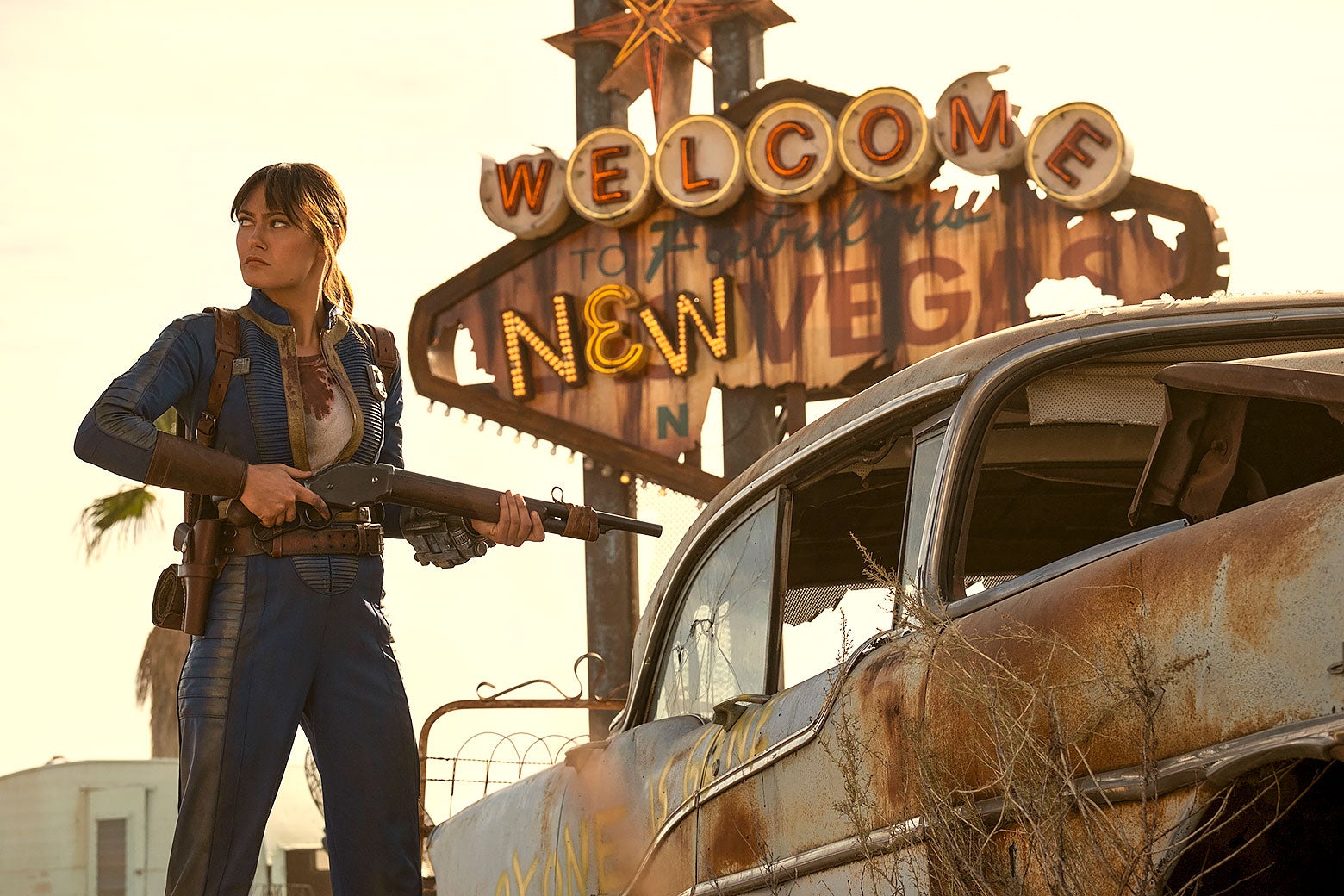
Scanners-style head explosions. Walton Goggins, in all his glory, in a gorgeous, retrofuturistic, school-bus-yellow kitchen. A bowl of flea soup for sale, exactly what it sounds like. Yes, Fallout, the TV show, is back for its second season, with the first episode on Prime Video as of Tuesday evening. (The streamer, likely pleased by how popular Season 1 was with viewers, is going to release this season’s eight episodes weekly, through February.) With their sophomore effort, the people who’ve adapted Bethesda’s long-running video game franchise into a wryly funny television show prove that they’re far from out of ideas.
It’s about 200 years after a nuclear war that’s deranged human civilization as we knew it, sending only a favored few down to live in bunkers built by the Vault-Tec Corporation. In Season 1, Lucy (Ella Purnell), a sunny vault-dweller who has grown up in comfort and safety, and who worships her father Hank (Kyle MacLachlan), emerges onto the surface of the wasteland after a war erupts inside her vault and raiders capture her father. While searching for him, she’s captured by the bounty hunter Ghoul (Goggins), a former movie-star cowboy named Cooper Howard, who has been irradiated into a precarious immortality and lost both his nose and his prewar idealism. Eventually, they cross paths with the third lead of the show, Maximus (Aaron Moten), a member of an order of mech-suit-wearing knights who comes to question the principles his society is built upon.
The new season sees Lucy and Ghoul teamed up, Lucy having realized that Hank is actually evil, and searching for him in order to bring him to justice inside the vault’s court system. (Well, that’s what Lucy would say she’s doing; what Ghoul would say is something like, “I hate to break it to you, darlin’, but the way you was raised wasn’t real.”) For his part, Ghoul is looking in vault after vault for his wife and daughter, who he suspects are still alive in cryo-freeze somewhere. Inevitably, Lucy gets increasingly hardened to the ways of the wasteland, and Ella Purnell’s bright face is often spattered with blood this season. But as we see her gain competence and daring, we also see more and more flashbacks to Ghoul’s prewar life. Cooper Howard, we find out, was a U.S. Marine before he was a movie cowboy, and he was personally involved in the failed effort to stop the atomic bombs from falling. (Goggins can do straight-laced midcentury father and military man just as well as he can do overcoated, shotgun-toting wasteland wanderer.) The two tour through pocket after pocket of postapocalyptic society, completing small mission after small mission, much like players in the game, just exploring the world. (Or, as Ghoul might say, “getting sidetracked by bullshit.”)
Father who lost his own daughter, who’s shepherding a naïve girl through dangers, showing her how to be violent? This remind you of anything? Don’t worry—Fallout (TV version) isn’t going to make you think hard about your own parents or children, or the inevitable tragedy of human mortality. Fallout doesn’t need you to know anything about the game. (I don’t, beyond some ambient knowledge gained while my husband has played it over the years. I suspect, based on some Reddit snooping to see game players’ reactions to the show, that it might be better off enjoyed this way.) Fallout doesn’t even need you to think too much about politics, though the overarching question of whether Lucy’s moral perspective on the universe has any value does push along the plot.
There are some real-world resonances you could glimpse, if you stretch. This season’s villain Robert House, an evil industrialist played with verve by Justin Theroux, is in the process of perfecting little devices that implant in the back of people’s heads and allow for control of their behavior. The first scene of the first episode has House facing down a group of angry men upset that robots are taking over their jobs. “Goddamn parasite is what he is. We didn’t vote for this dumb maggot,” one of them says of him.
But no, despite the obvious parallels, Robert House is not Elon Musk. (He’s far too self-possessed, just for starters.) And thank God for that. One of Fallout’s strengths is that it always exists a couple steps to the side from our own society. The prewar retrofuturist flashbacks are not quite the 1950s, the war Cooper Howard fights is not an obvious analog for World War II, and the little groups of survivors Lucy and Ghoul meet along the way are strictly pastiche—some inspired by the Romans, some inflected by Las Vegas show culture, one group doing sort of a Fagin-from-Oliver thing. The result is that you get some of the creative “What if one warrior played a guitar that shoots flames” worldbuilding you see in postapocalyptic masterpieces like Mad Max: Fury Road and Furiosa, without the “kidnapping women into slavery” side of these scenes ever truly feeling real.
The Fallout apocalypse is, well, fun—maybe even funner in Season 2 than it was the first time around. This is, after all, a game at its core. In the newly released Episode 1, Goggins’ Ghoul picks up a weapon and blasts a bunch of menacing wasteland dwellers, to the needle drop “Big Iron” by Marty Robbins—a moment one can only describe as badass. In one vault’s support group for people who are products of inbreeding, a redheaded, PDA-ing couple makes it clear that what they want is to change the rules so they can inbreed more. In coming episodes, guest stars Kumail Nanjiani and Macaulay Culkin will make scene-stealing appearances as a confident, combat-happy visiting paladin and a deranged legionnaire. There are one-liners, there’s slapstick, there are visual jokes galore.
No, things never get too serious here, out in the wasteland. Fallout is about realism versus optimism, reality versus utopia, but much more than that, it’s about rampaging deathclaws and magic potions you can drink that reverse addiction in a single dose. And to that, as a viewer, I simply say: Okey dokey!