This is part of Slate’s 2026 Olympics coverage. Read more here.
We weren’t even a week into the Milan Cortina Olympics when we got our first big A.I. scandal—on ice!
On Monday, the Games’ ice dancers showed off their intimate footwork to the greatest hits of the 1990s as part of the competition’s rhythm dance event. As any skating fan will tell you, the introduction of music with lyrics to the ice-dance repertoire in recent years has led to all kinds of copyright clashes; figure skater Amber Glenn just settled a dispute with a Canadian musician outraged by the use of his song in her gold-winning Team USA routine. So Kateřina Mrázková and Daniel Mrázek, a brother-sister duo from Czechia, came up with a work-around: Just move it to an A.I.-generated tune in the “style” of the ’90s, since that type of copyright-free soundalike is considered kosher by the International Skating Union.
That move may have warded off the lawyers, but it didn’t slide past Olympic viewers. Disgusted reactions ensued immediately after Mrázková and Mrázek took the ice and NBC’s announcers pointed out that, while half of their choreography was set to AC/DC’s “Thunderstruck,” the other half had been soundtracked by A.I. The ISU’s own documentation identifies the track as something called “One Two,” created by an A.I. prompted to come up with something resembling “90s style Bon Jovi.”
This wasn’t even the siblings’ first A.I.-music experiment. Shana Bartels reported back in November that when Mrázková and Mrázek competed in Skate Canada, they had a different A.I. complement to their “Thunderstruck” routine: a Bon Jovi–style generation that ripped off various lyrics from New Radicals’ “You Get What You Give.” Gráinne Nielsen, an artist who specializes in paintings of figure skaters, shared a TikTok video comparing the authentic ’90s classic to its bizarre replication.
After that original round of backlash, the Czech dancers fine-tuned their A.I. accompaniment—and generated more potential copyright infringement in the process. As Bartels noted in a follow-up, the two removed the New Radicals lyrics from their A.I. melody when they entered Skate America in mid-November, but their new earworm appeared to generously borrow its lyrics and melody from Bon Jovi’s “Raise Your Hands.”
This A.I. New Radicals/Bon Jovi ice dancing scenario is less a one-off scandal than a sign of the times. At their best, the Olympics offer a respite from the relentless horrors of the daily news cycle. But alas, these Winter Games have given us no reprieve from A.I. slop. Welcome to the first Sloplympics.
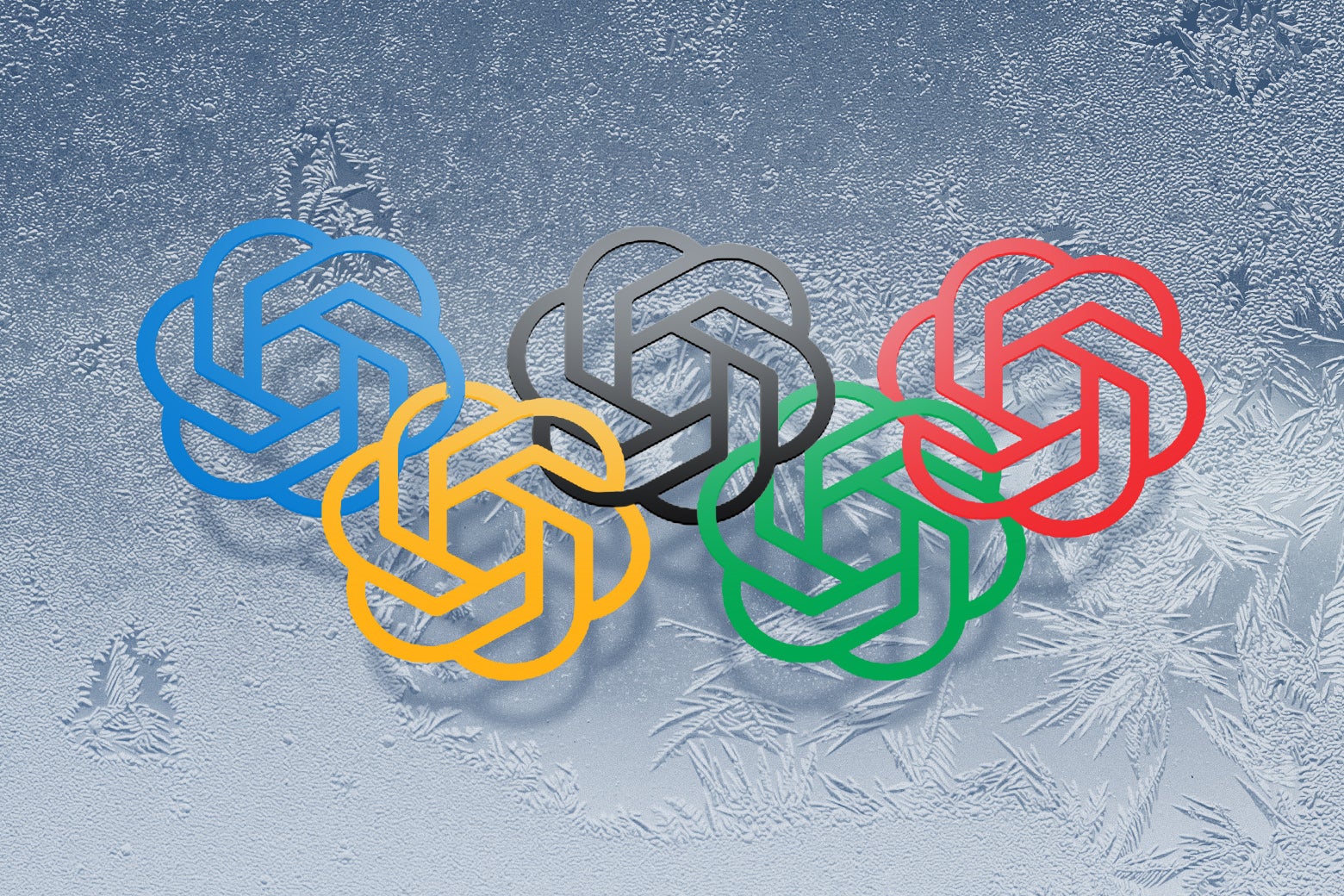
It started with the opening ceremony, which featured a cartoon montage of Olympic host cities with animation so ugly, jerky, and error-prone that viewers derided it as A.I., despite a lack of confirmation from NBC. After the ceremony, the Games’ official social media accounts shared a 30-second video introducing its skiing and speedskating events via stills of toy figurines playing their sports on top of iconic Italian foods. The A.I. gave itself away when one of the uniformed figures was displayed with an erroneous five-ring sequence—overlapping the black ring with the yellow ring at the wrong juncture. Worse still, the graphics appeared to draw upon the aesthetics of Japanese miniatures artist Tatsuya Tanaka, who’s been pairing Olympian figurines with sweet treats and household objects for years now.
Out of the multiple official Olympics graphics mocked as being A.I., only one appears to have been taken down by the Games’ media team: an image of ski jumpers Nika and Domen Prevc, whose Slovenian flags were affixed to their uniforms in a ludicrously sloppy manner.
All this dabbling with A.I. in and around the Milan Cortina Games isn’t surprising given the astonishing developments in generative tools this decade. And these Olympics, it turns out, have been a surprisingly useful exercise for figuring out where this tech is most useful, and where it still falls hilariously short.
One of the more telling motifs of these A.I. Games: The most effective uses of this software have been the least overtly visible. In the lead-up to the opening ceremony, American athletes proudly disclosed their use of various generative apps for training purposes. Team USA’s speedskaters used these tools to model various conditions on ice before trying them out for themselves. Halfpipe snowboarder Maddie Mastro deployed A.I. to analyze footage of her practice runs and figure out adjustments in position, like moving her arm below her head, to improve her performance. The MIT Sports Lab developed a similar apparatus for ice skaters, applying machine learning tech to analyze those wee little microseconds that determine whether your leap-and-spin can fit a quadruple axel instead of a mere triple.
Whether it’s causation or just correlation, these partly A.I.-trained Olympians have found success: Mastro and her teammates made the halfpipe final, American speedskater Jordan Stolz has already nabbed a gold medal, and the USA racked up team figure-skating gold.
Meanwhile, on site in Milan, the Chinese digital retail giant Alibaba is deploying its A.I. models to power everything from drone-camera footage to fan-generated “artworks” to the beloved pin-trading tradition.
It’s likely we’re only going to see more A.I. promotion, whether in the form of slop graphics of Google/Alibaba partnerships or machine learning–inspired physical tricks, throughout the rest of the Games. But those who fear that this will turn the Olympics into an unreal simulacrum of itself should take heart: Even the Czech ice dancers didn’t perform exclusively to A.I. For Wednesday’s free dance event, Mrázková and Mrázek skated to Ernesto Lecuona’s “Malagueña,” a movement from the Cuban composer’s Suite Andalucía that’s been a fixture of figure skating for decades. Sometimes, you just can’t beat the classics.