This is part of Slate’s 2026 Olympics coverage. Read more here.
After the doping scandal at the center of the 2022 Beijing Olympics, I wrote that if skating could not find a way to address the treatment of children in the sport, I was prepared to walk away. Fifteen-year-old Kamila Valieva, the gold medal favorite, was caught taking a banned substance, but allowed to compete anyway, pending an investigation. Under immense scrutiny, Valieva had an uncharacteristic meltdown in her free skate, missing the podium altogether. Leaving the ice, she was berated by her coach, Eteri Tutberidze, who left her fellow student, Anna Shcherbakova, alone in the “kiss and cry” to celebrate with no one. It was a spectacle that I hated watching.
Four years later, with another Olympics upon us, I haven’t walked away. In the intervening years, the International Skating Union banned Russia, not for its systemic doping operation but due to the invasion of Ukraine. (Russia’s ally Belarus has also been prohibited from competition.) Although individual Russian skaters haven’t been entirely banned—more on that later—the absence of a whole national contingent will hopefully allow for a clean Olympics, free of questionably trained teenagers doing quadruple jumps amid a moral miasma.
At the Milan Cortina Games, the United States is poised for its best results in decades, partially due to the vacuum created by Russia’s absence. The U.S. has already brought home a gold medal in the team event for the second consecutive Olympics, and is poised for more success going forward, with a credible shot at gold in three of the four disciplines. Earning a medal of any color in three different disciplines has not been achieved by our country since 1988. Regardless of placement, America has fielded an incredible group of skaters, and for the first time, I can feel the U.S. emerging from the shadow of the peak skating era of the ’90s and early ’00s, an era I affectionately call the Michelle Kwan regnal period.
Now, an event-by-event guide of what to watch for over the next two weeks.
Ice dance: Up first is the ice dance event, sort of the alternative art-school sibling of the sport. When my friends send me viral skating clips, it’s most often from ice dance. Is this because I used to be a pairs skater and they think they’re sending me videos of pairs because they can’t tell the difference? Highly likely. But I enjoy the clips!
Part of this year’s virality comes from the International Skating Union’s official theme for the rhythm dance: the 1990s. In the team event, we heard music ranging from Madonna to Will Smith to Backstreet Boys to the Offspring.
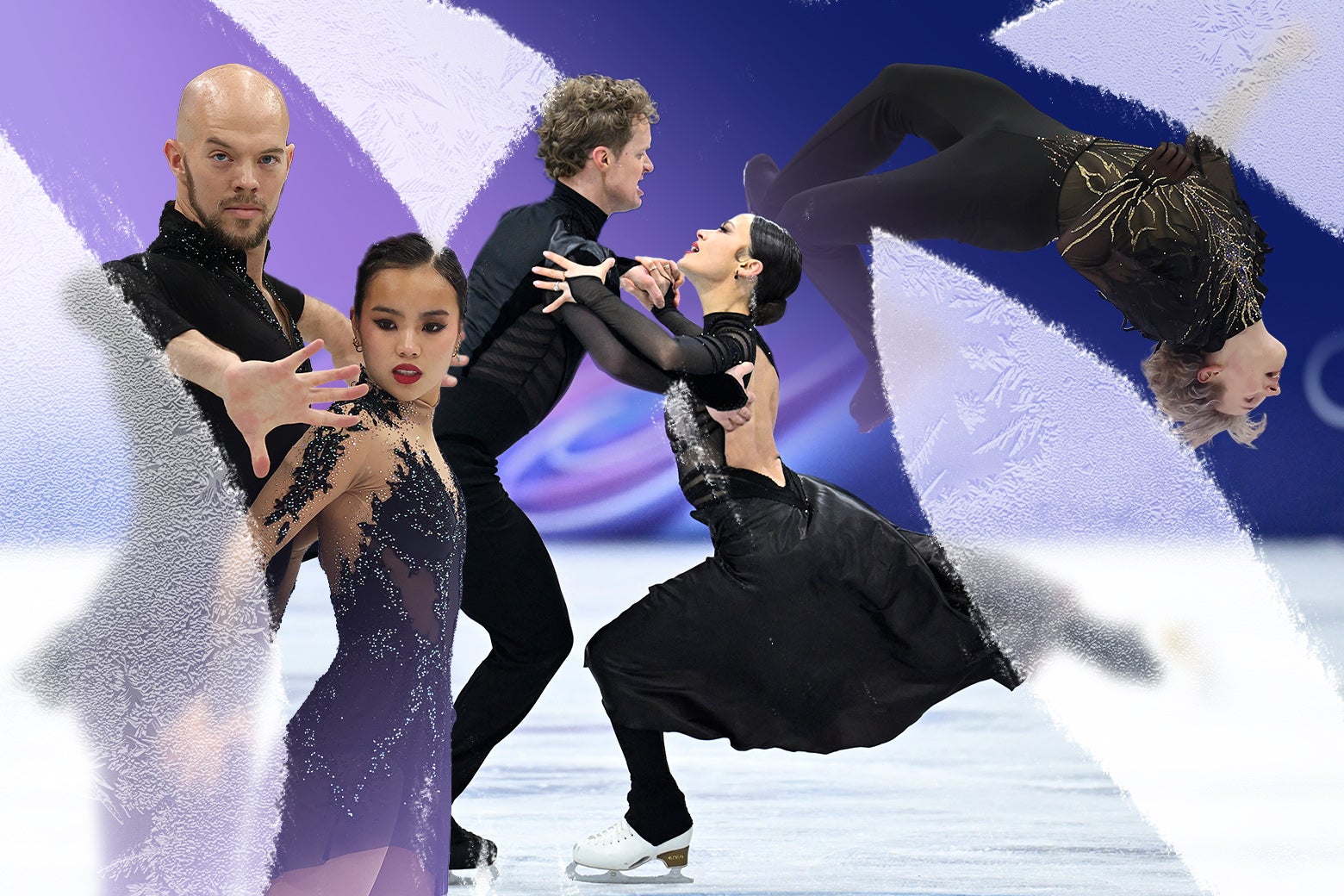
Madison Chock and Evan Bates are America’s top contenders for ice dance gold. Placing first in both programs in the team event, Chock and Bates were instrumental in America’s gold medal. They placed fourth at the 2022 Olympics, have since claimed three World Championship titles, and, most importantly, married each other. Their Lenny Kravitz medley in the rhythm dance is a crowd-pleaser, but it is their “Paint It Black” paso doble free dance that best shows off their graceful intensity.
Laurence Fournier Beaudry and Guillaume Cizeron announced their partnership in 2025. This team carries high medal hopes and a fair amount of off-ice controversy. Cizeron, with his previous partner Gabriella Papadakis, won gold at the 2022 Olympics. In January 2026, Papadakis published a memoir that accused Cizeron of controlling behavior that left her terrified to be alone with him. Cizeron has refuted these allegations and claimed Papadakis is orchestrating a smear campaign against him. On the ice, Beaudry and Cizeron placed second behind Chock/Bates at the ISU Grand Prix Final. Their fiercely femme rhythm dance to Madonna’s “Vogue” in the team event placed second and showed they are a serious threat for gold.
Other medal contenders in ice dance include Canadians Piper Gilles and Paul Poirier, who won my heart over with a rhythm dance to RuPaul’s “Supermodel (You Better Work)” in the team event and are bringing back a fan-favorite dance to Don McLean’s “Vincent” for their free dance. Although they have two silvers and two bronzes from previous World Championships, an Olympic medal has eluded them. Here’s hoping this Canadian duo can sashay and shantay their way to the podium this time around.
Remember those clips that my friends keep sending me? They’re usually of Team GB’s Lilah Fear and Lewis Gibson, who skate a Spice Girls tribute, complete with a Union Jack dress for Fear. They’ve become affectionately known by fans as the “Disco Brits,” after choosing a Donna Summer medley for their free dance in 2018. They won bronze at the 2025 Grand Prix Final, and I would not be surprised to see them spice up the results in Milan.
Men: Ilia Malinin will win gold in the men’s event. He will probably win with a double-digit margin. I have never seen such a prohibitive favorite. The “Quad God,” as he is known, performs acts of athleticism that are so shocking to me that I did have my suspicions that he is from another galaxy. Unfortunately for me and my telescope, it turns out he’s from Virginia, and his superhuman prowess is best explained by him being the son of two Olympic figure skaters.
All that said, favorites falter. Michelle Kwan missing out on gold in 1998 and 2002 is a foundational wound that I’m still working on in therapy. In 2018, it seemed certain that Nathan Chen would win gold, only for him to miss the podium entirely. (He did win gold, by a lot, in 2022, but that doesn’t change my point.) The Olympics are an entirely different beast, and the pressure in that quadrennial crucible is enough to break even the mightiest champions.
In the free skate at the U.S. Championships and to an extent in the team event, Malinin has seemed slightly off his game, leaving out some quad jumps and experiencing uncharacteristic wobbles. Malinin shockingly came in second in the short program of the team event due to a wonky triple axel, finishing behind Yuma Kagiyama of Japan. He did, however, triumph in the free skate, clinching gold for the U.S.
Malinin has yet to show off his quadruple axel at this event, a jump that has only ever been landed in competition by Malinin himself. Furthermore, at last year’s World Championships, he became the first skater to perform all six quadruple jumps in the same program. Oh, and one more thing: He does a backflip. Considered so dangerous that they were illegal in skating for decades, backflips were permitted again in 2024. It may not earn points like other elements, but it does add thrilling punctuation to a choreographic sequence.
I have my hopes that Malinin is holding back on us so far at these Olympics and is trying not to peak too early. But should he somehow crack under the pressure, who else could we expect to take the gold while we dodge the pigs flying overhead?
The most likely contenders are the two Japanese men who challenged Malinin’s dominance in the team event. Kagiyama won silver at the 2022 Olympics, bronze at the 2025 World Championships, and silver at the 2026 Grand Prix Final. While he does not have all six quads in his arsenal, his high grade of execution on the quads he does complete keeps him in the running. Shun Sato of Japan is also in the medal hunt here, finishing narrowly behind Malinin in the free skate of the team event. His marvelous jumping technique allowed him to rack up extra points that ate into Malinin’s lead in difficulty. Mikhail Shaidorov of Kazakhstan, the reigning World silver medalist, is another likely medal contender.
I would also be remiss not to take note of the presence of Maxim Naumov in this event. A year ago, Maxim lost both his parents, Olympic figure skaters Vadim Naumov and Evgenia Shishkova, in the crash of American Eagle Flight 5342 in Washington. Training without his parental support system, he became the feel-good story of the 2026 U.S. Nationals when he qualified for his first Olympic team. While Naumov is not expected to be a medal contender in Milan, his story of resilience makes his performances resonate even more deeply.
Pairs: In the pairs free skate of the team event, Ellie Kam and Danny O’Shea earned a personal best score and helped Team USA secure team gold. Their joy was infectious, and if there were a gold medal for biggest smiles, they’d have it wrapped up.
That said, I do not expect the U.S. to medal in pairs at these Olympics. I would love for Kam and O’Shea to break the U.S. medal drought in this discipline, which has persisted since 1988, but it would require some errors from the teams at the top. That being said, pairs is an event where it is notoriously hard to complete a clean program, allowing for volatility in the results. When you toss your partner into the air at a high velocity, sometimes it’s going to turn out horribly wrong, and we have to be OK with that.
Japan’s Riku Miura and Ryuichi Kihara were dominant in the team event, winning both the short program and free skate segments handily. They are the reigning world champions, and their performances so far at these Olympics have felt both powerful and effortless, the latter being a tall order in a discipline where you are lifting a whole person over your head.
Anastasiia Metelkina and Luka Berulava, who are hoping to be the first-ever Winter Olympics medalists for Georgia, finished right behind Miura and Kihara in both halves of the team event. Of everyone in the field, their style reminds me most of the Russian pair champions of yesteryear, and it’s that classic technique that could help win them an Olympic title.
Also in the medal hunt are the Italian team of Sara Conti and Niccolò Macii, reigning World bronze medalists and European silver medalists. As part of the Italian bronze-medal finish in the team event, they are already heroes to their countrymen, but a medal on their own would be even sweeter. Conti is suffering from a knee injury, but with the support of a knee brace and a friendly Italian crowd, a second medal at these Olympics is entirely possible.
Germany’s Minerva Fabienne Hase and Nikita Volodin, the 2025 World silver medalists, should also be considered a major medal threat. Volodin was born in St. Petersburg but became a German citizen in September 2025, enabling him to compete at the Olympics with Hase. They became a team in 2022, when Volodin could speak neither German nor English, forcing them to communicate through their coach at first—and if that isn’t the setup for a rom-com, I don’t know what is!
The 2022 Olympic champions in this discipline, Sui Wenjing and Han Cong, have returned to the sport after retiring in 2023. Although they have won some medals on the Grand Prix circuit this year, Sui has been plagued by injuries, resulting in a disappointing sixth-place finish in the team event short program and hindering their hopes of repeat gold.
Women: I have been waiting 20 years, since Sasha Cohen’s silver in Turin, for an American to medal again in the women’s singles event. I have confidence that my wait will be over, as the U.S. is sending its strongest team of ladies in a very long time: Alysa Liu, Amber Glenn, and Isabeau Levito. Any one of the three American women could have been the star of a previous Olympics, but together, the three of them, who call themselves the “Blade Angels,” are something greater. I can’t remember the last time the U.S. ladies team seemed so … cool. These are not overly media-trained ice princesses—all three seem to be authentically themselves and are, dare I say it, having fun.
What are their chances for gold? Liu is the reigning world champion (the first American to pull that off since Kimmie Meissner in 2006) and the only one of the three to have competed on Olympic ice before, placing sixth in 2022. After that Olympics, Liu retired at age 16, but in 2024 she announced that she was coming back, to skate on her own terms. The new Alysa seemed more carefree and released from the pressure of expectations, a fresh attitude that carried her all the way to that World title.
Liu says that she doesn’t get nervous before competitions, and you can see that fearlessness in every performance. Her elegant short program to “Promise” by Laufey takes my breath away every time. And while she briefly flirted with performing a Lady Gaga medley as her free skate, she has smartly decided to return to her effervescent Donna Summer “MacArthur Park” program from last season. To top it all off, if she does win gold, I’m pretty sure she would be the first-ever Olympic figure-skating champion with alternating stripes of bleached hair and a frenulum piercing.
Alysa Liu might have the world title, but Amber Glenn has the triple axel, an element that helped her achieve victory over Liu at the 2026 U.S. Nationals. Glenn, though just 26, is nevertheless the oldest American woman to qualify for an Olympic singles team since 1928. Regardless, nothing about her athletic style suggests she is too old for this. When she is in her groove, she is electric.
Glenn is also a trailblazer for queer women in the sport, proudly wearing her rainbow flag pin at these Olympics and speaking of its significance to her. Figure skating has been a surprisingly difficult sport for queer people to be themselves in until relatively recently, and it is much rarer for a queer woman to be so visible in this way. Watch out for her captivating short program to Madonna’s “Like a Prayer,” and please say a prayer with me that she hits her triple axel on her way to an Olympic medal.
The last of our American women is Levito, who placed second and fourth at the two most recent World Championships. Of all the American women, she skates the most like the traditional archetype of the ice princess. She has gone with an “Oops! All Italian!” musical theme for the Milan Cortina Games, skating to a Sophia Loren medley in the short program and the Cinema Paradiso score in the free skate. While she isn’t expected to win gold, the 2002 triumph of Sarah Hughes over Michelle Kwan and Sasha Cohen proves that you should never count out the possibility that an American teenager might stun the world.
For all my excitement about the American women, my money is on Kaori Sakamoto to become the Olympic champion. Her bronze-medal finish in 2022 was a moment of joy amid an otherwise harrowing event. Sakamoto has stated that this will be her final season, and her music choices include “Time to Say Goodbye” and “Non, Je Ne Regrette Rien.” From another skater, I would find these choices so literal I could cry; from Sakamoto, these pieces are interpreted with such an open heart that it makes me want to cry sincerely. She is a three-time world champion, and although she placed third at the Grand Prix Final behind Glenn and Liu in December, her strong performance in the team event makes her the favorite. Mone Chiba of Japan and Anastasiia Gubanova of Georgia should also be considered major players.
And all that brings us back … to Russia. Although there’s no Russian team at these games, individual skaters have been cleared to compete as “Individual Neutral Athletes.” Of the three in figure skating, only Adeliia Petrosian—who is coached by the notorious, scandal-plagued Eteri Tutberidze—is expected to factor into the medals. Petrosian is a bit of an X factor in this event, lacking international competition experience because her country has been siloed off from the world. She has reportedly been attempting quadruple jumps in domestic competitions, and if she can pull those off cleanly in Milan, she would have a technical edge on the competition. So, alas, while I thought we might have one Olympics free of Tutberidze’s influence, life finds a way.