This is part of Wet February, a series about America’s increasingly muddled relationship with drinking—and how to sip your way through it wisely and well.
Alcohol is my only vice, and boy, it does not feel good to have my vice validated by the new food pyramid, which also suggests that steak is the foundation of a healthy diet. But I can’t deny that a happy hour martini makes me feel as if I sparkle, whereas a cigarette has only ever made me want to cough and wash my clothes. Alcohol is the vice that fits me, and I’m a firm believer that everyone needs one that won’t kill them.
My love of liquor should not be remarkable, but these days, America’s relationship to alcohol is not as freewheeling as it once was. We are self-reporting drinking less, with more low- and no-ABV options to be found at bars and corner stores. Anecdotally, about a third of my friends don’t drink, whether it’s because they’re in recovery or they’re realizing that their bodies just don’t tolerate hangovers like they did in their 20s. And the rest who still do imbibe seem to be making a conscious effort to do so less.
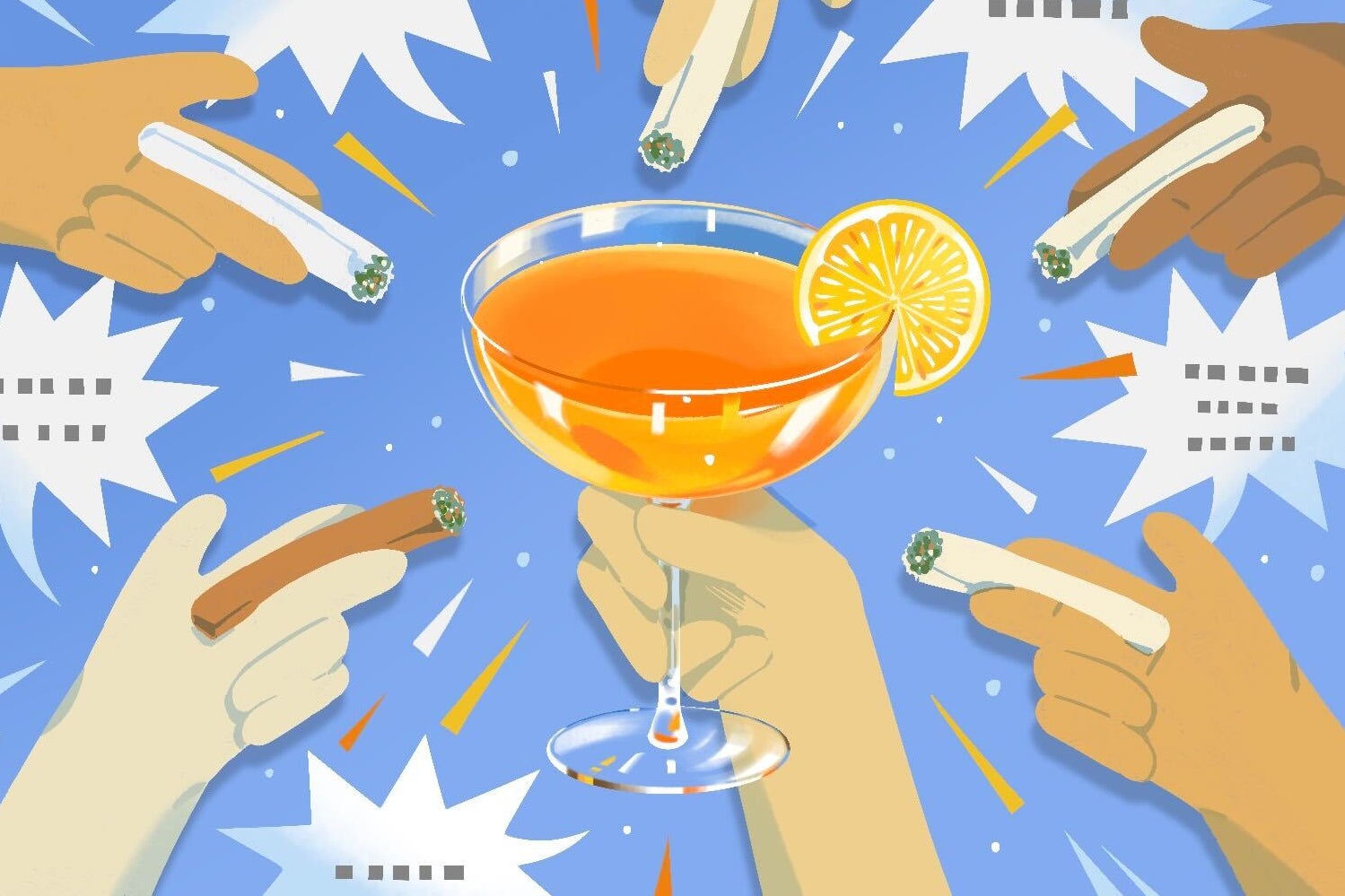
For most of them, though, this does not mean eschewing altered states entirely. Though they’d likely never use the phrase California sober with a straight face, every year I seem to gain another friend who has put down the bottle but picked up the vape or edible sachet with abandon. Studies are showing more people replacing alcohol with cannabis products. This coincides with cannabis becoming more readily available; more states are legalizing it, and it’s easier than ever to order edibles and cannabis beverages across state lines. This is fine! This is a morally neutral thing and is not a problem, unless you’re an alcohol industry lobbyist, in which case sorry, I guess. By all accounts, weed is winning. Which brings me to my complaint here: Please, weed enthusiasts, I need you to calm down—your substance of choice is not the perfect replacement for alcohol you think it is.
The first time I smoked weed, it didn’t work. And the boy whose apartment I had wound up in that night, after drinking a whole Mike’s Hard Lemonade at a party, delivered the refrain of 17-year-old boys with a weed connection to 17-year-old girls everywhere: “You’re just not doing it right.” Eventually it did work, which was worse, because something in my body chemistry clearly hates cannabis. For every time I felt a normal high, I seemed to have three experiences of extreme paranoia or becoming immediately catatonic after the smallest dose. I hated the way it made me feel, and by the time I was in my mid-20s, I finally admitted I’d never be the kind of person who could just casually hit a vape at a party. So I quit.
Almost immediately, I started to find myself in a recurring scene. I’d be offered some cannabis product and politely decline, saying I didn’t partake in order to avoid being asked again. And someone would insist, as if I were 17 again, that I was not doing it right. I needed to find the right strain! I would surely ditch my wine if only I understood the ins and outs of sativa and indica and CBD and THC! Some friends seemed genuinely confused that it was possible for anyone to not like weed’s high and gently suggested a change of environment, like if I did it in the right room with the right music playing, I’d finally see what I was missing. Once, a guy told me I must be too uptight, as if it were 1971.
I have for the most part stopped hanging out with people like this, and the stoners I do know are nice and normal. And also, this is—I’m so sorry—a real champagne problem. But I’m definitely not alone. “I had dear friends tell me that I wasn’t an addict, I couldn’t be addicted because weed isn’t addictive, constantly ask me when I would start smoking again, or laughed at me when I said I wanted to start attending Marijuana Anonymous,” one woman told writer Emma Specter about the response she got after she decided to quit weed. In some ways, weed does seem like the last drug it’s acceptable to push; if someone tries to get you to take a shot of tequila despite your repeated insistence that you don’t want to, they’re generally seen as an asshole, and I’m not sure anyone has ever responded to someone turning down cocaine by saying: “You just haven’t found the right batch!”
Some of these are garden-variety examples of people being annoying about their hobbies. But there is a new edge to these claims that wasn’t there when I was 17. Now it’s not just that I’m somehow too dumb to do it right, but that cannabis products would be good for me—an optimized high rather than mere drunkenness. Any demurring on my part is often met with a story of how weed has cured the user’s anxiety (with no “hangxiety” to worry about) or even made them more productive. They’re vaping to focus while reading and working out, or before a job interview to mellow out. It’s not just a drug, they insist; it’s a way to change your life for the better.
I understand why everyone is so single-minded about this. For generations, cannabis has been unfairly maligned, fueled by racist associations and resulting in racist policies that have led to countless life-altering arrests. It should have been decriminalized a long time ago, especially since alcohol came back from Prohibition just fine. But because alcohol has been so normalized, it’s never had to make an argument for itself, and thus it can get away with not having a moral value. Yes, there may be other pleasures in the notes of wine or a well-made cocktail, but at the end of the day (or at brunch, if you like), the point is intoxication.
The cannabis industry, in order to fight the negative associations most Americans picked up in DARE sessions at school (and in order to fuel growth), instead must insist on its product’s goodness. And while the active compounds in cannabis can genuinely help with things like pain management, sleep, and anxiety, the industry and its enthusiasts have gone a little overboard. It’s not hard to find cannabis products spoken of as an essential part of one’s daily wellness routine, or as if they have no effect at all. “It is cannabis themed, but it’s a wellness bar,” Matt Skinner, founder of High Rise Dry Bar, in South Carolina, told Eater of the establishment’s cannabis-derived drinks. Bon Appetit suggests taking cannabis powder at work to ease anxiety. Torch THC beverages advertises its products as “guilt free,” diet-culture phrasing that makes me want to shove 5,000 SnackWell’s Devil’s Food Cookie Cakes down the throat of whoever first thought of it.
We are living in the time of optimization, when vice must be cloaked in wellness in order to justify its consumption to both the world and oneself (or to obscure the fact that it is a vice at all). I would like to stop being sold on weed. But also, I resent the implication that one needs to be motivated toward an intoxicating substance by anything other than intoxication. When I have a cocktail, it is because I like the way it makes me feel (loose, warm, overly enthusiastic about how beautiful all my friends are), not how it makes me perform. That should be enough.
Ideally, the current cannabis PR push will result in its full legalization, and the normalization that comes with that will mean that fewer people will talk about it as if they’ve discovered ancient treasure. You won’t have to convince anyone they need to try it because it will be available for all to try. And then, finally, the hobbyists can take a deep breath and chill. Which, from my understanding, is supposed to be what happens when you smoke weed. But maybe they just haven’t found the right strain.