Sign up for the Slatest to get the most insightful analysis, criticism, and advice out there, delivered to your inbox daily.
I learned the phrase “go big or go home” at my first full-time job out of college, a media startup whose mission it was to supercharge content with proprietary algorithms for the masses. It was the earlier days of the internet, when digital-first companies were racing to figure out what worked and how they could scale content and capture search traffic. The approach—high-volume, quick turn-around, and low-cost—was designed to flood the internet with topical posts users were already searching for—think headlines like “how to lose belly fat,” and “how to get rid of fruit flies.” And, of course, bring in advertising revenue in turn. The experiment earned the company one of the first uses of the “content farm” label. It was eventually sold off and ceased operations, but it gave me, a first-generation kid who hadn’t completely absorbed cultural nuances, one of my earliest understandings of American excess.
Looking back, what started off as a tagline was really a preview of what was to come: a glimpse into a future of maximalism where food, clothing, politics, opinions, grief, children, and bodies were all fair game to be pushed to the edge. Fast fashion gave us 50 collections a year and we bought all of it. We cried on camera, turned our kids into blogs, and constructed entire editorial models, like xoJane, around mining private life for public consumption. Shows like My 600-lb. Life and Hoarders became the ultimate guilty viewing pleasure, and hustle culture at work dominated our lives, turning productivity into a personality trait. Our political systems shed their skin, sloughing off shame and truth in pursuit of attention.
Now, we’ve reached a tipping point. Mardi Gras is every day. We live inside a kind of permanent carnival, a pleasure island of our own making, where nothing quite ever ends and nothing is ever quite enough. Even the idea of a simpler life, spurred on by the tradwife movement, has become its own form of excess. It promises reserve, but it’s actually performance: a lot of labor, staging, and visibility optimized for views and clicks. Not a retreat from excess, but a rebranding of it.
And somewhere along the way, all of it made us tired and sick.
Psychologists call it information fatigue syndrome, data overload that disrupts sleep and degrades concentration. We are overspent, overstimulated, exhausted, and we know it. About half of Americans reduced their social media use in 2025, according to a recent American Psychiatric Association poll. Many are instituting no-buy months, logging off, and pulling back.
Restriction, it seems, has begun to look less like deprivation and more like relief.
Lent, the practice of abstaining and fasting in the run-up to Easter, is an old technology that can work for a modern era awash in excess. It offers the one thing we seem to not have enough of: a reason to stop. Lent gives us the architecture we need to remove ourselves from the churn; to reset, recover, and renew, to focus on something else that feeds us rather than our feeds. You do not have to be religious to recognize the wisdom in the system, and you do not have to integrate it into your life only in the weeks before the Christian celebration of the resurrection. Try it on anytime you need a break that actually heals.
Lent—the idea, the practice—works so well as an appropriate starting point to let us step back from maximalism, because food is an attainable vehicle through which restraint becomes something you can actually feel. The table is where philosophy takes tangible shape. And really, it’s less about food and more about appetite in a world where we’ve learned to be hungry for everything.
With grocery prices higher than pre-pandemic levels, staples like eggs, meat, and dairy have seen some of the sharpest increase in recent years, according to data from the Bureau of Labor Statistics. Even as food becomes expensive, the cultural pressure for abundance hasn’t eased. But Lent can offer us relief here, too. It doesn’t have to be a sacrifice. It can be an adaptation.
Having grown up in an Armenian Apostolic household, part of one of the oldest Christian traditions, of which there were once close to 200 fasting days observed, I am hardwired to think Lent is the antidote to overindulgence. It makes sense—this is a culture whose patron saint spent 13 years in a pit for refusing to renounce his faith—and turned Armenia into the first Christian nation in the world: a fun fact Armenians will remind you of at every opportunity they get. Endurance and restraint are not exactly foreign concepts.
For many Armenians, Lent is a strict regime, observed with no shortcuts, like fish on Fridays. Instead, it is 40 days of no meat or dairy, with key ingredients replaced by lentils, bulgur, beans, vegetables and for those adapting to the West, even peanut butter. There are fewer ingredients, clear rules, and predictability.
Though Lenten observance has been declining across Christian communities in recent decades, its logic has never been more necessary. Practices and guidelines like this can restore the balance in our lives, bring back yearning and mystery, and enable our minds to wander instead of being conditioned to the onslaught of algorithms.
What I remember most about observing Lent with my family is not the absence of food or hunger, but the creativity we incorporated into meals—some ancient and others improvised. It was not just a private practice in my household; it felt communal because groceries, delis, and bakeries—the cultural infrastructure I grew up with—catered to it too. Mushrooms were skewered instead of kebabs, water replaced milk in bread recipes, and tahini was added to match its former richness. It was an unwritten and understood agreement to scale back together.
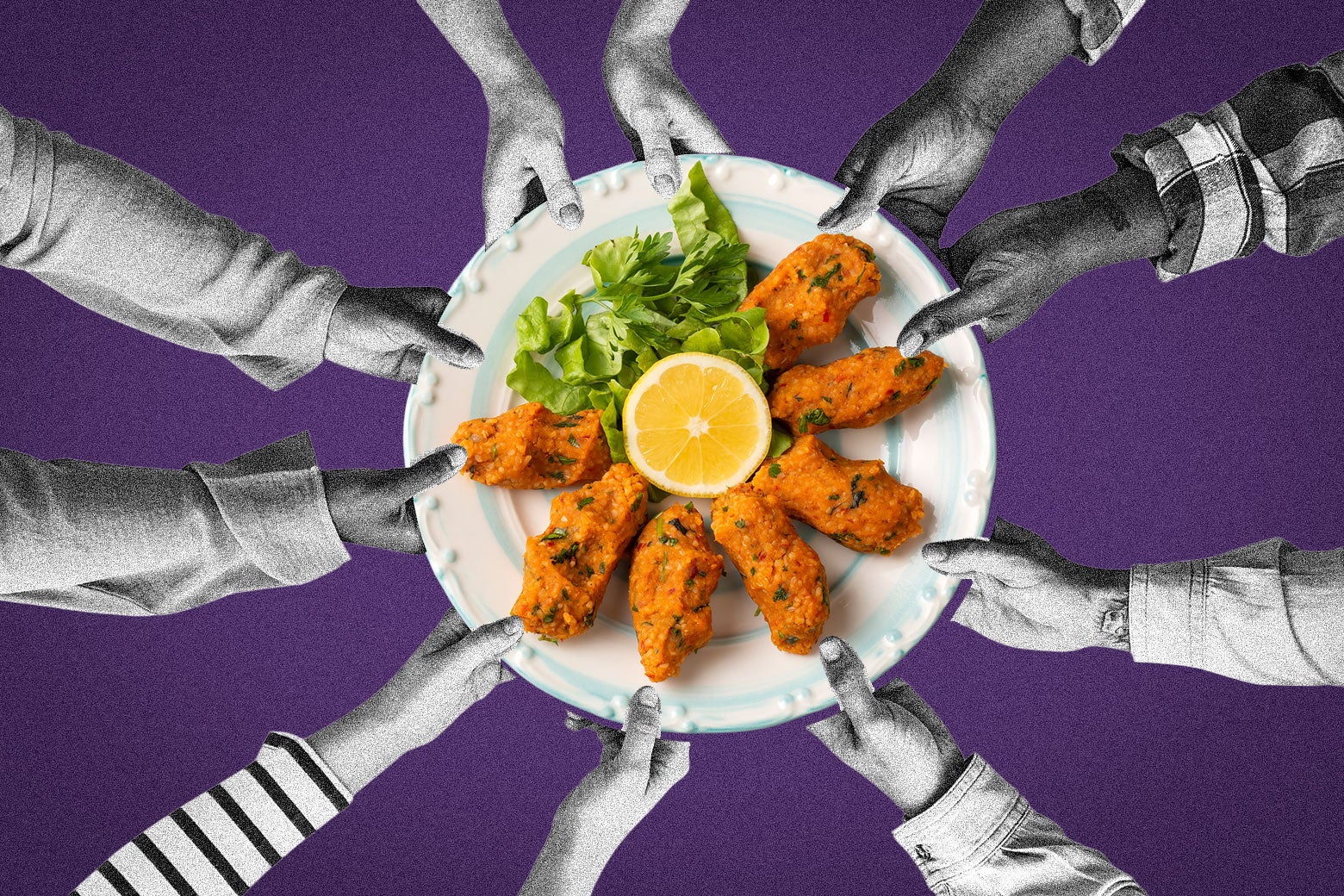
Lentil kufteh, or “vospov kufteh,” is one of those staple dishes: red lentils and fine bulgur are cooked down, kneaded together by hand with olive oil, onions, and spices until they become something cohesive. You shape it with your fingers, leaving impressions that are both functional and personal.
I remember the lentil mixture in my mother’s hands, spilling slightly out of corners of her palms as she shaped each piece. There were no special tools or complicated steps. Just repetition, touch, and time. The kufteh melted in your mouth, fragrant with spices but not overwhelming, very easy on the tongue. Served on a bed of lettuce, eating them never made me think something was missing.
It’s an incredibly simple meal that made me feel how little was needed to be satisfied, that what I thought was necessary, isn’t—that going big or going home doesn’t always work—and that just going home for a little while, to take a break, enjoy a dish and find relief in the absence of it all is enough.
Lentil Kufteh (Vospov Kufteh)
1 cup red lentils
3 cups water
1 cup fine bulgur (#1)
1/3 cup olive oil
3 medium onions, finely chopped
1 bunch parsley, finely chopped (leave some for garnish)
1–1½ teaspoons salt (to taste)
½ teaspoon cayenne pepper (adjust to taste)
1½ teaspoons paprika
1–2 tablespoons tomato paste
Juice of ½ lemon
In a saucepan, cook the lentils in water until soft and broken down, about 15–20 minutes. Stir in the bulgur, tomato paste, and spices, mixing well, then set aside to cool slightly.
In a skillet, sauté the onions in olive oil until golden and soft, then fold them into the lentil and bulgur mixture along with the parsley and lemon juice. Once cool enough to handle, knead the mixture by hand for a few minutes until smooth and fully combined.
To shape, take a small portion and press it into your palm, using your fingers to form an oval and leave slight impressions along the surface. Arrange on a plate lined with lettuce (or chopped salad) and sprinkle parsley and paprika on top. Serve at room temperature.